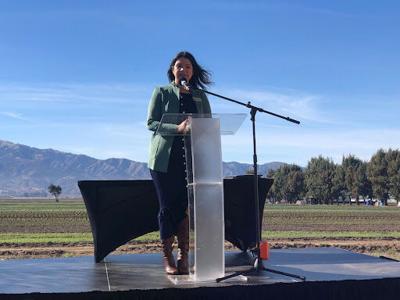

Tajha Chappellet-Lanier here, back at my desk after spending the morning enjoying the sun (and wind) in the Salinas Valley.
Today, on the occasion of World Soil Day, the nonprofit Agriculture and Land-Based Training Association (ALBA) celebrated 20 years and the release of a new impact assessment with a press conference/ceremonial ribbon cutting at the organization's farmland on Old Stage Road. ALBA has a simple but powerful mission—to turn limited-resource farmworkers (mostly immigrants) into farm business owners through training in organic farm management. After 20 years and 220 businesses launched/incubated, the nonprofit wanted to know: Is the mission working?
Today’s event began with remarks by Salinas Valley Chamber of Commerce President Karin Moss as well as comments from the staffers of a number of public officials, plus the presentation of various congressional resolutions and certificates of recognition. Then, Development Director Chris Brown (who wrote the report) shared a little of what was found.
In short, the impact assessment’s findings are promising. Over the past two years (with help from some UC Berkeley and UC Santa Cruz researchers, plus a team of Stanford students), ALBA surveyed 181 farmers who graduated from the organization’s year-long Programa Educativo para Pequeños Agricultores (PEPA) course, the first step in launching a farm business through ALBA.
Of the 181 respondents, 77 (43 percent) are currently operating a farm business—“which is a big relief to us, honestly,” Brown said. Around 90 percent of ALBA farms are wholly organic; 5 percent are partly organic. And 94 percent of the farmers surveyed say they plan to farm long-term. To ALBA all these numbers prove the value of the program—the training and resources they provide farmers with are, ultimately, translating into more small- and medium-scale organic farms, bucking the decades-long trend of consolidation into industrial-scale, conventional farming across the U.S.
Brown also highlighted the demographics that ALBA serves. Mexican immigrants and U.S.-born Latinos made up 74 percent of those surveyed, and accounted for a full 90 percent of the successfully operating farms. “These guys—and ladies—can really do the job,” he said. And doing the job as a farm owner rather than a farmworker means real economic opportunity for these farmers and their families, including higher incomes. The report argues that Latino farmers “are a vital asset in expanding the organic agriculture movement.”
Three ALBA-educated farmers also spoke about their experience—Rigoberto Bucio of Bucio Organic Farms, who took ALBA’s PEPA class in 2008, and Herlinda Huipe and Carmelo Rojas of Tierra HR Organic Farm, who began at ALBA in 2020, when classes were being held on Zoom due to pandemic restrictions. Executive Director Patricia Carrillo translated their stories and hopes for the future, including a tricky metaphor comparing ALBA (and the teamwork it takes to launch a new business) to a soccer team.
“All the opportunity that is here is incredible,” Carrillo said in her own remarks, mirroring those of the program participants. “You have the opportunity to come here with a dream, and you get where you want to go.”
There’s lots more interesting data—both quantitative and qualitative—in the impact assessment, which you can read for yourself here. And if ALBA’s mission sparks your interest, the nonprofit is currently fundraising through Monterey County Gives! Learn more, and donate, here.

(0) comments
Welcome to the discussion.
Log In
Keep it Clean. Please avoid obscene, vulgar, lewd, racist or sexually-oriented language.
PLEASE TURN OFF YOUR CAPS LOCK.
Don't Threaten. Threats of harming another person will not be tolerated.
Be Truthful. Don't knowingly lie about anyone or anything.
Be Nice. No racism, sexism or any sort of -ism that is degrading to another person.
Be Proactive. Use the 'Report' link on each comment to let us know of abusive posts.
Share with Us. We'd love to hear eyewitness accounts, the history behind an article.