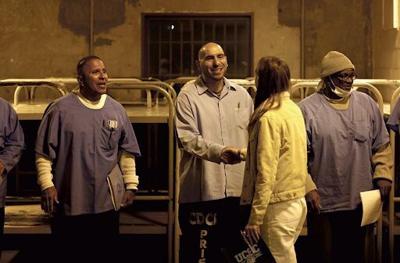

Agata Popęda here to share perhaps the most important story I’ve written for the Weekly so far. Over the last few months, I devoted my Thursday afternoons to weekly trips to the Correctional Training Facility, a state prison located 5 miles north of Soledad. This all-male prison holds 5,000 inmates, some sentenced for life.
I was invited by sociology professor Megan McDrew (Hartnell College and University of California, Santa Cruz) to take part in Exercises in Empathy: A Transformative Justice Initiative, a program she created with a grant from the California Department of Corrections and Rehabilitation. The program “runs through the model of inside-out educational exchanges, bridging the gap between campus-based students and the incarcerated,” as the official description states, but the invitation to participate is potentially open to any resident of Monterey County who is interested in transformative justice.
The story of how the program came to be, and the inmates and civilians who participate in it, is the subject of the cover story in this week’s print edition of the Weekly.
Two hours per week in a state prison is an eye-opening adventure. Like every direct experience, it involves your whole body in a fast-paced process of learning. In this case I found myself learning the obvious but rarely kept in mind: Incarcerated people are very much like everybody else, and—to an extent—it’s our luck in life that is keeping us, so far, on the other side of the bars.
Within the program, participants and inmates discuss issues like societal trauma, racism, domestic violence and drug abuse, often the things that were decisive to the fact of their incarceration. It’s mostly talking, listening and spending time together; I share many of the inmates' stories and reflections in the article. I also introduce McDrew and her two program assistants, one of them Carlos Aceves, a former CTF inmate who now flies in every week from San Diego to meet with his former fellow-inmates.
While I didn’t have much space to talk about Aceves’ experiences in depth, I would like to also invite you to listen to an interview he did for a podcast titled The Prison Post. In 1993, at the age of 19, Aceves was arrested and sentenced to 29 years to life for murder. He served 21 years of that sentence, almost half of it in Soledad, and was one of the 2 percent of incarcerated people found suitable for parole at initial hearing at the Board of Prison Hearings. He was released in 2014 at the age of 40.
The EinE project is funded by a California Reentry and Enrichment (CARE) Grant that provides $5 million in grants per year for three terms ($15 million total) to non-profit organizations to fund transformative programs in California prisons. EinE is one of about 30 grant recipients. The grant started on July 1, 2022 and will end on June 30, 2025.
And after you read the story, I’m curious: what do you, the readers of the Weekly, think about transformative justice programs and the future of American prisons?

(0) comments
Welcome to the discussion.
Log In
Keep it Clean. Please avoid obscene, vulgar, lewd, racist or sexually-oriented language.
PLEASE TURN OFF YOUR CAPS LOCK.
Don't Threaten. Threats of harming another person will not be tolerated.
Be Truthful. Don't knowingly lie about anyone or anything.
Be Nice. No racism, sexism or any sort of -ism that is degrading to another person.
Be Proactive. Use the 'Report' link on each comment to let us know of abusive posts.
Share with Us. We'd love to hear eyewitness accounts, the history behind an article.