
Rey Mashayekhi here, once again thinking about government—and how it’s able (or not) to meet the needs of its people at difficult times.
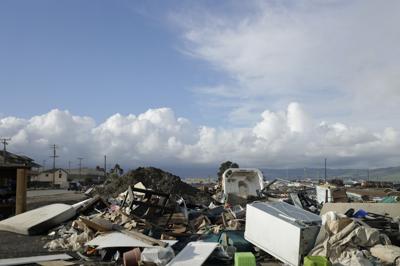
After January’s devastating series of atmospheric rivers, I wrote about how local, state and federal government bodies stepped up to meet those needs at a consolidated resource hub in Spreckels. Yet after March’s flooding of Pajaro and surrounding areas in the Pajaro Valley, a federal disaster declaration enabling the Federal Emergency Management Agency and other federal resources to enter the fray was painfully slow to arrive—placing much of the humanitarian burden on local nonprofits and community organizations.
FEMA and the Small Business Administration are now finally on the ground in the area. But as I examined in this week’s issue of the Weekly, their arrival has hardly gone off without a hitch—and in fact prompted a musical chairs-esque game around where to set up their disaster recovery centers in a manner that would provide as many resources as possible, as conveniently as possible.
After initially setting up at Monterey County’s existing local assistance center at the Watsonville Veterans Memorial Hall—where dozens of state, county and nonprofit agencies had operated—the federal agencies determined that the facility was not up to their standards due to a lack of Americans with Disabilities Act compliance as well as inadequate parking, multiple sources told me. Instead, FEMA and SBA moved into Watsonville’s old city hall on Main Street—a significantly smaller space that does not have room to also accommodate local and nonprofit actors.
The Veterans Hall assistance center closed April 7, leaving county and nonprofit entities without a base from which to operate. That drew the ire of Monterey County officials like Supervisor Luis Alejo, who blamed Watsonville officials including City Manager Rene Mendez for failing to provide a larger “one-stop” facility that could house all government agencies and community organizations—including state and nonprofit bodies that could provide assistance to undocumented residents—under one roof.
Alejo tells me that he had lobbied Mendez to make available Watsonville’s Ramsey Park Family Center, which had previously served as a resource center after the January storms. But according to Alejo, Mendez and Watsonville’s city government told officials at FEMA, as well as both Monterey and Santa Cruz counties, that Ramsey Park wasn’t available. “I still haven’t heard a good excuse from the city manager about why they haven’t offered Ramsey Park” or another larger facility, Alejo says. “This makes the [Watsonville] city administration look inconsiderate by not making access to needed resources as easy as possible for our Pajaro residents.” (The Watsonville city manager’s office did not return a request for comment.)
The situation appears to have come to some kind of resolution with this week’s announcement of a new disaster recovery center in Pajaro Park, where officials have set up a tent large enough to house a multitude of federal, state and county agencies in one location. Officials are also working to establish Pajaro Middle School as a “CBO hub” where community-based organizations and nonprofits can deliver aid to local residents.
But the whole affair raises questions about government’s ability to swiftly and efficiently step in at times of crisis, particularly when it comes to communities like Pajaro that are already underserved and often overlooked. Community Bridges CEO Raymon Cancino—whose nonprofit has been among the most active around Pajaro since the flood—notes to me the irony of how long it took the federal government to enter the fray when, simultaneously to the disaster on the ground, D.C. lawmakers had scrambled to bail out Silicon Valley Bank, located just an hour up the road. “[Silicon Valley Bank] get rewarded with a $30 billion bailout…and then we have an impoverished community next to a levee with failed infrastructure that was neglected for so many years, and there’s nothing going on to get those [federal] resources available [to them],” Cancino observes.
Among the federal lawmakers angling hardest for a SVB rescue was Rep. Zoe Lofgren, who has deep, longstanding ties with Silicon Valley’s tech and venture capital community. Lofgren also now represents Pajaro, which was tucked in on the periphery of her district after 2021’s congressional redistricting process. While Lofgren was among those calling for a federal disaster declaration in the wake of the storms, she was notably absent from a tour of Pajaro and the surrounding area on Wednesday, when she was scheduled to visit alongside Sen. Alex Padilla and Rep. Jimmy Panetta.
A spokesperson for Lofgren says she was unable to make the tour due to traffic on Highway 17. “She was on her way down and had to turn around because she wasn’t going to make it on time,” the spokesperson says, and adds that Lofgren has “toured the damaged sites two other times since the breach” and was joining Padilla and Panetta in “pushing to accelerate the federally authorized [Pajaro River] levee upgrade project.”
(0) comments
Welcome to the discussion.
Log In
Keep it Clean. Please avoid obscene, vulgar, lewd, racist or sexually-oriented language.
PLEASE TURN OFF YOUR CAPS LOCK.
Don't Threaten. Threats of harming another person will not be tolerated.
Be Truthful. Don't knowingly lie about anyone or anything.
Be Nice. No racism, sexism or any sort of -ism that is degrading to another person.
Be Proactive. Use the 'Report' link on each comment to let us know of abusive posts.
Share with Us. We'd love to hear eyewitness accounts, the history behind an article.