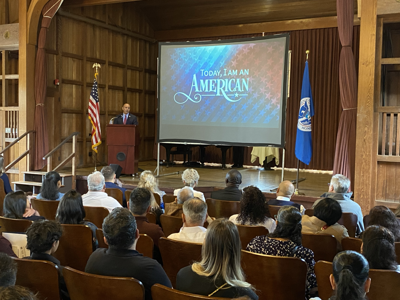

Sara Rubin here, thinking about the question “where are you from?” It’s one of those phrases that can be weaponized and used to make people feel like they don’t belong—like they are a visitor, even in their own homeland. (You can read more about this painful dynamic, and changing rhetoric around it, in a guest column in the Forum section of today’s issue of the Weekly.)
But the undercurrent of hostility and suspicion goes well beyond microaggressions. “There is this buzz all over the U.S. that immigrants are poisoning the blood of America. It’s just outrageous,” says Celia Barberena, who grew up in Granada, Nicaragua. She dreamed as a child of becoming a businesswoman like her grandmother, who supported a big family by selling dry goods like coffee, rice and beans from a counter in her living room.
Instead, thanks to a scholarship, Barberena attended college in Ohio. At the time, she could never have envisioned working for a college, much less becoming a college president. But she pursued a career in community college administration with roles at Sacramento City College, Hartnell College and Modesto Junior College. She eventually became the first woman president of Chabot College in Hayward in 2008, then retired in 2012 to Pacific Grove.
She’s also taught along the way, and she will return to the classroom next week, starting on Thursday, Sept. 5, for a three-session class called “Immigrants: Our Life Stories” through the Osher Lifelong Learning Institute at CSU Monterey Bay. (It’s $30 to enroll.)
The class format is simple. Six people with different stories to tell, including Barberena, will get up in front of the class and share their lived experience. Presenters hail from Syria, Vietnam, Hungary and Mexico. Barbarena’s co-instructor, Chris Hasegawa, is a retired educator and third-generation Japanese-American; he speaks about his family’s story.
This is a way of teaching students about the immigrant experience not through generalizations, but through the specifics of real people who are now members of the Monterey County community.
Barberena’s hope is that it can serve as an antidote to the idea that immigrants are “poison,” just by helping people see things differently—from the perspectives of immigrants themselves, which she thinks might be the missing piece in helping people change their perspective. “If I see people picking crops, I think: ‘This really moves the economy here, these people are doing work that is needed,’” she says—not people who are “stealing” someone else’s jobs.
I asked Barberena if she expects her class to feel like preaching to the choir—won’t the students be people who are open to hearing these stories, and maybe predisposed to agree with her premise? Her answer is yes, probably, but she needs to start somewhere: “You can’t just let the mean-spirited people speak without doing your little part to contribute to the other side.”
Her hope is to someday expand the concept into a podcast, featuring immigrant stories, each unique, but that collectively paint a picture of American lives. “This is a country of immigrants,” Barberena says. “I don’t care if you came with the Mayflower, or [just recently], but we are contributors to the development of this country.”
(0) comments
Welcome to the discussion.
Log In
Keep it Clean. Please avoid obscene, vulgar, lewd, racist or sexually-oriented language.
PLEASE TURN OFF YOUR CAPS LOCK.
Don't Threaten. Threats of harming another person will not be tolerated.
Be Truthful. Don't knowingly lie about anyone or anything.
Be Nice. No racism, sexism or any sort of -ism that is degrading to another person.
Be Proactive. Use the 'Report' link on each comment to let us know of abusive posts.
Share with Us. We'd love to hear eyewitness accounts, the history behind an article.