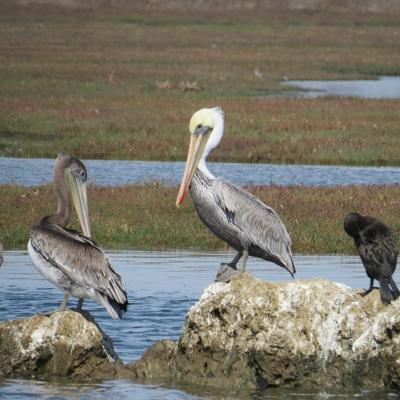

David Schmalz here, thinking about a place I love dearly, but don’t visit often enough—Elkhorn Slough. Established as a national estuarine research reserve in 1980—it’s one of 22 nationwide—it’s California’s second-largest estuary, and a place of extraordinary biodiversity that is rich in both marine and bird life.
It’s on my mind because of a story I wrote for this week’s issue about potential chemical contamination to the slough due to floodwaters reaching it after the March 11 breach of the Pajaro River levee—some of that water flowed south, into the slough, just as it did when the levee breached in 1995. At that time, the waters carried sediment laden with DDT, a pesticide finally banned in 1972 due to its toxicity. As DDT moved through the food chain, birds who ate fish, small animals or carrion were deeply impacted and it caused their shells to thin to the point where they weren’t viable—and bird populations started to plummet. (Shout out to Rachel Carson, whose seminal book Silent Spring, published in 1962, highlighted the crisis.)
But there was much detail from the 1995 floods that I couldn’t fit in my story this week, specifically how it decimated a growing colony of Caspian terns on a small island in the Elkhorn Slough.
At the time of the 1995 flood, Jen Parkin, then a grad student at Moss Landing Marine Labs, was years into a study of this growing colony, which she says “was doing really well.” It’s a long time ago, but Parkin—now a biologist for California Central Coast Black Oystercatcher Project—estimates that in 1994, there were over 200 breeding pairs, and about 150 fledglings. The focus of her study was on the reproductive and feeding habits of the terns, but after DDT—which persists for decades in the soil—poured into the slough following the 1995 floods, she says, “it became a toxicology study on top of that.”
That flood also happened in March, which is particularly bad timing for the nesting season of Caspian terns—they winter in Mexico, then arrive in their northern home in March, feeding for two months before they lay eggs. DDT can partially pass through an animal, she says, but not an egg, and those eggs were forming just as the terns, which eat fish, were ingesting the DDT.
To see it unfold, she says, was heartbreaking. She’d see a chick hatch, “and then a couple days later I’d be marking them dead. It’s really hard to watch that happening.”
Parkin adds that the pesticides can also cause wasting syndrome in chicks, so that they don’t gain weight, and their parents keep feeding them out of instinct. “They recognize that something's not right,” she says, “and what they don’t realize is the food is what’s making it worse.”
Caspian terns, which breed on the ground, eventually left the slough after the colony got poisoned in 1995. They have since established a presence at the Salinas and Pajaro river mouths, which given all the flooding this year, Parkin says, “could be a problem.” Scientists will be closely monitoring whether or not this current flooding into the slough is carrying DDT-laden sediment, and I, for one, pray that it is not.
Birds are beautiful, and critical to ecosystems that are often more fragile than many may think. They remain one of the most accessible windows into the wild—they are among us, everywhere, and I root for them, always.
(0) comments
Welcome to the discussion.
Log In
Keep it Clean. Please avoid obscene, vulgar, lewd, racist or sexually-oriented language.
PLEASE TURN OFF YOUR CAPS LOCK.
Don't Threaten. Threats of harming another person will not be tolerated.
Be Truthful. Don't knowingly lie about anyone or anything.
Be Nice. No racism, sexism or any sort of -ism that is degrading to another person.
Be Proactive. Use the 'Report' link on each comment to let us know of abusive posts.
Share with Us. We'd love to hear eyewitness accounts, the history behind an article.