
Pam Marino here. In a world where current events can sometimes evoke a feeling of hopelessness, I have a local story to share that sparks real hope. On Wednesday, Nov. 29, Montage Health celebrated the grand opening of Ohana, a treatment center for children and youth experiencing mental health challenges. Montage’s president and CEO, Dr. Steven Packer, referred to it as a crisis, with at least 1 in 4 families impacted in the United States.
That the Ohana campus is opening is cause for hope in and of itself. For the first time the region will have a comprehensive center for outpatient and inpatient treatment—Packer called it the most unique, privately funded facility for youth in the U.S.
For years, teens needing inpatient mental health care have had to go out of the county. And with not enough treatment beds in the state, the waits for admission were often perilously long. When the residential wing of Ohana opens in the spring, there will be room for up to 16 teens. Thousands of children and teens will come through the outpatient program annually.
The campus itself—made possible by a $105.8 million gift by Roberta “Bertie” Bialik Elliott in 2018 that included creating a comprehensive treatment program that’s been growing over the last few years—is an achievement, purposely designed as a tool for promoting healing and hope. This week’s edition of the Weekly features a photo spread by staff photographer Daniel Dreifuss showing the evolution of Ohana’s construction, accompanied by my story with some background about the campus and program.
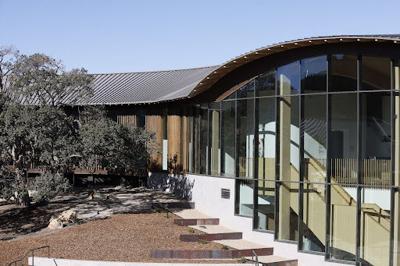
The architecture is stunningly beautiful, as beautiful as the natural environment it resides in, on a ridge in Ryan Ranch above Highway 68 in Monterey, across the valley from oak-studded hills. The parallel of beauty was no accident—it was the landscape that inspired architects and designers from Seattle-based NBBJ Architects to create the campus. Specifically, a large oak tree on the property served as special inspiration.
“What we saw was this tree, this beautiful oak tree just begging for people to come gather around it, to be part of the healing process,” said Jonathan Ward, NBBJ design partner, during the grand opening ceremony. The team sat under the tree for a couple of days at the start of their design journey—steering clear of the poison oak—noting the colors of the trees, grasses and blue sky above.
They also took inspiration from the architecture of sister-facility Community Hospital of the Monterey Peninsula, which was designed by famed architect Edward Durrel Stone, and took into consideration Ohana’s vision to support families and help children grow into healthy and resilient adults.
“There’s something powerful here and we all want to be involved in this,” Ward remembers the team thinking. They realized, “we’re not building a building, that’s not what’s happening. We’re creating a healing place.”
They turned to science to guide them as they designed the structures, with a mind toward utilizing nature to boost executive function and healing—not just for the youth, but for the staff as well. With floor-to-ceiling windows, they “used nature as paintings,” Ward said. (The natural “paintings” are joined by an impressive array of artwork throughout the campus.)
“Ohana tells us it can’t be a box,” Ward said. It had to symbolically embrace both patient and caregiver, and it had to create a visual community where people on one side of the complex could look out and see others across the way in a long hallway that faces the main courtyard.
The result of their efforts are timber-construction buildings that gently curve around the landscape to create a sense of calm and hope, as well as a sense of community. That inspirational oak tree sits perfectly surrounded by the arc of a building.
There’s so much more to share about Ohana—the art and music therapy rooms, the terraced healing garden that will soon be filled with vegetables and flowers, to mention a few—and we plan on writing more about it as Ohana continues to grow.
Since Elliott’s gift five years ago the outpatient program has been growing under the direction of Dr. Susan Swick, using other Montage facilities ahead of Ohana’s completion. In 2023 alone the program saw 2,500 unique patients and facilitated 23,000 individual visits. I was encouraged to hear that they’ve shaved the time that families wait for treatment from months to two to four weeks. That alone is reason for hope.
Another reason to feel hopeful: A key component of Ohana is prevention, which means its programs are not limited to patients and their families. Swick told the audience that she expects Ohana will become a resource to every family in the community. When I interviewed her for the story, she told me she foresees opportunities for families, educators and others to come for educational events.
Swick shared that while youth mental illness is common and often curable with treatment, the reality is that only 1 in 5 children get to see a mental health professional. With Ohana now firmly planted in Monterey County, I’m hopeful that ratio will shrink locally thanks to a combination of prevention and increased access to care.

(0) comments
Welcome to the discussion.
Log In
Keep it Clean. Please avoid obscene, vulgar, lewd, racist or sexually-oriented language.
PLEASE TURN OFF YOUR CAPS LOCK.
Don't Threaten. Threats of harming another person will not be tolerated.
Be Truthful. Don't knowingly lie about anyone or anything.
Be Nice. No racism, sexism or any sort of -ism that is degrading to another person.
Be Proactive. Use the 'Report' link on each comment to let us know of abusive posts.
Share with Us. We'd love to hear eyewitness accounts, the history behind an article.