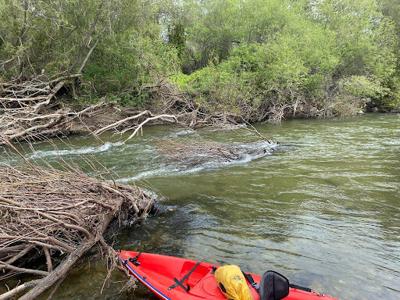

David Schmalz here, still alive after kayaking down the last five-or-so miles of the Carmel River on Saturday with two friends, one of whom had to bail early on after her inflatable kayak was punctured. That happened right by a tee box (the 12th hole, she thinks) of the Quail Lodge & Golf Club course, so after her kayak got rescued from the thicket and was deemed not to be river-worthy (I had a patch kit, but was an impossibly far distance downriver), she scrambled through poison oak in her wetsuit, holding her drybag, and walked onto the golf course and made her way to Valley Greens Drive to a place where a friend then picked her up.
This occurred just after we shot a rapid with about a 3-foot drop, and none of us had any idea what awaited below the horizon of whitewater as we approached—the river was moving swiftly, and my two friends and I didn’t use our paddles to propel ourselves, but to try to steer away from the willow branches at seemingly every turn. My friend whose kayak got punctured was trying to get ashore so we could regroup, but the branches along the bank did her kayak in.
A different thicket of branches, in the middle of the river, put me into the drink shortly before that incident. As I tipped—though my kayak didn’t, not all the way—I nearly lost my paddle, but I got it back into my kayak in a mad scramble as I tried to climb back in. The kayak then got hung up in another thicket and I couldn’t hold on: The current, in that narrow channel, had power, and it was a struggle to quickly get ashore so I didn’t stray too far.
Thankfully, over the latter half of the trip, there were fewer obstacles as the channel seemed to widen a bit and we had gotten more adept at avoiding the thickets.
All along the route I saw the impacts of this winter’s storms—downed willow trees, tattered sandbag casings and homes that may have flooded or, at the very least, were under evacuation orders. And with the wet years often becoming wetter as climate change alters the atmosphere’s physics, it was hard not to wonder how those homes will survive the coming century, where 100-year floods may become 25-year floods.
The good news for those who live in the Carmel River floodplain is that Big Sur Land Trust’s Carmel River FREE (Floodplain Restoration and Environmental Enhancement) project, which will use a former artichoke field east of Highway 1 as an overflow when waters get too high, plans to help protect the lower Carmel Valley from flooding.
Another initiative in this vein, which was approved by the Monterey Peninsula Regional Park District’s board on April 5, is the Rancho Cañada Floodplain Restoration project that will widen the river channel as it passes through Palo Corona Regional Park, and restore 40 acres of riparian habitat along a mile-long corridor.
These are the types of projects we should be pursuing to protect against the inevitable floods in our future—what is called “green” infrastructure, as it’s far cheaper and better for nature to let rivers, where possible, flow into their natural floodplains, as opposed to constraining them.
Designs for MPRPD’s project are expected to be completed this fall, and Rafael Payan, the district’s general manager, says work could start as early as next July, pending grants. I am certainly rooting for both projects to get started, and completed, as soon as possible. That said, I don’t know if the park district’s project will survive the next big flood—I can’t imagine saplings surviving when giant, mature trees are falling everywhere on the banks—but I hope for the best. Maybe the small survive.
On the survival note, I should add: You shouldn’t do what I just did without the proper equipment (lifejackets are a must), friends, and some solid river experience. I had all of the above and it was still spicy. It was, however, the best adventure I’ve had in quite some time.
(0) comments
Welcome to the discussion.
Log In
Keep it Clean. Please avoid obscene, vulgar, lewd, racist or sexually-oriented language.
PLEASE TURN OFF YOUR CAPS LOCK.
Don't Threaten. Threats of harming another person will not be tolerated.
Be Truthful. Don't knowingly lie about anyone or anything.
Be Nice. No racism, sexism or any sort of -ism that is degrading to another person.
Be Proactive. Use the 'Report' link on each comment to let us know of abusive posts.
Share with Us. We'd love to hear eyewitness accounts, the history behind an article.