
It’s no secret that agriculture is the dominant industry in Monterey County and the wider Central Coast region. Rey Mashayekhi here, noting that the history of agriculture is also the history of technological advancement—something that continues to this day, as an ever-widening cadre of startups and investors are pitching farmers and growers on advanced machinery and software designed to reduce labor costs, increase productivity and make their lives easier.
No matter how much automation they promise, that kind of “ag tech,” as it’s known, requires skilled, educated labor to operate: engineers and computer scientists not only capable of making such systems work, but who also ideally have an agricultural background that equips them to tackle ag-specific problems. (Last month’s FIRA USA ag tech conference in Salinas spotlighted such technology—from autonomous tractors to AI-powered cultivators, as well as the software that makes them all go.)
That is the workforce of tomorrow that local colleges and universities are now seeking to train—and pouring significant resources into doing so. On Monday, Oct. 2, I made it out to CSU Monterey Bay’s campus for the university’s annual “Greater Vision” forum. The theme this year was “Ag Jobs: Bringing A Greater Vision,” and the event featured panel discussions with ag tech executives as well as a keynote speech by Karen Ross, secretary of the California Department of Food and Agriculture.
Hundreds of students packed into the Otter Student Union to hear the program, lured not only by the lunch buffet (I’m not too old to remember the appeal of free food to college students) but also a genuine interest in the opportunities that ag tech may present in their future career paths—something evident by those students’ engagement in the discussions and the thoughtful questions they asked.
CSUMB Provost Andrew Lawson noted that the university was among several in the region, including Hartnell College, to recently receive grants from the U.S. Department of Agriculture’s NextGen program, designed to bolster a forward-thinking agricultural curriculum at those schools. CSUMB directly received a $5 million grant, which will help it launch a new mechatronics engineering program in fall 2024 and an ag business supply chain management degree in fall 2025. “The future holds tremendous opportunities for students and for the region,” Lawson said. “We’re constantly looking at ways that we can provide an innovative education.”
The event’s panels also provided fascinating insight into what the future of ag tech will look like. Not surprisingly, artificial intelligence and machine learning dominated much of the discussion. Lee Vetsch, an analyst at ag-focused investment firm Ospraie Ag Science, noted AI’s potential to automate fieldwork like harvesting and weeding—in the process “solving a big pain point for the farmer or whoever the customer might be,” specifically on labor costs and availability.
As far as how CSUMB students should view AI through the lens of their own career prospects, Claire Delaunay, COO of Watsonville-based ag robotics startup Farm-ng, noted that there are myriad possibilities beyond simply being a tech whiz capable of creating the next transformative piece of machinery. “If I look at this room, I’m pretty sure not everybody should be an AI expert, but everyone should work together to advance this pipeline,” Delaunay said. “All of the parts are really critical—from the person in the field operating the devices, to the person who will build the latest state-of-the-art algorithm. Each of you individually can see where this is going and choose where you fit the best depending on your talent, skills, who you want to become and where you want to work.”
In her keynote, Ross touched on data and technology’s potential to help better address everything from crop diseases to climate change impacts. “We’re seeing longer pest seasons, more cycles of pests, the loss of chill hours so there’s more year-round eradication work going on,” she noted. “We have to prepare for drought and floods simultaneously and think about our systems of how we capture water…These are the types of challenges that the workforce of the future is going to be engaged in.”
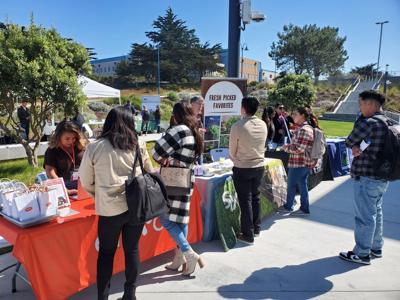
CSUMB’s expanding curriculum, coupled with similar ag tech education initiatives at Hartnell and other schools, is part of heightened efforts to train and provide that workforce—not only giving their young students a path to skilled, well-paying jobs, but also ensuring the progress of the region’s agriculture sector. After the event, the courtyard in front of the student union building hosted an ag job fair, where students perused booths set up by local ag employers like Driscoll’s and Church Brothers Farms.
For those young minds eager to set themselves up for a bright future, both the forum and the job fair surely gave them ample food for thought. They also spoke to how the region’s agriculture industry and educational institutions, coupled with government support, are coalescing to provide them with opportunities—and to ensure that the Salinas Valley and wider Central Coast remains an agricultural powerhouse in the 21st century.
(0) comments
Welcome to the discussion.
Log In
Keep it Clean. Please avoid obscene, vulgar, lewd, racist or sexually-oriented language.
PLEASE TURN OFF YOUR CAPS LOCK.
Don't Threaten. Threats of harming another person will not be tolerated.
Be Truthful. Don't knowingly lie about anyone or anything.
Be Nice. No racism, sexism or any sort of -ism that is degrading to another person.
Be Proactive. Use the 'Report' link on each comment to let us know of abusive posts.
Share with Us. We'd love to hear eyewitness accounts, the history behind an article.