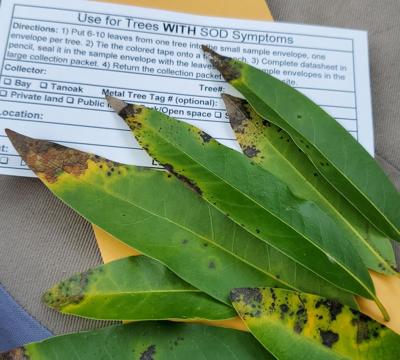

Pam Marino here, with an idea of how to make an important difference this weekend at the same time you get to enjoy the outdoors. With not a lot of time and effort, you can become a citizen scientist and assist researchers in tracking a terrible disease that’s killed tens of millions of California’s beloved oak trees and caused an estimated $30 billion in losses.
We’re talking about Sudden Oak Death, or Phytopthora ramorum (pronounced Fy-toff-thor-uh ra-mor-um). Phytopthora in Latin translates to “plant destroyer,” an apt name. It also goes by the acronym SOD.
SOD is a microscopic water mold that was first detected in Northern California trees in the mid-1990s. It began spreading up to Oregon, but soon was down the coast, exploding into an epidemic in the early 2000s. Big Sur and Carmel Valley have been some of the worst-hit areas of the state.
With millions of acres of trees to monitor, it’s too big a task for scientists alone, which is why in 2008, UC Berkeley, in partnership with other universities, organized what are called SOD blitzes, one weekend every year where thousands of volunteers spread out to collect samples that scientists then analyze and catalog so they can track the disease.
Kerri Frangioso, a staff research associate for UC Davis and Cal Poly, has been leading the SOD blitz in Carmel Valley since the very first one in 2008. She’ll be back in the valley starting tomorrow, April 26 at noon at her sampling station, at the Discovery Center inside Palo Corona Regional Park. She’s expecting around 20 volunteers over the weekend, but she needs more.
“It’s limitless,” she says of how many volunteers the event could use. “The more people the better because that’s more you can sample.”
All it takes to volunteer is to register online and watch a 15-minute training video that shows you how to recognize the disease and collect leaf samples. You pick up a collection packet from Frangioso, then return it to her by noon Tuesday, April 30.
I mistakenly thought that volunteers collect samples from oak trees, but Frangioso says the samples are taken from an entirely different tree. “Bay laurels are the main driver of the disease,” she says. The laurels don’t die from it, but it easily spreads from laurels to oaks.
It’s not an automatic death sentence for all oaks. Some treatments have been developed over the years. “For high-value trees, it’s worth trying,” says Frangioso.
If you have oaks in your yard, she says it’s best to keep bay laurels away from them, if possible. Small bay laurels should be removed to prevent the spread of the disease. “In the absence of bays it's highly unlikely oak trees will become infected,” she says.
Homeowners with bay laurels on their property get the benefit of free testing, which can cost a couple of hundred dollars per test. Other volunteers can go wherever they want.
I asked Frangioso if volunteers can go back to trees that have already been sampled. Some of the best information for scientists has come from resampling, she says. It allows researchers to track the disease on specific trees from year to year.
Previously sampled trees can be found using the free SODMAP Mobile app, available to download from app stores. It’s also helpful to anyone who wants to see if their oaks are at risk and need protection.
Overall, the blitzes have helped scientists track if SOD has expanded into new areas, how it varies from drought years to wet years (it can contract when conditions are dry and spread when wet). “It has taught us a lot about the pathogen,” says Frangioso.
If you’re interested, go to SODblitz.org for information on signing up and a link to the training. For questions, you can email Frangioso at kfrangioso@ucdavis.edu.
More information about SOD is available on the UC Berkeley Forest Pathology and Mycology Lab website.

(0) comments
Welcome to the discussion.
Log In
Keep it Clean. Please avoid obscene, vulgar, lewd, racist or sexually-oriented language.
PLEASE TURN OFF YOUR CAPS LOCK.
Don't Threaten. Threats of harming another person will not be tolerated.
Be Truthful. Don't knowingly lie about anyone or anything.
Be Nice. No racism, sexism or any sort of -ism that is degrading to another person.
Be Proactive. Use the 'Report' link on each comment to let us know of abusive posts.
Share with Us. We'd love to hear eyewitness accounts, the history behind an article.