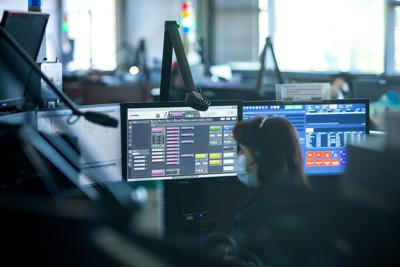

Erik Chalhoub here. It’s no exaggeration to say the role of the emergency dispatcher can mean the difference between life and death. When every second counts, they calmly and skillfully learn about whatever emergency a distraught caller is facing, and use that information to direct the proper response.
Studies of dispatchers say the call takers must convey a calm attitude, but in doing so, suppress feelings of fear, anger and sadness, which can lead to various physical and mental ailments.
I feel that agencies should pursue anything that helps ease the stress of this vital job, which is why I welcomed the recent news from the County of Monterey that it implemented artificial intelligence to aid dispatchers on non-emergency calls.
Now, when someone dials the non-emergency number from jurisdictions across Monterey County (with the exception of Carmel, which has its own dispatch center, and the Presidio of Monterey), they’ll be greeted by an AI voice, which asks the callers questions to learn about their situation. It will then either provide information to the caller or transfer them to the appropriate department.
County Director of Emergency Communications Lee Ann Magoski gave some examples—if a caller is reporting an injured seal, the AI will transfer them to the Marine Mammal Center. If they want to make an online police report, the bot will send a text with a link to where they can lodge one.
The AI is still learning, Magoski says, and it will transfer callers to a human dispatcher if it can’t understand a request. Still, the bot has shown to alleviate the volume of calls dispatchers receive—the Emergency Communications Department has seen a 30-percent average monthly decline in non-emergency calls, according to the department. (In 2023, it received 431,557 non-emergency calls for the entire year.)
“In terms of how it works, the AI is driven with machine learning,” Magoski says. “If there are conversations that it does not understand it will route the call to a dispatcher. The bot will log all conversation flows; both successful and unsuccessful. We can then review the input that callers said to help build more intuitive pathways so that in the future, when that same request comes in, the bot understands how to handle that particular call.
“The system will continue to learn to better assist our callers.”
The department also recently launched Spark, an online tool that allows the public to report a non-emergency using any internet-enabled device.
But remember—always call or text 911 if you are in an emergency situation.

(0) comments
Welcome to the discussion.
Log In
Keep it Clean. Please avoid obscene, vulgar, lewd, racist or sexually-oriented language.
PLEASE TURN OFF YOUR CAPS LOCK.
Don't Threaten. Threats of harming another person will not be tolerated.
Be Truthful. Don't knowingly lie about anyone or anything.
Be Nice. No racism, sexism or any sort of -ism that is degrading to another person.
Be Proactive. Use the 'Report' link on each comment to let us know of abusive posts.
Share with Us. We'd love to hear eyewitness accounts, the history behind an article.