
Pam Marino here, thinking about how we’ve all needed someone to help guide us at some point in life. Sometimes it’s a person who can help us see a new career path, or another way to relate to a loved one. In dire situations, the guidance can mean the difference between life and death.
In this week’s paper, I reported a story about how an old drug called buprenorphine is being used by paramedics on ambulances in Monterey, Santa Cruz and Sen Benito counties for the first time to help relieve the pain experienced by people suffering from opioid withdrawal.
Buprenorphine, or “bupe,” as it’s been nicknamed, is an opioid itself—but one with amazing properties, as I was told by the co-founders of Prescribe Safe, Dr. Reb Close and Dr. Casey Grover, emergency physicians at Community Hospital of the Monterey Peninsula. The drug binds with receptors in the brain and blocks other opioids from gaining access. Buprenorphine is being used to effectively treat people with opioid use disorder, and will actually prevent people from overdosing should they decide to use another opioid, including fentanyl.
My story shares how Close, through Prescribe Safe, led the charge to get paramedics trained so they would be allowed to use buprenorphine, as well as get all seven hospitals in the three counties on board. (Paramedics must communicate with doctors at the hospitals before administering the drug.)
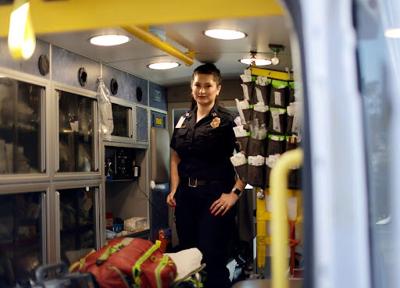
There’s more to the story I didn’t have space to share in print. Close, Grover and paramedic Rachel Kneeland told me that another reason they are excited is that once a withdrawal patient is brought to the emergency room they will be paired with a substance abuse navigator, someone who is trained—and may even have lived experience—to guide people toward recovery, if the patient is willing.
Kneeland tells me this hits close to home for her. “I have loved ones who are in recovery. I’m excited to make people feel better, so they don’t feel so awful,” she says of using buprenorphine. She’s also happy that her patients will be connected to navigators. “They've had a hard time getting help. Knowing that someone will follow up is really exciting to me.”
In addition to buprenorphine being made available, a small, pocket-sized tri-fold pamphlet was developed in English and Spanish with the phone numbers of navigators at each hospital, plus numbers for general help. The pamphlets will be on ambulances, in law enforcement vehicles and in emergency rooms so that first responders can pass along the information to patients or people they meet in the field.
If you or someone you know in Monterey County needs help in overcoming substance abuse, call the Substance Abuse Resource Team at 831-837-7251, or the Behavioral Health Crisis Line at 831-258-6029. You can also find information at the Central Coast Overdose Prevention website here.
(0) comments
Welcome to the discussion.
Log In
Keep it Clean. Please avoid obscene, vulgar, lewd, racist or sexually-oriented language.
PLEASE TURN OFF YOUR CAPS LOCK.
Don't Threaten. Threats of harming another person will not be tolerated.
Be Truthful. Don't knowingly lie about anyone or anything.
Be Nice. No racism, sexism or any sort of -ism that is degrading to another person.
Be Proactive. Use the 'Report' link on each comment to let us know of abusive posts.
Share with Us. We'd love to hear eyewitness accounts, the history behind an article.