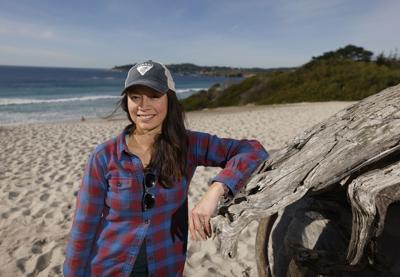

Sara Rubin here, thinking about how some challenges are almost too big to perceive. Something like trying to identify all life in the ocean? It’s such a wildly ambitious goal that when Kakani Katija told me she aspires toward that, I assumed she was referring to a legacy-type dream—something that might happen generations later.
But she’s talking about here and now. I interviewed Katija, principal engineer of the Bioinspiration Lab at the Monterey Bay Aquarium Research Institute, for a feature story in this week’s print edition of the Monterey County Weekly. (Just pause for a moment to appreciate that name—Bioinspiration Lab—a reference to a big part of what animates her work, a goal of finding information in undersea life that might be useful to humans. In one case, observing the swimming patterns of Tomopteris worms presents an inspiration—bioinspiration, that is—for possibly making more effective robotics that can move more gracefully underwater as they continue to search for new species. It’s all very meta, using bio-inspired design from one newly observed animal to improve the technology in our search for more.)
Katija’s goal is grand, but it’s not impossible. What makes it possible is bringing the public into the effort as citizen scientists. Katija thinks about how NASA has effectively utilized citizen science both in discoveries, and sharing the extraordinary wonder of what to look for in space. Although space is even further away than the ocean, Katija thinks for a lot of people, it feels closer. “People know more about space exploration than ocean exploration,” she says. “You can walk out your door and look at the sky and see stars. How do you create a connection with the ocean if you live inland?”
Her idea for creating that connection is to utilize gaming. She’s working with a group called Internet of Elephants, based in Kenya, and says Beyond Blue, a diving/oceans video game, has expressed interest in hosting modules. To make it all happen requires funding, which Katija is seeking, but given that an estimated 1.5 billion people in the world play video games, she thinks there’s a big opportunity.
“Watching people wander around our neighborhood playing Pokemon Go, I sat back and thought about it: There are people, myself included, wandering the streets looking for animals that don’t even exist. Can we harness that excitement? Can I leverage some of that energy and put it towards exploration and discovery?”
That vision, of a game-ified version of undersea discovery, is still in the making. But thanks to exploration, done increasingly by robots instead of human-occupied submersibles, anyone with a connection anywhere in the world can see what’s happening on a screen. And that principle is already at play with FathomNet, an open-source database of underwater images. Human eyes can do only so much looking and identifying when it comes to the entire ocean, but artificial intelligence can do a lot of the heavy lifting. The goal is to get AI to recognize species when panning through images of water upon water upon water.
FathomNet has an upcoming two-day training from March 31-April 1 that’s open to any enthusiast anywhere who’s interested in engaging with ocean science. (You can sign up here.)
It’s going to take a lot of us—humans and robots alike—to truly make sense of all the undiscovered life in our oceans. “There’s such a focus on what’s happening on the bottom of the ocean,” Katija says. “Because we are terrestrial animals, we always have a reference frame. But the midwaters represent 97 percent volume of livable space on this planet.
“The ocean is massive, and we’ve maybe explored 20 percent of the ocean—that’s the number NOAA floats, but I think it’s much less than that.”
The invitation is to join in this massive ocean exploration mission, regardless of whether you live near the ocean. Collectively, we might make a dent in that 80-plus percent of undiscovered ocean.
Read the full newsletter here.

(0) comments
Welcome to the discussion.
Log In
Keep it Clean. Please avoid obscene, vulgar, lewd, racist or sexually-oriented language.
PLEASE TURN OFF YOUR CAPS LOCK.
Don't Threaten. Threats of harming another person will not be tolerated.
Be Truthful. Don't knowingly lie about anyone or anything.
Be Nice. No racism, sexism or any sort of -ism that is degrading to another person.
Be Proactive. Use the 'Report' link on each comment to let us know of abusive posts.
Share with Us. We'd love to hear eyewitness accounts, the history behind an article.