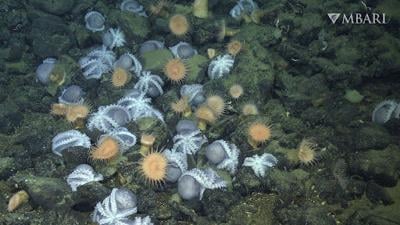


Sara Rubin here, thinking about the extraordinary wonders of nature. Specifically, I am thinking about the octopus garden—OK, technically an octopus nursery, but lyrical permission granted—that local marine scientists discovered in 2018 off the coast of Big Sur, near the base of Davidson Seamount.
This is not a place I’ve seen myself, and never will. But a research paper published on Aug. 23—and a story by staff writer David Schmalz that appears in this week’s edition of the Weekly about this discovery—help take us to the deep, rocky setting where likely more than 20,000 Muusoctopus robustus, aka pearl octopus, are incubating their eggs. (Researchers from the Monterey Bay Aquarium Research Institute, or MBARI, counted 6,000.) It is the largest known group of octopus in the world.
Female pearl octopus brood over their eggs until they hatch, and after that, the adult octopus dies, if she hasn’t already. In water at these depths (10,500 feet deep), it’s chilly, about 35 degrees Fahrenheit. The brooding process normally takes five to eight years. Scientists learned that the reason octopus are aggregating in this particular area is because of thermal vents that warm the water temperature to about 51 degrees, reducing the brooding time to 1.8 years.
Still, as Schmalz notes, that is a shockingly long time to spend doing any sustained activity. “The most extraordinary thing is that even though the thermal vents greatly decreased the time it takes for the incubation period, they nonetheless average 1.8 years—that, to me, was crazy,” Schmalz says.
For an octopus, it’s just part of life—and death.
At the end of the process, the female octopus will die. After that, snails, shrimps and anemones will eat their bodies—part of the biological diversity of this incredible location.
That’s all part of what makes this story so beautiful. Local scientists uncovering the wonders of our world that exist out of sight, using advanced technology to make it available to us, and helping us understand just why it’s so important that we protect places like the Davidson Seamount (it’s part of the Monterey Bay National Marine Sanctuary). As Schmalz tells me, there are other places out there that are not protected, and deep sea mining is among the threats to pockets of biodiversity like this one.
You can read more in the story in this week’s paper or online, where you can also view a stunning video produced by MBARI showing views of this extraordinary place. There are a lot of magnificent octopus images to be seen. However smart they are or aren’t, they are beautiful and amazing, and I’m so grateful to be able to see them through MBARI’s lens.
(0) comments
Welcome to the discussion.
Log In
Keep it Clean. Please avoid obscene, vulgar, lewd, racist or sexually-oriented language.
PLEASE TURN OFF YOUR CAPS LOCK.
Don't Threaten. Threats of harming another person will not be tolerated.
Be Truthful. Don't knowingly lie about anyone or anything.
Be Nice. No racism, sexism or any sort of -ism that is degrading to another person.
Be Proactive. Use the 'Report' link on each comment to let us know of abusive posts.
Share with Us. We'd love to hear eyewitness accounts, the history behind an article.