
Just yesterday, Weekly Editor Sara Rubin wrote in this newsletter about the incredible 10-year journey of Matika Wilbur, an Indigenous woman from the Swinomish and Tulalip tribes of coastal Washington who set out across America to document the stories of Indigenous people across the country. That journey culminated in a book, Project 562, that was released last week and has already landed on the New York Times bestseller list.
David Schmalz here, calling attention to a different story about Indigenous Americans, or rather, countless untold stories.
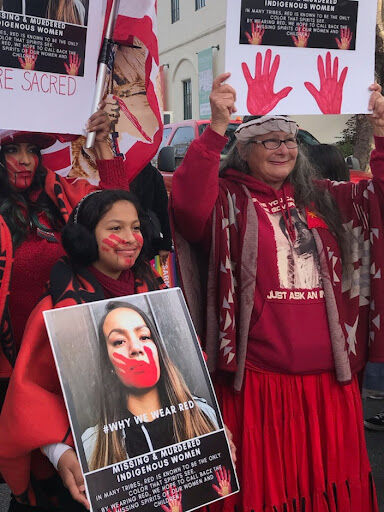
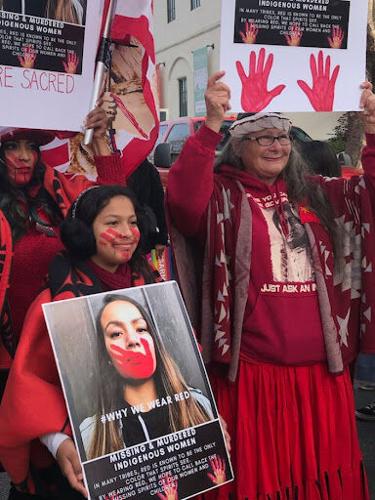
Tomorrow, at Seaside’s Oldemeyer Center (968 Hilby Ave.), an event for “Red Dress Day” will seek to raise awareness of the mostly hidden crisis of missing Indigenous women, girls and “two-spirit” people. (Red Dress Day, as recognized in various jurisdictions in Canada and the U.S., is May 5.)
The event has been spearheaded by Sand City Mayor Mary Ann Carbone, who has Chumash heritage. It’s an issue she’s long been fighting to raise awareness about: In December 2019, she was even able to bring it to the attention of the White House when she was invited to a women’s mayor conference. At one point in the conference, she wore a red dress in the White House to further highlight the issue—to make a “statement,” Carbone says. (The “red dress” concept to highlight the crisis was created by Canadian artist Jaime Black, who has Indigenous heritage; she chose red because it’s a color that draws attention.)
Among those Carbone says she broke through to at the event was then-Acting Deputy Secretary of the Interior Katharine MacGregor. Carbone recalls her saying that the Department of Justice didn’t have good data on missing Indigenous women and human trafficking.
And therein lies the issue: cases of missing Indigenous women are believed to be massively underreported, and crimes against them largely unprosecuted.
It is for this reason that organizations like Sovereign Bodies Institute have been formed—to better document cases of missing Indigenous women, in the absence of more complete federal databases. But the federal government is trying: In April 2021, Interior Secretary Deb Haaland, the first Indigenous cabinet secretary in U.S. history, announced the creation of a unit, housed within the Bureau of Indian Affairs, to investigate missing and murdered Indigenous Americans.
About a year later, President Biden signed a law that, per a May 5, 2022 White House proclamation, “expands special criminal jurisdiction of Tribal courts to cover non-Native perpetrators of sexual assault, child abuse, stalking, sex trafficking, and assaults.”
Carbone says she’s been drawn to this issue because, “I feel that being mayor, I am able to have a voice where others don’t, that’s why I try to speak out for victims. I feel it’s my duty to be a voice for those who can’t talk. I don’t know what makes me do it—maybe it's my ancestors standing behind me pushing me to do this.”
Tomorrow’s event, which runs from 11am to 6pm and is free, will start off with an acknowledgment of the land and a memorial ceremony with singing, and continue with panel discussions with various native participants and stories. The day will close with more singing, some remarks and ultimately, a prayer.
(0) comments
Welcome to the discussion.
Log In
Keep it Clean. Please avoid obscene, vulgar, lewd, racist or sexually-oriented language.
PLEASE TURN OFF YOUR CAPS LOCK.
Don't Threaten. Threats of harming another person will not be tolerated.
Be Truthful. Don't knowingly lie about anyone or anything.
Be Nice. No racism, sexism or any sort of -ism that is degrading to another person.
Be Proactive. Use the 'Report' link on each comment to let us know of abusive posts.
Share with Us. We'd love to hear eyewitness accounts, the history behind an article.