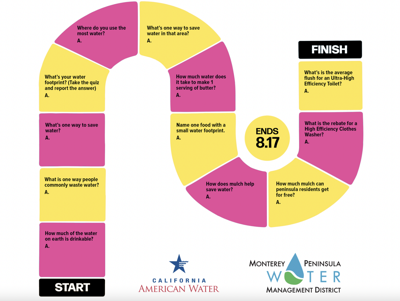

Sara Rubin here, crossing my fingers that this could be my year to win a high-efficiency dishwasher. I love any chance to enter a sweepstakes, which was my real motivation to start playing “Summer Splash,” a water conservation game produced by the Monterey Peninsula Water Management District with California American Water as a cosponsor, starting in 2020.
These agencies can often be seen tabling at community events, eager to share tips (and gear, like hose nozzles with shutoff valves) for conservation. But the pandemic forced them to get creative. MPWMD’s conservation analyst, Stephanie Kister, created a quiz game to inform people about water conservation. Answer questions to play, learning along the way. (The information is suitable to all ages, although the sweepstakes portion is only open to those ages 18 and up, sorry kids.)
Answering the questions requires a little learning along the way, through a combination of online videos and other materials. “We are always looking for resources to make people aware of the limited resources on Earth and using them sustainably,” Kister says.
This year, those resources include an interactive quiz on your personal water footprint, the feature I found the most informative—and surprising. The game directs players to a water footprint calculator. It begins with predictable stuff: how long your average shower lasts, whether you have low-flow faucets, if yours is a “if it’s yellow, let it mellow” household.
These things are “direct water use,” and I learned I use 139 gallons/day. (I promise it would be better if I won that high-efficiency dishwasher!)
What’s more interesting is “virtual water use,” addressing things that at first glance might seem unrelated to water conservation. This covers how often you drive and how much meat is included in your diet. All of a sudden, my water footprint soared to 1,229 gallons/day. (That’s still better than the U.S. average of 2,459 gallons, but still: whoa.)
It’s a reminder that decisions we make are all tied up in the intricate web of resource consumption. To me, the obvious thing I can change is eating less meat and less processed food—a personalized bar graph at the end shows that my diet is by far the biggest offender in my water footprint. There’s also an opportunity for improvement in my shopping habits, with the reminder that everything we consume, from food to clothing to smartphones, requires water to produce.
Anyone can play (until Aug. 17) online at montereywaterinfo.org/waterchallenge—good luck. If you decide to make a lifestyle change to reduce your water footprint, I’d love to hear about it.

(0) comments
Welcome to the discussion.
Log In
Keep it Clean. Please avoid obscene, vulgar, lewd, racist or sexually-oriented language.
PLEASE TURN OFF YOUR CAPS LOCK.
Don't Threaten. Threats of harming another person will not be tolerated.
Be Truthful. Don't knowingly lie about anyone or anything.
Be Nice. No racism, sexism or any sort of -ism that is degrading to another person.
Be Proactive. Use the 'Report' link on each comment to let us know of abusive posts.
Share with Us. We'd love to hear eyewitness accounts, the history behind an article.