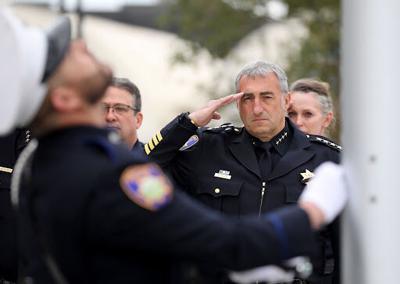

Sara Rubin here, after spending part of today in Monterey County Superior Court where Gustavo Morales is on trial for the murder of Jorge David “JD” Alvarado, a Salinas police officer who was shot and killed in the line of duty on Feb. 25, 2022.
Some of the facts of the case have long been publicly known; many remain unknown to the public and only emerge in court. (The prosecution and defense in this case agreed to file their trial briefs under seal, meaning only court officials, not members of the public and press, can view them, in order to help protect the integrity of the jury pool—the idea is to try the case in the courtroom, not the press.)
Some of the facts that have long been known: Officer Alvarado was on patrol when he initiated a traffic stop just a half-mile up the road from the Salinas Police headquarters, at the corner of Griffin and East Market streets. Alvarado was shot multiple times and he died at the scene. He was 30 years old.
The emotional outpouring in the days and weeks afterward was profound, with thousands gathering for a memorial service for the well-liked young man. Legal proceedings are different—the case against Morales takes place not in the language of emotion, but the language of legalese. There are no flowers nor personal tributes; instead there are facts and recollections and motions and objections.
Deputy District Attorney Christopher Puck called his first four witnesses to the stand on Monday morning, Oct. 9, to begin his effort to persuade the jury, beyond a reasonable doubt, that Morales fatally shot Alvarado then fled the scene. Many of Puck’s questions had to do with inherently unemotional facts—distances, speeds, time stamps on body camera footage, the activation technology for body cameras.
But plenty of emotion did come through. Alvarado’s colleague, Officer Steven Villaneda, broke down on the stand and a bailiff brought him tissues. Villaneda responded to the report of shots fired, where he found his friend, Alvarado, lying next to his patrol car, feet still inside the footwell of the vehicle and a pool of blood near his head. Body camera footage captured Villaneda yelling his colleague’s nickname: “Alvy! Alvy! Alvy!” Before beginning CPR, Villaneda performed a sternum rub—a hard fist on Alvarado’s chest, designed to create pain and elicit a response from someone in critical condition.
In court, Villaneda described “a look,” the thing that made him so concerned. Puck asked him to elaborate: “What ‘look’ did you see?”
“A look of death,” Villaneda answered. “It’s an empty stare. You just know there’s nothing behind the eyes.” He choked back tears.
Villaneda was the first police officer on the scene, and others arrived shortly after. They rendered aid until paramedics arrived and took over on CPR, but it was too late. Officers turned their attention to securing the crime scene and looking for evidence.
But there were other people on the scene before any officers arrived. Two of those people spoke in court today, giving eyewitness testimony of the shooting.
They are just regular people who were working when a gun battle erupted before their eyes. They did not know Alvarado and their testimony was less personal and less emotional. But they both gave accounts of running to the scene, rather than cowering to hide, sharing what I found to be remarkable accounts of heroism.
A 33-year-old delivery driver said he was in his van driving down Griffin Street when he saw police lights. Then he said he saw the man who’d been pulled over shoot at the officer—he saw the flashes from the gun and heard the shots.
He could have fled, or hidden, or simply stayed still. But instead he attempted to use his big van to block the shooter from getting away, pulling in front of his vehicle. The shooter drove around him, maybe over the sidewalk, and hit the gas. So the delivery driver followed him, turning left on Alisal Street—right in front of the police station—then going about a half-mile to Hebbron Street before losing the driver, who ran the red light. He called 911 while chasing the vehicle. (He spoke to the court through a Spanish interpreter.)
One woman, a manager/assistant at El Pollo Loco, the fast food restaurant right on the corner, described closing up the store at 10:35pm when she saw the traffic stop occurring. She watched as a man in a gray sweatshirt fired at the police officer, and she saw the officer drop to the ground. She said she then saw the attacker return to his vehicle and drive away, “very quickly.” (She spoke to the court through a Spanish interpreter.)
She watched and heard the gun battle, then ran outside where she found Alvarado lying on the ground, clutching at his chest—he was still alive.
“I don’t understand English, but I think he was telling me to leave,” she said.
Even in his final moments, it seems that Alvarado was trying to protect a witness, urging her away from the scene. She called 911 after she found him there, clearly injured although she could not see his injuries.
(0) comments
Welcome to the discussion.
Log In
Keep it Clean. Please avoid obscene, vulgar, lewd, racist or sexually-oriented language.
PLEASE TURN OFF YOUR CAPS LOCK.
Don't Threaten. Threats of harming another person will not be tolerated.
Be Truthful. Don't knowingly lie about anyone or anything.
Be Nice. No racism, sexism or any sort of -ism that is degrading to another person.
Be Proactive. Use the 'Report' link on each comment to let us know of abusive posts.
Share with Us. We'd love to hear eyewitness accounts, the history behind an article.