

In Monterey County last year, Immigration and Customs Enforcement officials arrested 29 suspected undocumented immigrants, 28 from Mexico and one from El Salvador, out and about in the community, at their homes or on the street. Over the same time period, they made 391 arrests at the Monterey County Jail. That’s according to data obtained by the Weekly via a U.S. Freedom of Information Act request to ICE.
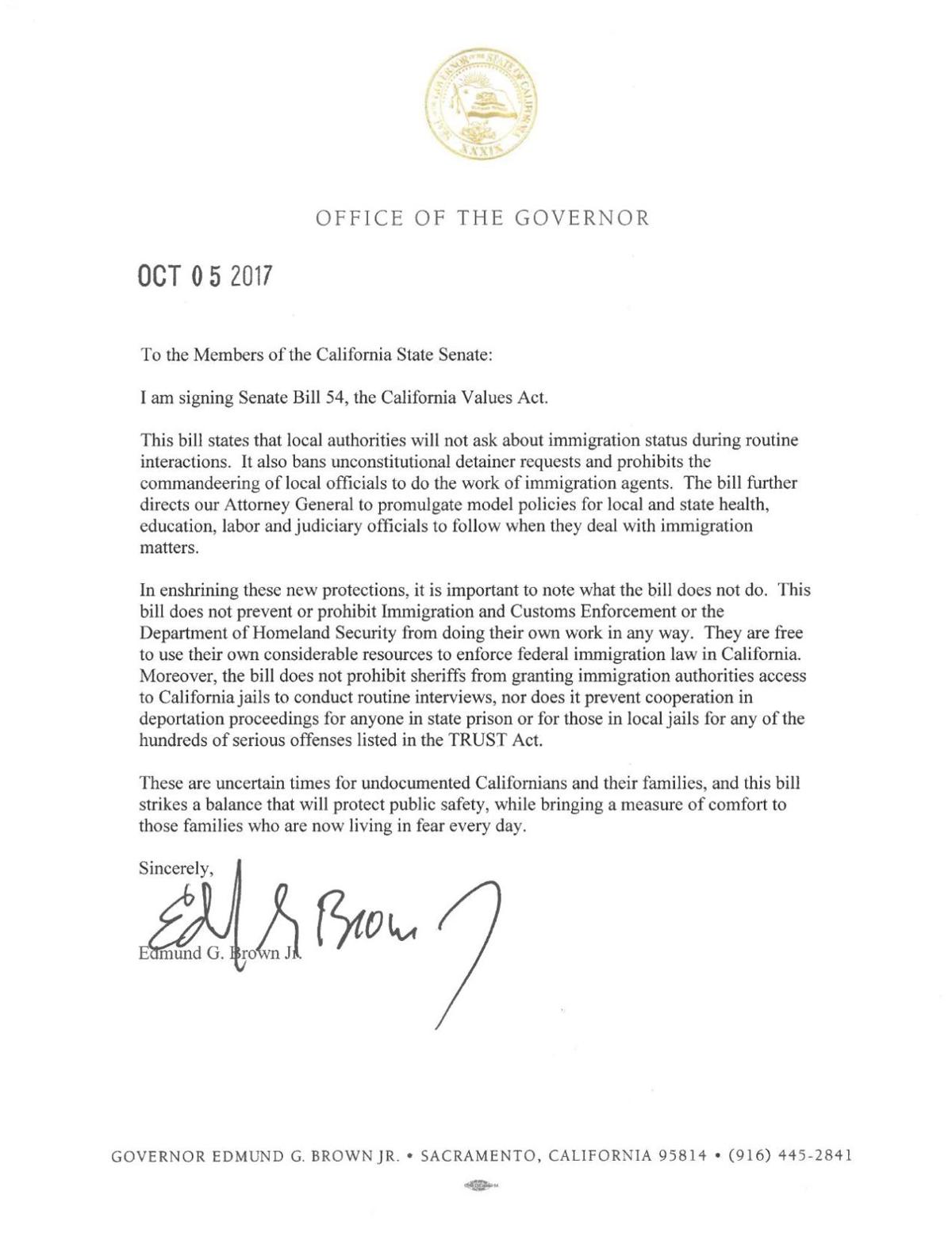
Those numbers are likely to change when California’s sanctuary state law, SB 54, takes effect on Jan. 1. A reasonable person would expect the total number to decline, but ICE Acting Director Tom Homan issued a statement to say that instead of hanging around jails, ICE agents will instead go everywhere else: “ICE will have no choice but to conduct at-large arrests in local neighborhoods and at worksites, which will inevitably result in additional collateral arrests, instead of focusing on arrests at jails and prisons where transfers are safer for ICE officers and the community,” Homan said.
It could undermine the very purpose of SB 54, which is meant to make California communities safer, to bring immigrants into the fold, to empower them to report crimes and not hide from law enforcement.
While Homan issues his bullying remarks from Washington, Monterey County officials are in a somewhat defensive position as they try to figure out what SB 54 means. Under Sheriff Steve Bernal’s administration, an ICE officer has kept a desk in the county jail for the purpose of reviewing records, enabling those 391 arrests (and in the first five months of 2017, another 115 arrests, per the FOIA response).
SB 54 prohibits local and state law enforcement officials from providing information about a detainee’s release date to federal immigration authorities, and from “provid[ing] office space exclusively dedicated for immigration authorities for use within a city or county law enforcement facility.”
That sounds pretty clearly to me like no desk at the jail. That’s also what it sounds like to State Sen. Bill Monning, D-Carmel, who co-authored SB 54. “I would interpret that to mean you cannot provide office space,” he says.
County Counsel Charles McKee reads it and sees something more ambiguous. “That’s tricky language to figure out exactly where the limitation is,” McKee says. “‘Here, you can have this desk, or that desk over there. Does that mean space exclusively dedicated? Where’s the line?”
To interpret the line, Sheriff’s Cmdr. John Thornburg says Bernal has invited representatives of the ACLU and a coalition of immigrant advocates to participate in mapping out an implementation plan for SB 54. The fact that they’re already quibbling over how to define “office space” does not bode well.
I asked Monning if, under the new law, ICE agents could still do almost exactly what they do now. Instead of setting up shop in the jail, they could set up shop in a library or cafe, and drive over to the jail daily. While SB 54 prohibits county jail officials from volunteering records, an ICE agent could still request the daily booking log, which is publicly available. “If that became a broad practice, an end run, that would violate – if not the letter – the spirit of SB 54,” he says.
Some law enforcement officials support both the letter and the spirit. The California Police Chiefs Association originally opposed the bill, then shifted to a neutral position.
Bernal is a member of the California State Sheriffs’ Association, and he tweeted out the group’s statement in response to the bill. “We are disappointed that the Legislature chose political symbolism over public safety,” it reads. Santa Cruz County Sheriff Jim Hart broke ranks with the association and wrote a letter supporting the bill, back in May: “We must strengthen trust with all of the communities we are sworn to serve,” he wrote.
Homan’s statement undercuts that trust. County officials’ tepid reception of the law weakens that trust. At least three county supervisors (Simon Salinas, Jane Parker and Luis Alejo) came out in support of SB 54 on Oct. 9, speaking at a press conference alongside other elected officials about why they think sanctuary state status will make Monterey County a more peaceful place. Assemblymember Anna Caballero, D-Salinas, puts it simply: “What we can expect is that people will feel safer.”
(1) comment
This law will have negative effects.
Welcome to the discussion.
Log In
Keep it Clean. Please avoid obscene, vulgar, lewd, racist or sexually-oriented language.
PLEASE TURN OFF YOUR CAPS LOCK.
Don't Threaten. Threats of harming another person will not be tolerated.
Be Truthful. Don't knowingly lie about anyone or anything.
Be Nice. No racism, sexism or any sort of -ism that is degrading to another person.
Be Proactive. Use the 'Report' link on each comment to let us know of abusive posts.
Share with Us. We'd love to hear eyewitness accounts, the history behind an article.