




Brittney Akerson turned to poetry to help deal with the impacts of COVID on her family.
When Jamie Wagner discusses the enormous effect that the coronavirus has had on women in the workforce, she knows what she’s talking about.
Not just from the economic standpoint — she’s an assistant professor of economics and the director of the Center for Economic Education at the University of Nebraska at Omaha — but because she’s a mother of two.
“It’s really tough. I feel it very much, too. My kids are in day care right now, but for a long time they were not,’’ she said. “I was predominantly taking care of them because I have the more flexible job.’’

Jamie Wagner, with children Brook and Vella. Like many moms, she had to care for her children while working from home.
Wagner is one of the lucky ones. Many more women did not have that flexibility and have had to make the hard choice to leave their jobs to care for and educate their children at home, cut back on hours or find other options.
Millions of other women in hard-hit industries like food service, housekeeping, child care and hospitality were laid off.
The recession of 2007-2009 was sometimes called the “man-cession” because men were the most predominantly affected, Wagner said. The 2020 economic situation has been much worse for women.
“It’s been really scary,’’ Wagner said. “A lot of it is not by choice. That’s really hard.’’
According to the Bureau of Labor Statistics, 2.2 million women left the labor force between February and September. In September alone, 865,000 women left compared with 215,000 men.
Many women returning to the labor force are being brought back on a part-time basis, which isn’t reflected in those job numbers. That severely hurts household incomes and masks the devastation of the economic picture for women.
Those numbers likely will create long-term repercussions, Wagner said. Among them:
» Leaving the workforce stalls progress toward pay equality. According to research, people who enter the workforce during a recession often start at a lower pay scale and their income rarely catches up for the length of their career.
“Women graduating right now will be at a big disadvantage,’’ Wagner said. “Women who step out and go back in are going to be hurt” in terms of job and pay prospects. “This is really setting women back a long way as far as workplace equity.’’ Regaining their pre-pandemic foothold will be difficult.
» It’s harder for women of color already facing pay gaps. They have to make decisions knowing that they and the men in their lives face a higher mortality rate if they contract the virus.
Women make up just over half of the workforce (55.9% in October), and their departures are hurting the companies they work for, too. It’s in the best interest of a business to help them stay because a diverse workforce has nothing but positive benefits, Wagner said. Research shows that companies with a diverse workforce have better balance sheets and outpace competitors.
To keep women on the payroll, companies need to be flexible, Wagner said. Instead, according to a McKinsey and Co. report, the opposite often happens.
“They are not actively changing policies to help women,’’ Wagner said. “Women are taking on a lot of child care and are still expected to perform at work in the same capacity. It’s not appropriate or realistic.’’
That causes women to quit. Businesses would do well to actively seek out and help their employees figure out solutions to day care and other issues during the pandemic, Wagner said. A one-size-fits-all approach won’t work.
Of course, in some industries that isn’t feasible.
“But if you are working remote maybe you don’t have to work 8 to 5,’’ Wagner said. “Allow your employees to figure out their schedule as long as they are getting things done.’’
A résumé gap makes it difficult for men and women to return to the workforce. But one good thing about 2020 is that the gap is being caused by a pandemic. Everyone faces the same issues.
“Having a gap in your résumé in the year 2020, you get an asterisk,’’ Wagner said. “It has nothing to do with work performance. It has something to do with other situations. Maybe that is kind of the silver lining.’’
Mom's life is an endless circle of worrying about finances
Rebecca Wade feels trapped in an endless circle.
She can’t get a job until she has day care. But she can’t return to her day care until she pays off her past due amount. Without a paycheck, that’s impossible.
She can’t get state assistance until she pays those bills either. She’s going through a divorce and child support is temporarily up in the air because of a job change.
“It’s like this continuous loop of how am I going to do this and stressing and how am I going to pay bills,’’ she said.
Rebecca has three children, two in the Ralston school district and a 3-year-old.
She used to be a recruiter for an insurance company. A friend’s mom helped with day care.

Then the coronavirus hit and schools shut down. That friend’s mom had an underlying health condition and couldn’t handle three children full time. So Rebecca was forced to quit her job.
“It was either ditch my kids and continue working or come home and take care of my kids,’’ she said.
Her oldest son is 12 and could watch the kids overnight if she could work the late shift, but she can’t afford to pay her car insurance and her tires are bald.
She’s lucky, she said, that she lives with her father, a disabled veteran. He’s able to keep food on the table and lets her use the second floor of the house for her family.
Before that, she was living with a friend in Bellevue. But they were flooded out in spring 2019.
Life is endless worrying. It’s hard on her oldest son, too.
Rebecca dreams of having her own space. Where she and the kids can sit on a couch to watch a movie together instead of piling on her bed.
“I’m not going to give up. I’m going to keep going,’’ she said. “I just wish there was something I could do to better my situation right now.’’
Teacher's side gig carried family through layoff

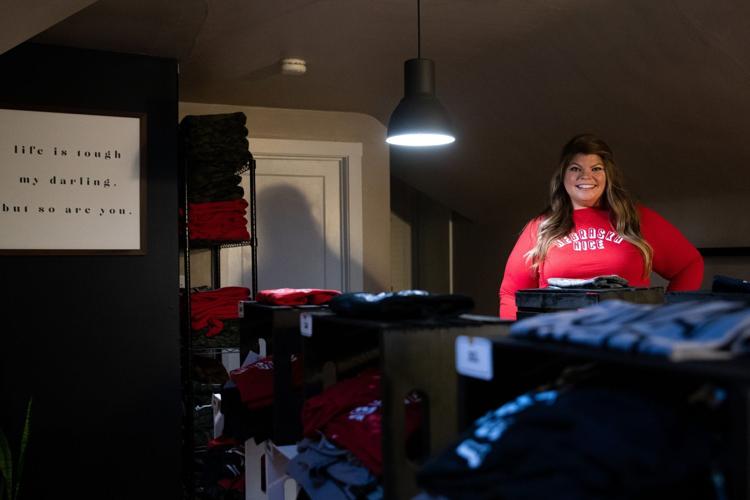
Meg Rutledge, a teacher, started making and selling t-shirts as a way to earn extra money after her husband lost his job at the start of the coronavirus pandemic.
Meg Rutledge wallowed in a pity party for a week after husband Clark was laid off from his job as a medical recruiter last spring.
Then she got busy. Her teacher’s salary alone wouldn’t pay the mortgage, day care and all of their bills, so she went online and searched for every COVID-19 relief program she could find.
“It hit us hard financially,’’ she said.
Even with that help she needed another way to bring in money. She tried making custom signs for a side gig she calls Milk & Daisy, after her dogs, and then pivoted to T-shirts and sweatshirts for toddlers.
They have one of their own, 20-month-year-old Hank.
She sank $500 in an industrial heat press and a screen printing setup, and she and a colleague collaborated with clever sayings on a few of the toddler tees.

Meg Rutledge's clothing has found a niche, selling well in several Omaha stores.
Her clothing has found a niche, selling well in several Omaha stores.
“It became kind of a necessity to help us,’’ Rutledge said. “If I didn’t have it, I don’t know what we would do financially.’’
Milk & Daisy’s profits allowed the family to get back on track and then some. Clark found another job after three months.
The experience wasn’t easy. Clark struggled with not being the provider and Meg had to take on a new role as the sole breadwinner. But Meg said Clark is thriving in his new position, and she has loved seeing his swagger return.
For Meg, it’s been all about giving Hank the same great life she had, and she’s grateful to everyone who has supported her fledgling business.
“I wish I could hug every single one of my customers,’’ she said. “They think they’re just getting a cool shirt. Honestly, they’ve made my son’s Christmas. It’s cool how it’s all blown up like it has.’’

Hank Rutledge, 20 months, wears a shirt designed by his mom, Meg Rutledge.
Now that she's the main breadwinner, she's working seven days a week
Krisy Byers starts filling special orders at her Gigi’s Cupcakes shop at 6 a.m. almost every day of the week.
At 9 a.m., six days a week, she begins her shift as a manager at Addy’s Sports Bar & Grill. She’s also the marketing director for the family-owned business.
She usually gets home around 6:30 p.m. — unless she needs to stay for a double shift.
It’s a grueling schedule she’s managed since the pandemic began last spring.
Byers became the main breadwinner in her family when the job offer husband Anthony received was rescinded in March because of the coronavirus. He’d already begun training and had resigned his previous position.
“Since March, we went from both having easier days, having a lot of time together, to me working full time and taking over the majority of the financial responsibilities for our family,’’ Krisy said.
She has to work both jobs to keep their cupcake shop flourishing and to keep the family afloat. Anthony, meanwhile, is either taking care of daughter Pepper and son Logan, both under 3, or working at the shop. Family helps babysit on the weekend.
“He keeps me going; he keeps our family going,’’ Krisy said. “He’s so good at the store and with our kids. I can’t imagine it’s an easy transition for him as well.’’
Evenings are sacred family time. After the children go to bed, Krisy and Anthony brainstorm about their schedules and plans.
If she didn’t love both jobs so much, Krisy isn’t sure she could keep doing what she’s doing. The kids have almost grown up at their shop. Pepper was only a few days old when she first visited so mom could fill an order. Logan took some of his first steps there.
“It’s been a huge delight,’’ Krisy said. “We love seeing the customers. We love seeing their cake dreams happening. It’s a blessing to us.’’
With jobs lost, mom struggles to keep family of six going
Mia Black lost her part-time job when the coronavirus forced the closing of bars and restaurants.
Her husband, Joshua, who did heating and cooling work for new construction, was laid off, too.
Mia still works full time doing payroll processing, but the income doesn’t cover much more than utilities and food.
The couple are grateful that their landlord is working with them on their rent, so they and their blended family of six can keep a roof over their heads.
“We’re behind and scraping and moving things around,’’ Black said. “We’re just trying to survive, trying to get through it.’’
They’ve applied for rental assistance and help with their utilities, but neither is a certainty.
Family can’t help, she says, because they are struggling, too.
The three older girls are in school, so while Mia works from home she’s often helping them navigate their school work.
She said they really don’t know what is going on be-sides the fact that they need to be careful so they don’t catch the virus.
Mia says she’s scared and worried.
“What keeps us going is just knowing that there is always an end,’’ she said. “And that we will get through it.’’
Her poetry is the only thing mom of four feels she can control during crazy year

Brittney Akerson has found a positive in the challenges of the past year. Being home has allowed her to write, and she’s published a book of poetry.
The coronavirus has taken a heavy toll on Brittney Akerson and her family.
Both she and her husband lost their jobs. Last month, they and their four children got COVID-19.
Her grandmother died of the virus and her father and uncle were both hospitalized. Making it even harder was that her baby brother, Jesse, had joined the U.S. Marine Corps and couldn’t come home when things were at their worst. He, by the way, got COVID at boot camp.
“It was just a lot at one time. It was all COVID-related,’’ she said. “It’s just been a crazy year.’’
After both Brittney and husband Zach were laid off in the spring, they survived on unemployment, savings and careful spending until Zach found a new job two months ago.
That was a relief, but that’s also where he was exposed to COVID and passed it to the family. All have recovered.

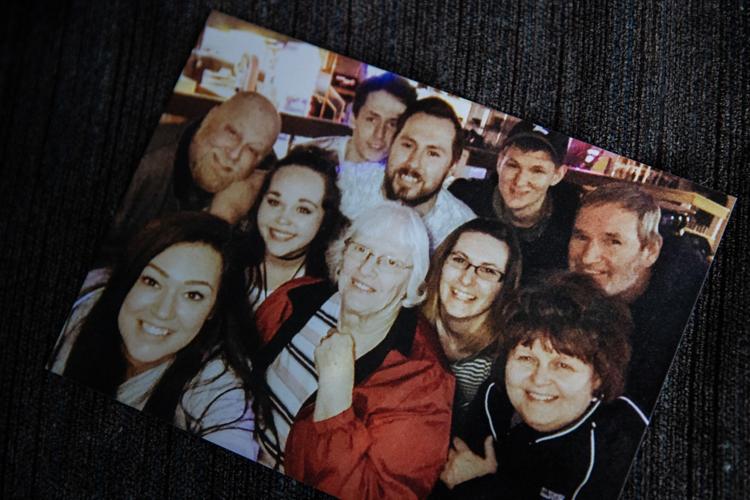
A family photo of Brittney Akerson with her grandmother, and other family members. Both of them, plus Akerson's husband and their four children, her father, uncle and brother have all had COVID-19. Her grandmother, Elaine Hersha, died after being hospitalized with coronavirus.
Brittney said that although her company has been great, and she was offered her job back as an administrator at a medical spa, she has decided to stay home.
“With how things are going and school shutdowns and quarantine, it was smarter for one of us to stay available,’’ she said.
Being home has been crazy, too, though. Their children are ages 13, 12, 8 and 5, and helping them with their online learning when the Millard school district goes remote or the two times they’ve had to quarantine has been difficult. Someone always needs help.
“It’s next to impossible,’’ Brittney said. “It’s not fun. I have a lot of friends who have multiple kids who say this is impossible. Sadly, I see a lot where older kids stay home with younger kids and are forced to help the younger kids.’’
Brittney has found a positive in the challenges of the past year. Being home has allowed her to write, and she’s published a book of poetry. It keeps her mind off worrying about the future or if she’ll ever be able to return to work.
“Honestly, writing has saved my sanity. Somewhere to expel the anxiety and fear that has mounted during all of this,’’ she said. “A sense of control when the rest of my life is completely out of my control.’’

“Honestly, writing has saved my sanity. Somewhere to expel the anxiety and fear that has mounted during all of this,’’ Brittney Akerson said. “A sense of control when the rest of my life is completely out of my control.’’
She works more for less to accommodate her child's school schedule
Jennifer Miller loves being a mom.
But she never wanted to be a teacher.
Before the coronavirus hit, she was working part time at a bar while her husband, Ryan, worked a 9-to-5 job. It helped pay the bills.
School closings last spring forced her to quit her bar job. She started working again as a CNA, which has meant more hours because it pays less.
“I had to change my job, so I could be flexible around my son’s schooling,’’ she said.
She works overnight shifts and sleeps while her son, Anthony, attends first grade in the Omaha Public Schools. Whenever there is a change in the school schedule, she has to shift her hours.
“It’s been hard,’’ she said of some 16-hour and weekend shifts she’s had to take. “It was a financial burden switching jobs.’’
Her husband is very helpful when he’s home, she said. But she’s had to take on the task of keeping Anthony busy and happy when there is no school and on task when classes are remote.
It’s tough to separate being a mom and a teacher, she said. He misses his friends.
They took lots of walks over the summer, Anthony learned how to ride his bike, and they did several science experiments. But she dreads the three weeks off and then another week of remote learning over the holiday break.
“It would be different if we could go out and do things and stay active,’’ she said.
Being a stay-at-home mom and teacher has been a 180-degree turn from what she was used to before the virus struck.
“I didn’t get to choose these new roles or these changes,’’ she said. “It was just the sacrifice I had to do for my family.’’
She manages the money, and there's little left after bills are paid
Brittney Ladd says she’s struggling mentally, emotionally and financially.
“I guess we’re lucky in the sense we have food to eat and heat and power and water,’’ she said. “But it’s hard living paycheck to paycheck.’’
Both she and husband Nick have jobs. He’s a mechanic at a car dealership who works overnight.
She works at a day care center where she brings their newborn daughter.
Nick had been working two jobs when the virus hit, and lost one of them. Both had their hours cut back.
In the summer, things started to look up, but then Brittney was exposed to COVID-19, forcing her to take two weeks off work. Because of complications with her pregnancy, they ended up with $8,000 in medical bills.
Nick works on commission, so there are times he doesn’t get paid. He’s looking for more work.
Brittney is the one who manages the bills and sees where the money goes. It’s tough, she said, when there’s only $15 to $20 left when everything is paid. There’s a lot of hoping and praying that nothing goes wrong.
She longs for an end to the hardships caused by the virus but doesn’t know when that will come.
“I think right now we’re just trying to keep treading water to stay on top of things,’’ she said. “When my checks are hardly big enough to cover bills, then I have to start limiting what we get in groceries.’’
Maybe, she says, they’ll get lucky and win the lottery.
Our best staff images from December 2020
Photos: Our best staff images from December 2020
20201204_new_hunger_pic_cm001 (gallery)
Updated
Looking east at 21st and Wirt Streets, cars line up for blocks for the Heart Ministries drive-through food pantry on Thursday, December 03, 2020.
20201204_spo_unoice_ar05 (gallery)
Updated
Western Michigan's Drew Worrad gets caught up with teammate Ty Glover in the Western Michigan vs. UNO hockey game at Baxter Arena in Omaha on Thursday, December 03, 2020.
20201202_spo_unohockey_pic_cm006 (gallery)
Updated
UNO plays Minnesota-Duluth in a virtually empty Baxter Arena on Tuesday.
20201202_spo_unohockey_pic_cm003 (gallery)
Updated
UNO's Martin Sundberg watches his shot go past Minnesota-Duluth goalie Ryan Fanti for UNO's second goal of the first period at Baxter Arena on Tuesday, Dec. 1, 2020. Also on the play is UNO's Ryan Brushett and Minnesota-Duluth's Louie Roehl.
20201202_spo_cubkc_ar02.JPG (gallery2)
Updated
The UNO vs. Creighton men's basketball game at the CHI Health Center in Omaha on Tuesday, December 01, 2020.
20201130_spo_cubkc16 (gallery)
Updated
Creighton's Marcus Zegarowski drives and scores against North Dakota State during their game on Sunday in Omaha.






(0) comments
Welcome to the discussion.
Log In
Keep it Clean. Please avoid obscene, vulgar, lewd, racist or sexually-oriented language.
PLEASE TURN OFF YOUR CAPS LOCK.
Don't Threaten. Threats of harming another person will not be tolerated.
Be Truthful. Don't knowingly lie about anyone or anything.
Be Nice. No racism, sexism or any sort of -ism that is degrading to another person.
Be Proactive. Use the 'Report' link on each comment to let us know of abusive posts.
Share with Us. We'd love to hear eyewitness accounts, the history behind an article.