
With Monterey County’s population projected to grow about 21 percent over the next 25 years, the number of cars on the road will likely continue to increase, leading to even more traffic congestion. With this in mind, the County of Monterey and the Association of Monterey Bay Are Governments hired the consulting firm Mobycon Inc. to author the grant-funded Monterey County Zero Emissions Shared Mobility Study.
By zero emissions, the study’s authors mean modes of transportation that do not use internal combustion engines. Shared mobility refers to everything from public transit to services like Uber and Lyft to e-bike and scooter sharing.
The study was presented to the Monterey County Board of Supervisors on Feb. 10. It includes six recommended actions including the establishment of multimodal mobility hubs of various sizes, which the study’s authors see as forming “the backbone of Monterey County’s zero-emission shared mobility network,” and would serve as connecting points where people could securely store a bicycle before hopping on a bus, for example.
“They function as ‘mobility centers’ that support easy transfers between transit, shared EV cars, vanpool fleets, e-bikes and walking,” the study reads.
Alongside the mobility hubs, the study recommends creating e-bike libraries, which provide free or low-cost long-term lending for those who can’t afford an e-bike of their own. The study says the libraries would be ideal for farmworker communities and those with physical limitations who would benefit from a bike with an electric assist. The estimated startup cost for a library with a small fleet of e-bikes is about $282,000.
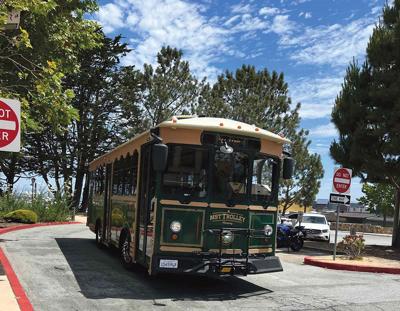
To cut traffic congestion, the study suggests expanding the Monterey Trolley’s service beyond the summer months and potentially extending and adding trolley routes to “new corners of the Peninsula, creating a central transit network for car-free Peninsula travel.”
Another idea includes establishing a scenic corridor shuttle service for Big Sur, which would connect Monterey to major trailheads and other key destinations in Big Sur and would operate like the free shuttle service in Yosemite National Park. Launching the program would cost an estimated $4.5 million.
Although none of the projects in the study are currently funded, the document provides a framework for county and transportation officials.


(0) comments
Welcome to the discussion.
Log In
Keep it Clean. Please avoid obscene, vulgar, lewd, racist or sexually-oriented language.
PLEASE TURN OFF YOUR CAPS LOCK.
Don't Threaten. Threats of harming another person will not be tolerated.
Be Truthful. Don't knowingly lie about anyone or anything.
Be Nice. No racism, sexism or any sort of -ism that is degrading to another person.
Be Proactive. Use the 'Report' link on each comment to let us know of abusive posts.
Share with Us. We'd love to hear eyewitness accounts, the history behind an article.