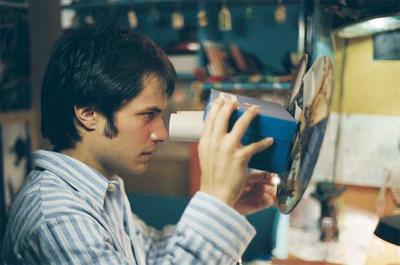
Suddenly the protagonist’s hands are huge, seemingly the size of refrigerators. He fumbles as he attempts to paste pieces of art to a calendar with a gluestick. He is on a tight deadline, so speed is of the essence, but the faster he goes, the more his gigantic hands get in the way.
Stéphane (Gael Garcia Bernal) is dreaming, as he does about half the time in The Science of Sleep. As it gets harder for him to differentiate between reality and dream, the audience is lifted along on a reverie of self-exploration all their own.
In the normal-sized hands of most directors, such dream scenes—let alone a nonstop, surreal sequence of them—can feel fabricated, incoherent or wandering. But in the hands of Michel Gondry, writer-director of The Science of Sleep, they feel accessible, authentic and thought-provoking.
The film follows the explosive imagination of Stéphane, an eccentric Mexican-born artist who comes to France following the death of his father. While living with his mother, Stéphane accidentally meets Stéphanie (Charlotte Gainsbourg), a woman whose creativity leads her to share a whimsical life with Stéphane—a life they catalyze with a shared viewing of cotton clouds floating to the ceiling of her living room.
But a world that borrows too much from reality is a world Stéphane can’t control. The world he lives in is his own dreamscape, where he is the master. In his dreams, Stéphane is many things: a talk show host who plays the drums, a criminal making a getaway in a cardboard car, a chef who concocts a dream as if it was a recipe—one cup of a nostalgic memory, two tablespoons catchy song, a dash of the girl your heart is chasing.
It is in the dreams of Stéphane that Gondry separates himself from other directors and their attempts at hard-to-handle, nonlinear meaning. Instead of the boring hazy white backgrounds that so many other directors have fallen victim to, Gondry showcases his playful side with bright pastel colors and an intelligent obscurity that resonates with our own random REM state.
For every bizarre moment in Stéphane’s dreams, there is a subtle reminder of our own experiences. It is in The Science of Sleep’s reoccurring theme of “parallel sequencing randomness” that this feeling of familiarity is able to poke through the dreamy states and spark a powerful connection with the audience. It is a notion that beats loudly in the back of all our brains—the notion that everything can change in a heartbeat, and all that it takes to make it happen is misconfigured timing.
Bernal’s performance adds crucial continuity to the lovable story. Through him Stephane’s flamboyance doesn’t come off as indulgent or off putting, just charming and even charismatic.
But the true science in The Science of Sleep is Gondry’s art, where there’s just one law to follow: anything and everything is possible. With this film, Gondry, previously known for his co-writing credit on Eternal Sunshine of the Spotless Mind with Academy Award-winning screenwriter Charlie Kaufman (Being John Malkovich, Adaptation) fully moves out of the shadow of other surrealist directors, wielding his own believable bit of magic.
For the audience, it means a dream come true: a film that is as much fun to follow as it is to interpret.
The Science of Sleep ( * * * )
Starring Gael García Bernal, Charlotte Gainsbourg. • Directed by Michel Gondry. • Rated R. At the Osio Cinemas.


(0) comments
Welcome to the discussion.
Log In
Keep it Clean. Please avoid obscene, vulgar, lewd, racist or sexually-oriented language.
PLEASE TURN OFF YOUR CAPS LOCK.
Don't Threaten. Threats of harming another person will not be tolerated.
Be Truthful. Don't knowingly lie about anyone or anything.
Be Nice. No racism, sexism or any sort of -ism that is degrading to another person.
Be Proactive. Use the 'Report' link on each comment to let us know of abusive posts.
Share with Us. We'd love to hear eyewitness accounts, the history behind an article.