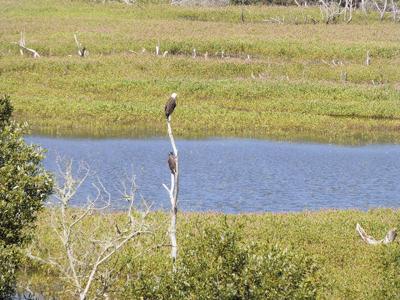

In the mid-1980s, when the Ventana Wildlife Society began reintroducing bald eagles to the Central Coast, the last known bald eagle nest in the region dated back to 1933, near the top of a redwood tree along Torre Creek on the Big Sur coast.
But since the reintroduction campaign by VWS – a conservation nonprofit – which released 66 bald eagles in Big Sur from 1986 to 1994, the iconic birds have made a spectacular recovery: Scientists believe there are now 30 breeding pairs of bald eagles from Marin to Santa Barbara counties.
Evidence of that recovery was published in the June issue of Journal of Raptor Research. VWS Executive Director Kelly Sorenson is the lead author of the study, and he took part in the eagle releases decades ago.
“For me, it’s a really great outcome because reintroduction worked,” Sorenson says. “It was the same thing with condors – people said it wouldn’t work.”
For decades until the 1970s, bald eagles, an endangered species, had been in decline across California due to a variety of factors, most recently because of DDT, a once widely used pesticide that causes eggshell-thinning in birds.
With the federal ban on DDT in 1972, bald eagles and other large birds have since been on the rebound.
But the robust recovery on the Central Coast was not foreseen.
“In our particular zone, [federal scientists] thought four breeding pairs was a regional number to expect,” Sorenson says. “What’s so exciting is we far exceeded that number.”
The history of bald eagles in California is not well documented, and Sorenson says the best account to date is a 1985 master’s thesis by biologist and bald eagle expert Phillip Detrich.
Detrich writes that historically, bald eagles bred everywhere in the state except desert regions, but began to decline in the late 1800s and early 1900s due to “shooting, poisoning and habitat loss.”
The widespread use of DDT following World War II furthered that decline, and in 1981, nine years after the ban on DDT, there were only 50 breeding pairs in California, all of which were in the northern third of the state.
Fish are a primary part of bald eagles’ diet, and all of those nests were within two miles of freshwater, most often a man-made reservoir.
The distribution of known nests in Central California mirrors that: All of the nests are near year-round freshwater.
In Monterey County, as of 2012, all of the bald eagle nests were clustered around lakes Nacimiento and San Antonio. Within the past five years, a new nest has appeared at Elkhorn Slough.
The essence of Sorenson’s paper – co-authored by fellow VWS biologists Joe Burnett and Mike Stake – is that bald eagles were on a slow path to recovery in the Central Coast, but the recovery was greatly expedited by reintroducing young bald eagles to the region.
(The young eagles, called eaglets, were taken from Alaska and British Columbia.)
“We’re proud we brought the bald eagle back to our region,” Sorenson says, “so that future generations can enjoy the majesty of these wonderful birds.”


(0) comments
Welcome to the discussion.
Log In
Keep it Clean. Please avoid obscene, vulgar, lewd, racist or sexually-oriented language.
PLEASE TURN OFF YOUR CAPS LOCK.
Don't Threaten. Threats of harming another person will not be tolerated.
Be Truthful. Don't knowingly lie about anyone or anything.
Be Nice. No racism, sexism or any sort of -ism that is degrading to another person.
Be Proactive. Use the 'Report' link on each comment to let us know of abusive posts.
Share with Us. We'd love to hear eyewitness accounts, the history behind an article.