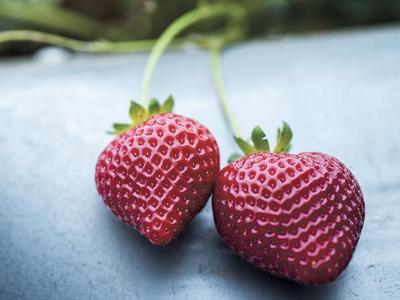

Genetic research in strawberries might conjure ideas of science fiction, but a lot of research relies on simple, old-fashioned practices of breeding. “It’s this idea of crossing two things together to bring the nice attributes,” says Steven Knapp, director of the strawberry breeding program at UC Davis.
Researchers gather plant samples from around the world, looking for genes that are resistant to different diseases. Starting in 2015, they began a quest for strawberry varieties resistant to fusarium wilt, a pathogen that threatens Monterey County’s most valuable crops.
Fusarium wilt is caused by the fungus fusarium oxysorum f. Sp. fragaraie, and it emerged in California about 15 years ago, and it spreads easily. “It’s a very aggressive disease,” Knapp says. “It’ll devastate a plant that’s susceptible. It just kills it right to the ground.”
Those susceptible plants include Monterey County’s most valuable crops, strawberries and lettuce.
The challenge for breeders was to find varieties of crops that are resistant to fusarium wilt; by analyzing DNA, they found that about 25 percent of plants naturally have three genes that are resistant. “We’ve discovered this plant has a tremendous diversity of resistance genes,” Knapp says.
Finding the gene is step one. “The genes have been floating around in the germplasm for thousands of years,” Glenn Cole, breeder and field manager for the strawberry breeding program, said in a statement. Cole, Knapp and other members of their team published the findings in the journal Theoretical and Applied Genetics.
The next step is to breed strawberries that have these genes. To do that, researchers at UC Davis pollinated hybrids, then screened for the desired genes, separating out the seeds that carried them. “It’s a big deal,” Cole said. “Everything is incremental in plant breeding, but it’s a big deal.”
The gene helps trigger the plant’s immune system – similar to what white blood cells would do in our bodies – to attack the fungus.
Plant scientists at UC Davis have been breeding strawberries since the 1930s, and since then, they’re released more than 60 patented varieties through the public breeding program. The fusarium-resistant berries should be released later this year.
For growers on the Central Coast, it should be a welcome relief. Methyl bromide was a common soil fumigant that was historically used in strawberry fields to eliminate disease, and it was phased out due to its ozone-depleting effects. “Diseases can start to build up in the soil and those diseases can affect the productivity of the plant, and can also kill the plants,” says Chris Christian, a senior vice president at the California Strawberry Commission.
A fusarium-resistant berry is good news for growers, Christian says. “It ultimately means that farmers are able to use less pesticides,” she says, adding that it will also reduce costs. “In this time when costs are significantly increasing, we are definitely looking for any and all different alternatives to improving the disease resistance of the strawberry plant.”



(1) comment
While this sounds great-and the elimination of Methyl Bromide is- engineering food so you can patent it, is not. This will have huge consequences down the road which the public is completely unaware of. Never before in our history have we allowed food to be patented. But engineer it and voila it is no longer considered food and now a Corp can own it.
Welcome to the discussion.
Log In
Keep it Clean. Please avoid obscene, vulgar, lewd, racist or sexually-oriented language.
PLEASE TURN OFF YOUR CAPS LOCK.
Don't Threaten. Threats of harming another person will not be tolerated.
Be Truthful. Don't knowingly lie about anyone or anything.
Be Nice. No racism, sexism or any sort of -ism that is degrading to another person.
Be Proactive. Use the 'Report' link on each comment to let us know of abusive posts.
Share with Us. We'd love to hear eyewitness accounts, the history behind an article.