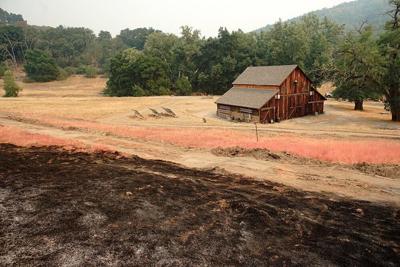
JEN HUNTER, DIRECTOR OF THE HASTINGS NATURAL HISTORY RESERVE IN CARMEL VALLEY, SOUNDED DESPERATE as she tweeted directly to @CALFIREBEU on the evening of Aug. 20. “We are on the southeast side of the River Fire. Hastings Reserve. We have no support from CalFire. 50k gallons of water, hydrants, but no hoses, no engines. The reserve is burning now, the neighbors are fighting on alone with dozers, can you send us some help?”
A short time later she tweeted again: “From my neighbor of Boekenoogen Ranches: tell them to send some freaking help. I got five cowboys out here fighting fire.”
At the moment, firefighters and equipment were busy attacking the River Fire over the hill, on the Salinas side, Cal Fire Capt. Tony McHale says. He understands why Hunter might have been in a bit of a panic, but he says the situation was actually well under control.
“When faced with this kind of crisis, everyone, including myself, wants help right away,” McHale says. “Wildfire is an existential threat. So of course people wonder, ‘Where is the cavalry? Is it even coming?’”
McHale had been one of the first people to spot what would come to be called the Carmel Fire. He’d driven to the top of Laureles Grade on Tuesday, Aug. 18, to get a better view of the River Fire, which had then been burning for two days. From that perch, he saw a new column of smoke forming on the east side of Carmel Valley. He reported it to Cal Fire’s incident command center at Toro Park and was instructed to go check it out.
A veteran engine company captain based in Ventura, McHale is also qualified to work as a public information officer, and was deployed here in that capacity. “I got up to Cachagua when the fire was really booming,” he says. “I witnessed some extreme fire behavior.”
While he was not involved in the decision-making process that followed in the next hours and days, McHale was privy to radio communications. Because of the unprecedented situation with 12,000 lightning strikes that exploded across the state beginning Aug. 15, Cal Fire’s resources were stretched thinner than ever. The fact that there was already an incident command post in Monterey County was fortunate, McHale says.
The decision-making team at the post included officials from Cal Fire, local law enforcement agencies, Caltrans and PG&E, as well as several meteorologists. This team decides which areas to focus on – and not to focus on. “Not that we’re not focusing on all areas of the fire,” Cal Fire spokesperson Toni Davis says. “But resources are seriously limited.”
Ultimately, decisions about how to deploy those resources are made at the state’s Emergency Command Center, which is run by Cal Fire and the Office of Emergency Services. The ECC is housed in a Costco-sized building at the decommissioned Mather Air Force Base in the rural industrial area on the eastern edge of Sacramento. The building’s nerve center resembles the chambers of the State Senate a few miles away, a large theater with a mezzanine wrapping around the second floor. Desks are arranged in a semicircle facing a massive two-story screen alternately displaying videos from fire events and spreadsheets. It shows acreage, containment, the number of firefighters deployed and structures destroyed. News reports from various media sources are displayed at the edges of the screen. The folks at the desks include not just Cal Fire but folks from the U.S. Forest Service and senior members of the agencies represented back at Toro Park.
On the evening of Aug. 20, in addition to the Carmel, River, and Dolan fires burning in Monterey County, the screen displayed information about the CZU Lightning Complex, tearing through the Santa Cruz Mountains; the SCU Lightning Complex east of San Jose; and the LNU Lightning Complex, straddling five counties. There were more than 500 fires burning in the state at that moment.
Lucas Spelman, a battalion chief at the ECC, says decisions about where to send resources are made on a “minute-by-minute” basis. As requests pour in for crews, aircraft and other equipment, the folks on the floor communicate online or tuck into offices located off the mezzanine to discuss situations face-to-face.
“The system allows us to break everything down into little pieces,” Spelman says. “We can see the amount of equipment we have throughout the state and know what’s available and what is not. We’re able to know that this strike team or this fire engine is available, and then move it where it needs to go.
“This situation, with the amount of lightning strikes, and the dry conditions on the ground, we were definitely stressed. It’s not that we weren’t prepared – even with the deficits from our inmate population, we have backfilled and increased the number of firefighters and crews. But this was an immense firefight throughout the state.”
FOR THE EIGHT YEARS HE SERVED AS SECRETARY OF THE CALIFORNIA NATURAL RESOURCES AGENCY, JOHN LAIRD WAS RESPONSIBLE FOR ENSURING THAT CAL FIRE WAS SUFFICIENTLY FUNDED AND EQUIPPED. Now he is a candidate for the State Senate district covering much of Santa Cruz and Monterey counties. And he spent a lot of time in the past three weeks on the phone, fighting for some of that equipment.
At the moment Jen Hunter was calling for help on Twitter, Laird and his spouse were preparing to evacuate their home on the West Side of Santa Cruz, as the CZU Fire approached the city. “I was pounding every single person I know at the top in Sacramento about getting more resources here,” Laird says. “It’s fair to say that they were all overwhelmed, at first. There just weren’t enough resources.”
During his time as secretary, while wildfires morphed into a year-round consequence of the climate crisis, Laird oversaw a reboot of Cal Fire. Among other things, he secured funding so the department’s fleet of Vietnam War-era helicopters could be replaced with new aircraft. He says Gov. Gavin Newsom has accelerated that effort – but it’s not enough. Laird’s campaign platform includes a promise to further prepare for the “new normal” of wildfires.
ON AUG. 21, LESS THAN 24 HOURS AFTER SHE POSTED HER PLEAS FOR HELP ON TWITTER, HUNTER WAS BACK. “Well fam, we made it. @CALFIREBEU swooped in, (literally) in the nick of time. We had several retardant drops, followed shortly by hand crews and engines. Dozers are cutting fire breaks now. Back burns are burning.” And a few hours later: “We are on spot fire patrol now. Water tender crews are coming and going. Lots of fire breaks. Lots. It’s a bit shocking, given the prior state of the reserve but they did the job. No complaints here.”



(0) comments
Welcome to the discussion.
Log In
Keep it Clean. Please avoid obscene, vulgar, lewd, racist or sexually-oriented language.
PLEASE TURN OFF YOUR CAPS LOCK.
Don't Threaten. Threats of harming another person will not be tolerated.
Be Truthful. Don't knowingly lie about anyone or anything.
Be Nice. No racism, sexism or any sort of -ism that is degrading to another person.
Be Proactive. Use the 'Report' link on each comment to let us know of abusive posts.
Share with Us. We'd love to hear eyewitness accounts, the history behind an article.