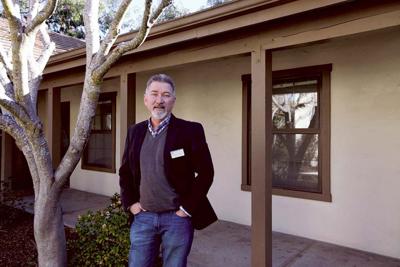

Carbon credits for upgrades in energy efficiency made by local households could actually be going to a group of municipalities in Riverside County, or so says Scott Dick, the government affairs director for the Monterey County Association of Realtors.
Dick has taken aim at Property Assessed Clean Energy (PACE) programs that have been approved by the Monterey County Board of Supervisors and city councils of Salinas and Monterey in recent years.
PACE programs allow building owners to finance not just rooftop solar projects, but double-pane windows, solar-reflective paint and new energy-efficient appliances, through their property taxes. The loans come in the form of so-called “super liens” against the property that take priority over mortgage lenders.
“We need to reduce our carbon footprint, but we need to do it in a different way than PACE,” Dick says. “These programs are open to abuse and unregulated.”
There are three providers of PACE loans in California: Home Energy Renovation Opportunity (HERO), Ygrene and California First.
Monterey County and the city of Monterey have agreements with HERO to allow for payment to be made through property taxes collected by the governments. The city of Salinas has done the same with HERO and Ygrene.
HERO’s loans in Monterey County, according to the company, have totaled $2.43 million with a projected energy-cost saving of $4.14 million.
What makes HERO unique is that the lending entity was established by the Western Riverside Council of Governments – a Southern California equivalent to the Association of Monterey Bay Area Governments (AMBAG) – and Renovate America, a private company. By joining HERO, carbon credits for energy efficiency go to the WRCG, Dick says, rather than local jurisdictions. That means a city like Monterey won’t be able to count these credits toward its state-mandated carbon cutbacks, he adds.
Yet a spokesperson for HERO sees this as a moot point.
"To date, carbon credits have been aggregated together and assigned to regional government authorities who oversee the program," says Greg Frost, spokesperson for HERO. "If there were any value to these credits to individual homeowners that would be reevaluated."
City officials presented the Monterey City Council with a proposal on Sept. 9 to allow Ygrene to expand its PACE services to Monterey residents. The agreement was pulled after Councilmember Timothy Barrett expressed concerns over lending practices, but it’s expected to be presented to the Council again in early 2017.
PACE programs are still championed by many: “It’s important to understand the details of financing,” says Brennen Jensen, co-chair of the Monterey Regional Climate Action Compact, “but these programs give access to people who otherwise couldn’t afford upgrades. It can be a really good option.”
Editor's note: This article has been updated to include a response from HERO, a Property Assessed Clean Energy (PACE) financing company.


(1) comment
Dick claims that PACE funding comes in the form of sub prime loans. They are not subprime loans. To be a subprime loan, first a prime loan must have not worked out. No denial of prime lending occurs. PACE funding employs a completely different mechanism. Dick's language is inaccurate and does not apply to PACE financing, he is wrong.
Because something is 'like' something else, it doesn't mean it is the same.
PACE financing has some great advantages to the unsecured loans Dick seems to want to push people into.
The article goes on to state that for every $1 loaned out, $1.70 in savings is produced. Sounds like a good thing to me.
Suppose one were to fund some solar panels for their home with PACE... The economics are such that the monthly payment is typically less than the monthly savings!
Yes - the periodic $$ savings produced by a properly sized solar system are greater than the PACE payments to pay for it!
Dick says a person's ability to pay is not considered. If the savings produced are greater than the expense, doesn't that count?? That's exactly what PACE financing considers. Additionally, the money for the loans comes from an existing revenue stream, existing cash flow, not new money. PACE funding inherently includes analysis of money saved vs. money owed. I have used PACE, I know.
Dick's problem is stated to be with the carbon credits. Later the carbon credits are described as 'worthless'.
PACE funding is described as a 'super lien'. Your local sewer system, sidewalk, and perhaps school funding also deserve this description then, as these are all property assessments, too. Additionally, California has bent over backwards to address the concerns of the mortgage lenders around PACE financing, Dick should already know this, it is not an issue, except for him saying that it is.
As a spokesman for realtors, one can assume Dick is in the business of selling houses, and something about this is cutting into his ability to sell houses. This is true! However it is the solar lease that is the primary culprit.
PACE financing is designed to be transferable, assumable by the next occupant. This is absolutely not the case with solar leases. It sounds like the realtors need some education in distinguishing PACE financing from a solar lease.
Next time someone flags you down in your favorite big box store, know that the lease they are pushing may make it impossible, or at least unattractive, to sell your home. There are many types of financing, educating ones self as to the pluses and minuses of the different options is important, as the article helpfully states. Dick's disjointed criticism does not help and is not educational.
3rd party studies in California show definitively that homes with solar PV sell faster, and sell for more money than similar homes without solar. In fact, buyers in California are willing to pay a premium for homes with solar, at times exceeding the original value of the solar system! I see opportunity, not a problem!
Dick's charge that PACE financing is 'open to abuse and unregulated' is 100% unfounded with no evidence, and is patently false.
I personally would be happy to meet with Dick to help disavow his misconceptions. And I am happy to hear that the local realtors care so much for the city of Monterey's carbon credits. I am curious what MCAR's stand was back when we had actual sub-prime lending going on - were Dick and MCAR equally as vocal decrying sub prime lending then? Anyone?
Welcome to the discussion.
Log In
Keep it Clean. Please avoid obscene, vulgar, lewd, racist or sexually-oriented language.
PLEASE TURN OFF YOUR CAPS LOCK.
Don't Threaten. Threats of harming another person will not be tolerated.
Be Truthful. Don't knowingly lie about anyone or anything.
Be Nice. No racism, sexism or any sort of -ism that is degrading to another person.
Be Proactive. Use the 'Report' link on each comment to let us know of abusive posts.
Share with Us. We'd love to hear eyewitness accounts, the history behind an article.