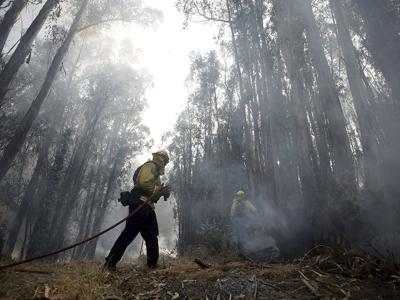

Fueled by the wet winter – not in spite of it – there have already been a handful of small wildfires in Monterey County this year. They’ve mostly been grass fires, which firefighting crews, more often than not, can quickly bring under control.
The grasses are called “fine fuels,” and they take up water faster than bigger fuels like shrubs and trees, but they also dry out faster (or, in the lingo of fire, they “cure”).
What about the outlook for massive wildfires that consume thousands of acres, like the type that have scorched parts of Monterey County in years past? The answer to that question isn’t entirely clear.
The Southern California Geographic Area Coordination Center (OSCC), which acts as a collaborative nerve center for the federal and state agencies involved in fire response in California, does predictive modeling, and on June 30, released a report with the fire risk outlook on the Central Coast from July through October.
It predicts the fire risk outlook for the entire Central Coast during the period as “normal” (the other two categories are “above normal” and “below normal”). And in terms of major wildfires, it shows the current moisture in the region’s forest is well above the average in July when compared to the most recent five – and 10-year averages. The bad news is that the moisture in the forests dropped considerably in June.
“With the previous three years of drought, we are seeing trees are still stressed,” says Adrienne Freeman, a spokesperson for the U.S. Forest Service, which is part of OSCC. As far as this year’s outlook, she adds, “A lot of things depend on it: the ignition source, and how hot and dry does it stay now? And understanding it will depend on when we get precipitation again in the fall.”
One thing to watch out for, and that is hard for firefighters to contend with, are fires caused by dry lightning. “Dry lightning tends to come in clusters,” Freeman says, which creates fires with multiple points of ignition and they become “very difficult to manage.”
Even absent dry lightning to start a forest fire, Freeman says even small grass fires can pose a great threat to life and infrastructure.
“A one-acre fire is as destructive as a 100,000-acre fire if you happen to be that house in the one acre,” she says.
Matt Mehle, a fire weather program manager with the National Weather Service’s Monterey office, says that compared to recent years, the outlook doesn’t look as “dire,” though like Freeman, he concurs that the biggest risk for major fires will be lightning.
And what causes dry lightning is when warm, low-lying air is surrounded by colder air, causing the warm air to rise – hence “instability” – which can result in thunderstorms higher up in the atmosphere. And higher up in the atmosphere, Mehle says, there is less moisture, “so if there is lightning, it’s less likely it will have rain.”
If the coming rainy season’s precipitation is below normal, he says, this past winter’s rains will help mitigate fire risk in the short term, but beyond that, it’s highly speculative.


(0) comments
Welcome to the discussion.
Log In
Keep it Clean. Please avoid obscene, vulgar, lewd, racist or sexually-oriented language.
PLEASE TURN OFF YOUR CAPS LOCK.
Don't Threaten. Threats of harming another person will not be tolerated.
Be Truthful. Don't knowingly lie about anyone or anything.
Be Nice. No racism, sexism or any sort of -ism that is degrading to another person.
Be Proactive. Use the 'Report' link on each comment to let us know of abusive posts.
Share with Us. We'd love to hear eyewitness accounts, the history behind an article.