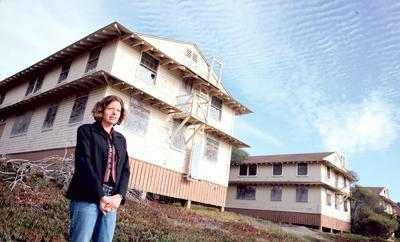
The scenery along Imjin Parkway is enough to tell passersby something has gone wrong: Billboards promising family living are perched on vacant lots showing no signs of life.
It’s no secret that the 1997 Base Reuse Plan for redeveloping the former Fort Ord hasn’t come to pass, but a $500,000 report completed last December highlights some of the missed targets: just 40 percent of a projected 11,000 homes built, 23 percent of CSU Monterey Bay’s projected 25,000 students, 21 percent of an anticipated 18,000 new jobs.
That dismal report card looks to some Fort Ord Reuse Authority board members like an opportunity. “No economy is flat. That’s a mistake that was made, creating an implementation plan that is dependent upon the business cycle. We need to make the implementation more weatherproof,” Carmel City Councilwoman Victoria Beach says.
Beach is on a FORA committee that convened in March to figure out what to do with the stalled plan. As step one, they’re hosting a two-day colloquium Dec. 12-13, with planners, architects and government officials from all over the nation who will deliver 20-minute TED-style talks, followed by Q&As.
The colloquium is the brainchild of CSUMB President and FORA board member Eduardo Ochoa, who successfully lobbied the CSU Chancellor’s Office for $30 million to remove all remaining blight from the campus. (See story, p. 12.)
“I felt that as a campus, we needed to take a more active role in helping steer the conversation in FORA toward longer-term, more strategic common ground, rather than spending our time on divisive issues that are missing the forest for the trees,” he says.
Not every development – even one that may generate revenue – is worth building, Ochoa says, even in times of economic desperation. At the same time, he says, conservation groups aren’t always tuned in to the true costs of blight removal; he hopes the colloquium brings about “economic realism.”
County Economic Development Director David Spaur will moderate a panel on national monuments as economic engines. The panelists will focus on how the abstract idea of value in a beautiful natural area can be made into a real revenue generator.
Jim Meadows, a consultant who led the reuse of San Francisco’s Presidio after it closed in 1994, will speak about the transformation of Crissy Field from a truck repair shop to a waterfront destination for up to 18,000 people a day.
“Crissy Field is now a weekend playground for people that don’t harm the area and in fact are becoming educated on the sensitivity of the environment,” Meadows says. “Could that be achieved at Fort Ord? I’d think quite naturally.”
For Spaur, the colloquium is a chance to get FORA board members thinking in a whole new direction: “Instead of fighting over projects that seem to be of lower value, why aren’t we reaching higher? Let’s replace those 18,000 jobs, but not those same jobs. Let’s do higher paying, or more creative jobs.”


(0) comments
Welcome to the discussion.
Log In
Keep it Clean. Please avoid obscene, vulgar, lewd, racist or sexually-oriented language.
PLEASE TURN OFF YOUR CAPS LOCK.
Don't Threaten. Threats of harming another person will not be tolerated.
Be Truthful. Don't knowingly lie about anyone or anything.
Be Nice. No racism, sexism or any sort of -ism that is degrading to another person.
Be Proactive. Use the 'Report' link on each comment to let us know of abusive posts.
Share with Us. We'd love to hear eyewitness accounts, the history behind an article.