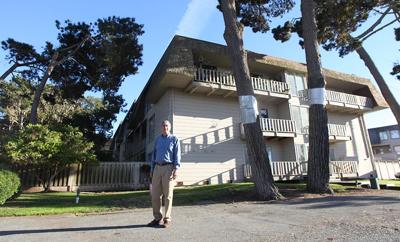
On his way to meet with planners at the Marina office of the Association of Monterey Bay Area Governments (AMBAG), Pacific Grove Mayor Bill Kampe remarked on the traffic in the Highway 1 southbound lanes.
“I thought, my goodness, that’s coincidental,” Kampe says. Then AMBAG Principal Planner Heather Adamson told him that’s a daily occurrence. “It really brought home the reason [housing] allocation can be so important,” Kampe says. “We’re trying to trend in the direction of putting housing closer to where the jobs are.”
Kampe is one of 24 members of the AMBAG board, which brings together representatives of the cities and counties of Monterey, Santa Cruz and San Benito. Under state law, they’re required to direct Adamson and her team to plan for 10,430 new inclusionary housing units in the region by 2023.
At issue is how AMBAG will crunch the numbers. Preliminary data shows 70 percent of the 10,430 required units getting built in Monterey County, and 30 percent getting built in Santa Cruz County. (Tiny San Benito County goes through a separate balancing act for its own units.) That’s a smaller share than the 2007 process assigned to Monterey County, with 79 percent of the total.
“Why does Monterey County accrue all the reduction?” Santa Cruz County Supervisor Neal Coonerty asked at a Nov. 13 board meeting. “Our interest is to adopt housing numbers that are fair.” Coonerty, along with other Santa Cruz County AMBAG board members, are meeting with planners next week to review the math on this complicated affordable housing planning process before the board reconvenes Dec. 11 to decide on the appropriate math.
The whole process changed in 2008 with Senate Bill 375, which sets up a plan for California to establish sustainable community strategies. That means housing can no longer be plotted out in a vacuum; factors like commute times and proximity to workplaces need to be accounted for, in effort to reduce greenhouse gas emissions.
“We feel that it’s pretty balanced in terms of projected job growth, existing jobs, and it’s representative of where the population is projected to be working and living,” Adamson says.
All this deliberation doesn’t mean any of the units will actually get built. “The part that’s always squishy is that the state doesn’t require them to build this housing,” Adamson says.
The planning exercise is just that: planning, not enforcement. Even with a housing market recovery in the works, the demise of redevelopment agencies in the state means cities and counties have less ability to incentivize inclusionary units than they used to.
Take Pacific Grove, for example. Just outside to the city boundary, Pebble Beach Company has proposed 24 affordable units. P.G. City Council voted Nov. 20 to oppose the plan, based on strong neighborhood opposition.
AMBAG’s preliminary analysis shows somewhere between 120 and 370 new housing units being planned for P.G. in the next decade, 10 times more than the controversial Pebble Beach proposal.
“We will be facing this on an even larger scale in our community,” Kampe says. “We really have to grapple with more heterogeneous mixes in our community and all communities.”


(0) comments
Welcome to the discussion.
Log In
Keep it Clean. Please avoid obscene, vulgar, lewd, racist or sexually-oriented language.
PLEASE TURN OFF YOUR CAPS LOCK.
Don't Threaten. Threats of harming another person will not be tolerated.
Be Truthful. Don't knowingly lie about anyone or anything.
Be Nice. No racism, sexism or any sort of -ism that is degrading to another person.
Be Proactive. Use the 'Report' link on each comment to let us know of abusive posts.
Share with Us. We'd love to hear eyewitness accounts, the history behind an article.