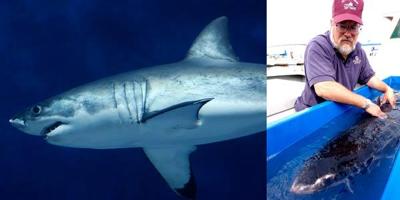
The young white shark worked her way along a low shelf at roughly 120 feet, hoping to catch something by surprise. She’d found food in a similar place and was on high alert for the slightest jolt of movement. Rounding a curve in the deep shoal, schools of mackerel took flight into the inky water above with an electric flurry of muscle.
With a lightning-quick flick of her powerful tail, the young shark launched herself in pursuit—only to find her way blocked by some unseen force. Distressed, she turned to avoid the obstacle and found her snout bumping into a rough but pliable wall at every turn. After a few quick circles she found a pocket in this alien environment where she could swim in tight, unobstructed circles. But there didn’t seem to be any way out. Confused, she swam tense loops, waiting.
The Sandy Bea floated in tranquil seas 20 miles off Huntington Beach. As the day’s first rays began to light the sky a star-dotted cobalt, Nick Guglielmo threw a switch at the stern of his 30-foot Maine lobster boat and watched the hydraulic winch labor to haul a massive gillnet off the ocean floor.
A third-generation commercial fisherman, Guglielmo, 46, had spent much of his adult life in these waters. And Aug. 20, 2004 was a good day to be a fisherman in Southern California. Seas were calm and the pre-dawn air was warm and still.
The Sandy Bea fished lobster for six months out of the year and spent much of the off-season gillnetting for halibut. Most mornings he and his one-man crew were out of San Pedro Harbor by 4am and home by noon. On any given day, the fish could lead them as far north as Malibu and as far south as Oceanside.
Guglielmo’s father and grandfather had been fishermen. But Guglielmo’s son doesn’t have his own boat yet, and the fisheries have been changing. The fish simply aren’t as abundant as they once were. Critics are targeting the practice of gillnetting—mostly because of its careless cousin, the driftnet. As a result, Guglielmo was forced to find other ways to supplement his income.
The whine made it seem the winch was dragging the sun up with the halibut net. It was going to be a spectacular day. The sky was so clear they could see 20 miles in every direction. As the net began to surface, Guglielmo’s attention returned to the water off the Sandy Bea’s stern. This time of year they checked the gillnets every 14 to 18 hours. The nets were designed in such a way that the fish were brought to the surface live. Guglielmo brought the big flat halibut to local sushi bars still flopping.
Guglielmo saw it coming 15 feet from the sea’s glassy surface; at first just a shadowy flash of pale gray and black, then the unmistakable outline of a young white shark. She was pretty small—about five feet—and caught in one of the net’s voluminous pockets. When she broke the surface, Guglielmo let the winch haul her into the boat and then wrestled the struggling shark into the boat’s live fish hold.
A cursory examination of the big fish convinced Guglielmo it was in good health. This one would have a good chance of surviving the ordeal that might lay ahead.
Instead of releasing her, Guglielmo decided to make the call.
~ ~ ~
John O’Sullivan was at home asleep when his phone rang at 6:30am. Hearing that Guglielmo had a young white shark in good condition, the Monterey Bay Aquarium’s curator of field operations leaped out of bed and got on the horn to his field crew of biologists in Ventura.
Within minutes the field crew had Guglielmo’s VHF radio channel and his cell phone number and were steaming south on the aquarium’s 29-foot Cloudburst research vessel, The Lucile, to meet the fishermen. Their rendezvous was a three-million-gallon holding pen anchored off the coast of Malibu.
The timing wasn’t perfect—O’Sullivan had just ended his field rotation. If the shark had been caught a few days earlier he would have been on hand for the transfer. But he wasn’t complaining. His three-year, $1.2 million shark project was a mere 15 days from ending without success, and he was grateful for another shot at bringing a white shark to the Monterey Bay Aquarium.
The idea of housing a white shark had been discussed by aquarium staff ever since the earliest days. The aquarium’s original director of husbandry, David Powell, had worked on Sea World’s unsuccessful bid to bring a white shark into captivity.
In fact, a month before the aquarium’s grand opening in 1984, a 4-foot, 10-inch white shark caught off Bodega Bay was placed in the Monterey Bay Habitats exhibit. The young shark, which weighed around 100 pounds, navigated the 90-foot-long exhibit well but it never fed and died within 10 days, becoming just another casualty in a half-century of botched attempts by aquarists to hold a white shark captive.
To date, the history of efforts to put a white shark on display had been a sad affair, with a high mortality rate and next to nothing learned about the mysterious, feared predators. So when John O’Sullivan’s team of biologists, aquarists and scientists examined 50 years of failed attempts, they were shocked at how little they had to go on.
The scant data that did exist applied to adults or sub-adult specimens but O’Sullivan was targeting a young shark for a number of reasons. A younger shark would be more resilient to the stress of capture, transport and captivity, and would fit in the aquarium’s million-gallon Outer Bay exhibit.
Getting money for the project had been a long shot. First off, this was not a white shark team. Although it consisted of highly regarded staff from Stanford University, the Monterey Bay Aquarium, California State University, Long Beach Sharklab and Southern California Marine Institute, the team’s combined experience with tagging, capturing, transporting and housing a white shark was minimal.
It took O’Sullivan and his colleagues seven months to write the proposal in which they outlined their mission. The team had decided that, first off, the project was going to be “slow, methodical and systematic.” It was clear to O’Sullivan that his predecessors had been too quick to put the shark directly on display after its capture. They suggested transitioning the animal in a huge open-ocean holding pen.
Until recently, the only way proposed to contain a white shark had been to net off a small cove. But the recent advancement of tuna farming had resulted in something called the “tuna pen.” O’Sullivan believed it to be the perfect staging area to relieve some of the initial stress of capture. And when the white shark was captured on Aug. 20, there was one already set up off Malibu.
~ ~ ~
As the sun rose higher in the sky, the Sandy Bea rushed north to meet the crew of marine biologists at the holding pen, while the white shark sloshed around in its hold. It was good fortune that the shark had found Guglielmo’s nets. Of the five commercial fishing boats tapped by O’Sullivan to catch a white shark for the aquarium, the Sandy Bea was the only one large enough to reliably travel all the way to the holding pen at good speed. It saved crucial hours.
Guglielmo also had experience. This was the third white shark that Guglielmo would be sending into captivity. The first one he caught died en route to the Steinhart Aquarium in San Francisco over a decade ago. The second one survived transport to Sea World in San Diego six years ago, but died after 18 days in captivity. Both sharks had been in good condition when he handed them over to aquarium staff.
When the Sandy Bea arrived at the holding pen, Guglielmo and his “crew” helped the field crew and the pen’s handlers measure the shark, weigh it, and tag it. Then Guglielmo put her in himself. With a splash, the shark disappeared to the bottom of the 40-foot-deep pen.
~ ~ ~
As O’Sullivan drove south down Highway 101 on Aug. 21, he checked in with the field crew by cell phone to get updates on the shark’s condition. The field crew reported that they hadn’t seen the shark much since it was put it in the pen. They’d hung salmon steaks in the pen, which had subsequently disappeared off their tag lines, but there was no hard evidence the shark had actually eaten any of them.
The shark had to eat. If the shark didn’t eat they would have to release it. The animal’s well-being came first and foremost. Yet the thought of releasing the shark troubled O’Sullivan. This was the third and final season of funding for the shark project’s field work and if this attempt didn’t meet with some success, the project might fail.
And there was no doubt on whom the responsibility of the project rested. O’Sullivan was the leader of the team. The go-to guy. A cheerful middle-aged marine biologist with a slightly expanding waistline and some thinning hair, an earring in his left lobe gave him a subtle pirate’s bearing. O’Sullivan exuded a relaxed Jimmy Buffet cool, but was under pressure.
This was nothing new. Back in 2002, the project had gotten off to a rough start. The first field season was a learning experience. First off, there was simply no way of knowing exactly where the sharks were. The team knew that the young sharks were pupped by their mothers and moved into Southern California waters as early as May and as late as September. The problem was, the field season was only 28 days long. Knowing nothing about population numbers, let alone pupping and migration, planning for the optimum time was impossible. Finally, they decided on a field season straddling the months of May and June based on advice from the commercial fishermen who had worked these waters for generations.
O’Sullivan and his team also went into this first field season with the idea that they needed to catch their own shark. He wanted to eliminate the stress of the hand-off from fisherman to field crew, and wanted the aquarists to be with the shark from the moment it was caught.
Unfortunately, the waters off Southern California were plagued by unusually cold and cloudy conditions in 2002. Commanding a “circus” of boats, which included a 41-foot boat captained by an experienced commercial shark fisherman, the aquarium’s research vessel The Lucile, and a documentation vessel, O’Sullivan and his team set 10,000 hooks over the course of that first field season without catching a single white shark.
To complicate matters, O’Sullivan had decided that, to minimize transfer time, the crew would tow a five-million-gallon holding pen with a tugboat. But the pen was so large that with a two-knot current, it towed the tug rather than vice versa. The tug and pen began one memorable day caught in a longshore current eight nautical miles away from the team. Eight hours later they were 19 nautical miles away and still running.
Working from Santa Barbara to San Diego, the team kept at it until their field season ended and the tuna pen was shipped back to the tuna fisheries. It had been a very disappointing first year. And although they had no sharks to show for their efforts, they were beginning to understand the tools they needed.
Despite this dismal first season, the aquarium’s senior staff made it clear that the project would remain funded for the next two years. But O’Sullivan could see there wasn’t a sense of great hope. Regardless, he realized that the best tool the team had was the aquarium’s generous financial backing. They couldn’t create good weather or biting fish with money but they might be able to hang in long enough for those conditions to happen naturally.
~ ~ ~
The second season saw some changes and improvements. First off, the team again chartered a holding pen from a tuna fishery, but opted to anchor it in 120 feet of water off the coast of Marina Del Rey to avoid the headache of towing it around. Because of its size, it needed two 1,500-pound anchors and a handler. As a result, the documentation vessel was replaced by the Barbara H, an 85-foot purse seiner captained by David Hawthorne. Hawthorne and his crew remained with the expensive pen and made sure it came to no harm.
Secondly, they realized they needed to develop some type of rapid response team. Over the course of the first season they’d missed the opportunity to tag or capture five sharks due to their inability to quickly reach the commercial fishermen who netted them.
The rapid response team consisted of Dr. Christopher Lowe of the Cal State University Long Beach’s SharkLab and a number of his students. Equipped with cameras, measurement tools, tissue samplers and tags, as well as a fast boat, Lowe and his team could reach any fisherman in the area in 45 minutes.
The aquarium had always relied on commercial fishermen from Eureka to San Diego to bring in specimens for the exhibits. Aquarium staff couldn’t populate the institution’s numerous tanks all by themselves. But O’Sullivan knew the shark project had to walk a fine line to not “create a market” for catching a high profile and protected species.
Furthermore, the aquarium’s relationship with commercial fishermen was a complicated matter. After all, there were people working for the aquarium who would like to see gillnetting shut down. So instead of putting up a reward poster, O’Sullivan handpicked five commercial fishermen from the Ventura and Los Angeles areas based on credibility and trust. He says he felt comfortable compensating the fishermen fairly for their efforts, because, after all, they are a business. And so he offered them fair compensation. But he wanted it clear that the aquarium had not put out a bounty on a young white shark.
Although ocean conditions were considerably warmer and clearer in 2003 than they were the previous season, Southern California experienced one of the most extensive red tides on record. This made inshore fishing more difficult but had the benefit of pushing sharks into deeper waters where fishermen had a better chance of catching them in halibut nets.
Yet the shark project’s fishing vessel continued to have no luck, and as the weeks ground by, morale wavered. The crew was staying in a rented four-bedroom house in Ventura where there were as many as six people at a time. The 16-hour fishing days were depressing. They’d leave the dock at 5am and wouldn’t return until after dark. The routine grew monotonous as they were forced to be spectators, watching the project’s fishermen constantly pulling and checking their gear and changing baits.
As the second 28-day field season drew to a close, O’Sullivan’s heart sank. It was going to be a grim state-of-the-project report he brought back to the aquarium.
Then, five days before the 2003 field season was going to end, they got a call. One of their fishermen had a young white shark on-board and it seemed to be doing well. The shark project team mobilized and met the fishermen in Ventura, where they negotiated the animal onto The Lucile, steamed to the pen, tagged it, and dropped it in.
Two years into the project, the shark team had scored its first major victory. Now they had to force themselves to be patient and let the shark acclimate to the pen. But the clock was ticking. The lease on the holding pen ended after the 28-day field season. The pen had to be shipped back to the tuna fishery without fail. Yet for 73 hours they forced themselves not to interfere with the shark. It was excruciating.
Then, on the fourth day, the team deployed salmon filets into the pen, and within five minutes the shark had attacked the bait from below, breaching the surface like an adult, and fed. The team celebrated. They followed this up by putting a camera in the water. The shark, a female, responded by attacking the camera.
The shark’s feeding behavior was the first positive sign the team had in two years, but the pen’s charter was ending, which meant the shark had to be released. Still, its capture gave new life to the project, as well as the confidence to go into the all-important year three.
~ ~ ~
More than a year later, on September 14, 2004, a team of five vessels, 26 people, three divers, and a semi-truck congregated in Los Angeles to transport the young white shark out of the holding pen, into a transport tank and north to the Monterey Bay Aquarium.
Once again, the shark team found themselves in the familiar position of executing a complicated and potentially disastrous maneuver without precedent. Since no one had ever successfully transported a white shark to captivity, there were no answers for the team. It was one step at a time.
At 4am, the team left their hotel and steamed out to the holding pen off Malibu where the young white shark had been swimming and feeding for the last three weeks since its capture by Nick Guglielmo and the Sandy Bea.
The shark team was anxious to move her. The day before, after 80 days at anchor, a strong long-shore current had dragged the pen’s 1,500-pound anchors 100 yards. Another disaster narrowly diverted. O’Sullivan made a mental note: if we ever get a chance to do this again—more chain, more weight on the anchors.
At least they owned this holding pen and had a contract with the babysitting purse seiner to stay as long as necessary. This year, they’d been able to extend their season a week to ensure safe transit.
This third season had been extended from 28 days to 70 days. That proved to be the clinching factor. The foundation’s faith in O’Sullivan and his team was about to be justified.
The mood was tense at the holding pen. They’d allotted three hours to get the shark out of the pen and back to the truck. Like mountain climbers with turnaround times, if they fell behind their schedule, they would return the shark to the pen and go back to the drawing board.
O’Sullivan went into the pen with scuba gear while the fishing crews from the other boats pursed the bottom of the pen and forced the shark into a smaller pocket. O’Sullivan was trying to track the shark’s progress in the ever-shallower pen when he heard screaming through the hood of his wetsuit. He surfaced and looked up at the boat. Associate Curator Manny Ezcurra had the shark in a dipnet and was hauling it in. Simple as that.
O’Sullivan was in shock. They’d certainly talked about having dipnets on the boat ready if it came to the surface, but it simply didn’t come to the surface much. It was really rare to even see the animal in the pen. On the shark’s third subsurface pass, Ezcurra had just leaned over and scooped the five-foot fish up.
As aquarium veterinarian Dr. Michael Murray later recalled, “I could have opened a Pepsi with my butt.”
The team leapt into high gear around Ezcurra. They gently transferred the white shark into the reservoir—a seven-by-two-foot holding facility on the boat—and immediately began monitoring the animal’s health. They reduced the tank’s water temperature, elevated the oxygen levels to reduce stress and disengaged the PAT tag, which had recorded an account of the shark’s three penned weeks.
When the shark was stabilized, The Lucile shot back to the semi-truck waiting on shore. The whole process had taken 40 minutes. O’Sullivan was optimistic. But the trickiest part was still to come.
When the boat docked, the team hustled the shark into a 3,000-gallon tank in the semi’s trailer, yet instead of rushing north, they waited for 25 minutes, carefully observing the shark’s movements. This was the moment of truth and Dr. Michael Murray was worried. He was unsure how the shark would respond to the tank’s tight confines. Murray watched anxiously as the shark repeatedly bumped its snout on the tank’s walls as it measured the volume of its new confinement by trial and error.
When the shark did a smooth figure eight without touching the walls, Murray breathed a sigh of relief. Satisfied, Murray and O’Sullivan gave the sign to pull out and the truck lumbered north towards Monterey, stopping every hour to check on the shark and consider turning around.
The semi pulled into the aquarium parking lot five and a half hours later, at roughly 6pm.
~ ~ ~
A curtain of bubbles obscured the tank’s giant wall of glass as Manny Ezcurra, Michael Murray and John O’Sullivan oversaw the shark’s introduction into the Outer Bay exhibit.
As soon as the white shark hit the water, Galapagos, scalloped hammerhead and soupfin sharks, 300-pound bluefin tuna, yellowfin tuna, barracuda, and the rest of the exhibit’s open ocean inhabitants (except the eternally nonplussed turtles) dove and hugged the bottom of their million-gallon home, apparently expecting the worst. But when the young white shark ignored them and began exploring its new boundaries, they slowly returned to their normal altitudes and patterns.
This was a good sign. Ezcurra, Murray and O’Sullivan did not want the famed pelagic exhibit to become a white shark tank. O’Sullivan was less concerned with her attacking another shark and more concerned with deciding how long to let her go without eating before they pulled her. Privately, O’Sullivan was thinking four, five days at the most. If she didn’t eat by then, she’d have to be released.
O’Sullivan didn’t have to wait long for an answer. An excited aquarist broke into a press conference on the arrival of the white shark the very next day at 11:30am to announce that the white shark had fed on a meal of wild-caught salmon filets, and a cheer went up. O’Sullivan was flush with the news. To think that the shark would have fed its very first day on exhibit…he couldn’t believe the project’s reversal of fortune. What had seemed doomed to disappointment just a few weeks ago was suddenly exceeding everyone’s wildest expectations.
It was only the second documented instance of a white shark feeding while held at an aquarium. In 1968, a white shark at Manly Marineland Aquarium in Sydney, Australia reportedly ate other fish swimming with it in a multi-species exhibit. That shark was killed by Manly aquarium staff after ten days on exhibit because they feared it was becoming too aggressive toward divers.
O’Sullivan forced himself to temper the jubilation he felt. The shark had only been in the exhibit for a day. Anything could happen. He understood the mortality rates of captive white sharks were sky high and was determined to avoid a tragic end to his Cinderella story.
Ezcurra was concerned with the high density of animals in the Outer Bay exhibit and kept 24-hour surveillance on the shark to make sure the tank remained a community exhibit and not a richly-lain buffet table for the young predator.
The biologists were also interested to see that the long-held belief that rebar or metal in an aquarium’s construction could throw off a white shark’s poorly understood electromagnetic “sixth sense” didn’t seem to be true. The white shark was navigating the Outer Bay exhibit expertly under the metal catwalks and supports.
As weeks went by and the shark appeared to adapt to its new environment, the importance of O’Sullivan and his team’s accomplishment began to be made clear. It was international news and aquarium attendance rates were skyrocketing. But with the media attention came criticism from many corners.
As O’Sullivan points out, the aquarium’s press department was suddenly “forced to grow a spine.” Instead of fielding softball questions about sustainability, conservation and biology, press principles like Rachel Gomez, Randy Kochevar, Karen Jeffries, Mimi Hahn and Ken Peterson spent their days parrying accusations of abuse, exploitation and ethical negligence. As O’Sullivan put it, the burden of keeping the credibility of the aquarium had fallen on their shoulders like a 1,000-pound mola.
After a while, Ezcurra realized they weren’t going to be able to please everybody. What was truly important was that they didn’t lose focus and continued to do what was right for the animal. The worst thing the team could do at this point was to start making decisions as a response to criticism.
Ezcurra saw the criticism as a positive: The fact that so many people were concerned about the aquarium harming the shark signaled a big change from the Jaws-era demonization of white sharks.
As the weeks turned into months and the white shark continued to grow and thrive, the attention, both positive and negative, remained. In late February and early March, when she began exhibiting natural hunting behaviors, the media crescendo reached a fever pitch.
The aquarium labeled the first casualty, a soupfin shark, an accident, optimistically blaming the unfortunate soupfin for “getting in her way.” When the white shark took a second soupfin down shortly thereafter, the aquarium was again hesitant to acknowledge their prize resident was trying to kill and eat her tank mates. But when she began visibly chasing the Galapagos and hammerhead sharks around the exhibit, there was no avoiding the inevitable. The white shark was starting to hunt the smaller sharks. Her days at the aquarium were numbered.
O’Sullivan and his team accepted this bittersweet fact and began making plans for her release. Even before she began exhibiting hunting behaviors, it had been clear she was getting too large for the tank.
As for development of the white shark’s vicious side, Ezcurra couldn’t have been happier. White sharks have no parental care, they’re pupped out and freed. That’s nature and instinct and while he didn’t care to see the soupfins get eaten, he recognized the white shark’s predation as a beautiful thing.
On Mar. 26, five days before the shark was released back into the wild, Nick Guglielmo brought his family up to see the shark he had caught seven months earlier. At the end of the tour Guglielmo and his family gave a donation to the aquarium, an institution that employed people who would see the man’s way of life end. O’Sullivan was tremendously touched by the gesture.
“Each year as we’ve met and talked with these guys. They love the ocean. They come from generations of families who loved the ocean. They’re the last of the cowboys on the water and they have no problems stating their opinions on the subject. We have our differences. But we can work professionally and honestly and still have our differences because we share a respect for the animals and the ocean.”
~ ~ ~
At 4:46am on March 31, the shark project team, dressed in bright yellow aprons, caught the white shark in two hoop nets and placed her in a long, narrow, vinyl-lined fiberglass “shark box.” Upon weighing and measuring her, something they had been unable to do while she was in the exhibit, they discovered she had put on nearly 100 pounds and grown a foot and four inches. This data alone was invaluable to the nascent science of white sharks and would have justified the entire project, but O’Sullivan his team had learned much more over the shark’s record-breaking 198-day stay at the aquarium.
Still, O’Sullivan is quick to point out how much more they still have to learn. “What we knew about white sharks before this project could fit in two thimbles. What we know now could fit in three.”
The team transferred the shark box into a pick-up truck and back to The Lucile, which was waiting at the end of Cannery Row for her valuable passenger. As the sky began to lighten over the Gabilan mountains and the Monterey Peninsula, the team steamed out past the breakwater and its hordes of drowsy sea lions.
A little less than two miles off Point Pinos, the team outfitted the white shark with a 30-day pop-up tag to record her first month of freedom and gently reintroduced her to the ocean.
As the sun began to rise, the white shark made two quick turns beside the boat, as if to say goodbye, then chose a direction and swam off, its iconic dorsal fin disappearing beneath the dark water.
The juvenile white shark slipped into the water and immediately responded to the boundary-less space surrounding her. No more walls. Her navigation system began pinging and instinct kicked in. She dove back into the deep, limitless ocean to look for food.


(0) comments
Welcome to the discussion.
Log In
Keep it Clean. Please avoid obscene, vulgar, lewd, racist or sexually-oriented language.
PLEASE TURN OFF YOUR CAPS LOCK.
Don't Threaten. Threats of harming another person will not be tolerated.
Be Truthful. Don't knowingly lie about anyone or anything.
Be Nice. No racism, sexism or any sort of -ism that is degrading to another person.
Be Proactive. Use the 'Report' link on each comment to let us know of abusive posts.
Share with Us. We'd love to hear eyewitness accounts, the history behind an article.