
Donna Aikins needed an appointment with her doctor to get some questions answered after she had surgery last fall. She was trying to get an appointment in January, around the time Covid-19 was hitting the U.S., which could have complicated her situation but in a twist of fate turned out to be serendipitous. The pandemic spurred local doctors to turn to telehealth – delivering health care from a distance by digital means – and she recently met with her doctor via video.
“It was great,” Aikins says. “We probably had a longer visit face-to-face than I would have had in her office.” The Pacific Grove resident estimates she saved up to two hours, on travel time to and from the Ryan Ranch office in Monterey and in the waiting room.
“We’ve been doing Zoom stuff with our families – it’s been nice to be face-to-face with somebody that way. It wasn’t any big deal to be doing it with the doctor,” says Aikins, who had no reservations about the video appointment with her doctor. She says she would gladly meet virtually again with any doctor when an in-office exam isn’t needed.
Aikins will get that chance, say doctors interviewed by the Weekly. Even with some challenges, overall the response to using telehealth is positive for both patients and doctors. “That’s going to be the real story at the end that will come out of this,” says Mark Carvalho, CEO of Montage Medical Group – telehealth is here to stay.
Montage was already on its way to using more telehealth when Covid-19 struck, and the push to introduce it full time to both staff and patients was fast-tracked. “We are doing twice as many visits by video or telephone as we are face-to-face,” Carvalho says. The medical group started with telephone visits then expanded to include video calls.
Montage also began its eVisit service, where patients fill out an online form and receive a reply later, either within about an hour during office hours or the next morning if submitted during the night. Those with Covid-19 symptoms can use it for free. Those with other ailments are charged $25 for the eVisit, although if they can’t be helped online they aren’t charged.
It wasn’t just the shelter-in-place order triggering the increased use of telehealth, since medical visits are allowed as “essential services.” A couple of forces were at play: keeping people who were sick with respiratory symptoms out of medical offices and clinics; and patients afraid to come in to be seen because they worried they might be exposed to the virus. Doctors say telehealth has been valuable in assessing patients with potential Covid-19 symptoms and either keeping them at home to recover or referring them to respiratory triage tents at local hospitals.
Contributing to the quick move to telehealth was the federal government allowing greater use of telehealth in the wake of the pandemic by allowing use of many online platforms under the Health Insurance Portability and Accountability Act of 1996, or HIPAA. In addition, health insurance companies were allowing for billing of telehealth visits.
At PrimeCare Medical Group, part of Salinas Valley Memorial Healthcare System, the pandemic allowed the group to fast-track the move to telehealth, according to PrimeCare physician Peter Oppenheim. “It’s definitely a game-changer for us,” he says. They’ve been able to keep the doors open, which means staff stay employed, and patients feel safe staying at home.
“You can learn a lot in a video briefing,” Oppenheim says. Even without physically examining the patient, a doctor can see if a patient is struggling to breathe, for example.
Recently, Oppenheim assessed a patient who had been injured a few days prior. Oppenheim took a look at the bruising on the patient’s arms, watched him wave his arms and walk around his home. He says he was able to assure himself and the patient that there were no fractures, just bruises. Any doubts would have prompted Oppenheim to direct the patient to come in to be seen.
It’s also valuable in continuing to assess patients with chronic conditions like high blood pressure, irregular heartbeats, diabetes and others that need ongoing care to keep them out of the hospital in the long term, Oppenheim says. Many patients already have blood pressure cuffs or other medical testing equipment at home, and can report results in a video call.
Older patients who can’t drive could also benefit, although doctors say it’s often those patients who have the greatest challenges using technology. Some don’t have the most up-to-date computers, tablets or phones, which aren’t always compatable with telehealth platforms. Challenges like those, as well as lack of access to the internet, would have to be overcome for some patients.
For the most part, doctors are reporting that patients are liking the new technology, just as Aikins did.
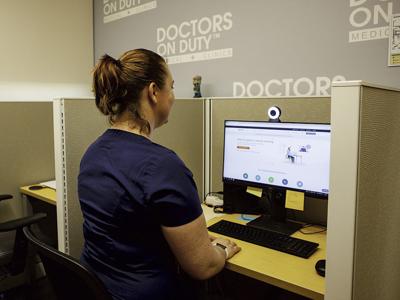
“It’s been really well received,” says Scott Prysi, medical director of Doctors on Duty. There was trepidation at first, but now that its’ been used regularly patients are “pretty much hooked.”
It’s not just larger medical groups, urgent cares and hospitals using telehealth. Cassandra Ohlsen, a solo-practicing internist in Monterey, was able to make the switch to telehealth after the pandemic struck, with the help of her office manager, Marnie Lamas, who donated time outside of office hours researching which platform to use. Ohlsen is now using it successfully on many of her patients with chronic conditions.
“I love being able to see the patient and see their expressions,” she says. And her patients like the convenience: “I think we’ll do more of it in the future.”


(0) comments
Welcome to the discussion.
Log In
Keep it Clean. Please avoid obscene, vulgar, lewd, racist or sexually-oriented language.
PLEASE TURN OFF YOUR CAPS LOCK.
Don't Threaten. Threats of harming another person will not be tolerated.
Be Truthful. Don't knowingly lie about anyone or anything.
Be Nice. No racism, sexism or any sort of -ism that is degrading to another person.
Be Proactive. Use the 'Report' link on each comment to let us know of abusive posts.
Share with Us. We'd love to hear eyewitness accounts, the history behind an article.