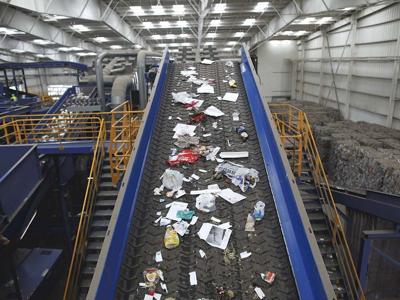

All of those good habits we learned over years – bring your own bag or reusable coffee cup – have gone out the window during the pandemic, in favor of disposable one-time-use goods. It might feel like we’re generating more garbage than pre-pandemic, but waste haulers and landfill operators report an overall reduction during shelter-in-place.
“We’re at about a 10 – to 15-percent decline in year-to-year tonnage overall,” says Tim Flanagan, general manager of Monterey Regional Waste Management District. “That’s generally been the same data reported regionally and nationally.”
There’s been a slight increase in household trash, Flanagan says, but it’s more than offset by the loss from hospitality and special events.
While it’s good news from an environmental standpoint, the challenge for landfillers comes in how they generate revenue – largely through tipping fees collected per volume of garbage. At MRWMD, that translated to a projected reduction of 20 percent, or $4 million-$5 million this year. With that came a 20-percent reduction in workforce; 14 people took an early retirement and 15 were laid off. Most of them work at Last Chance Mercantile, a second-hand store that is closed for the foreseeable future. (Operating the store safely during a pandemic was one challenge; that it runs at a net cost of $1 million per year was another.)
At Salinas Valley Recycles, which serves a region where agriculture rather than hospitality is king, the decrease in revenue was relatively minor, 6 – to 10-percent down in March and April. “Agriculture is an essential business, and didn’t shut down,” General Manager Patrick Mathews notes.
“Maybe this is something we can use to reset.”
Still, given the uncertainty of the economy, they are taking a wait-and-see approach on the budget; hiring is frozen, so a new piece of equipment will sit idle until a team of two can be hired to operate it. It’s a sorting station for construction debris to remove metals and paint from wood that can then be made into wood chips. “That’s low-hanging fruit as far as increasing our organics diversion,” Mathews says. “Wood is on that list of materials we have to divert. We are going to hold off until we are certain the economy and revenue are on track to recover.”
He’s talking about SB 1383, which requires that by 2022, 50 percent of organic waste is diverted from landfills and, by 2025, 75 percent. CalRecycle has not backed off the timeline. (CalRecycle does not have authority to suspend implementation of a state law or its regulations, therefore CalRecycle is unable to back off any timeline, according to a statement provided by CalRecycle.)
Both MRWMD and Salinas Valley are already making progress toward that. In Salinas, a salad de-bagging system came online last year, separating 15,000 tons annually of lettuce – called “green salsa” in industry speak – from plastic bags. “[In the past] it was a worker with a box knife, cutting and emptying hundreds of bags of salad,” Mathews says. “It’s not cost-effective and it’s dangerous.”
At MRWMD, Flanagan is hopeful about the pandemic losses shifting how landfills structure their economics, relying less on tipping fees (his goal is 50 percent) and more on innovation; for example, they’ve inked a deal to sell landfill gas converted to methane to Monterey One Water, located next door. “In a weird way,” he says, “this may be something we can use to reset for the next generation.”
Editor's note: This story has been updated to include a statement from CalRecycle in response to the timeline on SB 1383, noting the agency does not have authority to change the timeline put forth in the legislation.




(0) comments
Welcome to the discussion.
Log In
Keep it Clean. Please avoid obscene, vulgar, lewd, racist or sexually-oriented language.
PLEASE TURN OFF YOUR CAPS LOCK.
Don't Threaten. Threats of harming another person will not be tolerated.
Be Truthful. Don't knowingly lie about anyone or anything.
Be Nice. No racism, sexism or any sort of -ism that is degrading to another person.
Be Proactive. Use the 'Report' link on each comment to let us know of abusive posts.
Share with Us. We'd love to hear eyewitness accounts, the history behind an article.