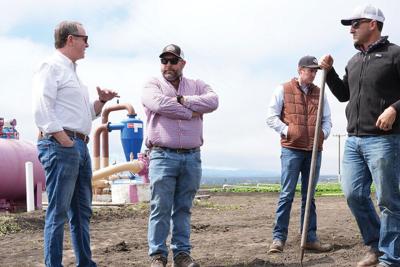

One day after the U.S. Senate passed the reconciliation bill in a “vote-a-rama” – a process that lasted more than 26 hours – a bleary-eyed Senator Adam Schiff visited farms across Salinas and Soledad on Wednesday, July 2, to discuss concerns and needs from the county’s agriculture industry.
“[The bill] makes massive cuts to the Supplemental Nutrition Assistance Program (SNAP) program,” Schiff says. “But it’s also going to mean a lot less demand for agriculture by the federal government.” He adds that the bill will cut back programs that provide fresh produce to schools and food banks, and it “is going to deeply impact mostly small- or mid-sized farms.”
Two days later, on July 4, President Donald Trump signed the reconciliation bill – also known as the “One Big Beautiful Bill” – into law. Local agricultural leaders are still trying to decipher what it means for farmers and farmworkers in Monterey County, as well as what it will mean for the upcoming Farm Bill – a legislative package passed every five years that allocates billions of dollars in federal spending for nutrition, conservation and farm subsidies.
“There are a lot of unanswered questions,” says Norm Groot, executive director of the Monterey County Farm Bureau. “Everyone is, at this point, waiting to see how it all falls out, where those dollars are going to, and what the overall implications are for the agricultural labor force.”
Immigration enforcement is the biggest concern, Groot says. The bill allocates nearly $30 billion to ICE’s enforcement and deportation operations, $45 billion for new immigration detention centers, and over $6 billion to hire new ICE officers through 2029.
While the bill largely supports traditional commodity crops, it does include investments that could bode well for Monterey County farmers. That includes the Specialty Crop Research Initiative, which would increase funding for specialty crop research from $80 million to $175 million in fiscal year 2026. The bill also authorizes $125 million per year from 2026-2030 for the construction, modernization and repair of USDA Agricultural Research Service (ARS) facilities.
However, that support contrasts recent setbacks, including USDA workforce cuts by the Department of Government Efficiency, reductions in grant funding streams, and the termination of leases for nine USDA offices in California. Eight of those closures were rescinded – including the one in Salinas – but the disruption remains fresh for many.
Mark Bolda, a farm adviser for strawberries and caneberries across Monterey and Santa Cruz counties, says ongoing workforce instability has driven away some of their most talented researchers, and made it harder to apply for and execute new research grants.
“Quite frankly, I think the USDA is being looked at as being a poor employer,” he says. “Science is a very slow process. Because of some vacillation, you have all this uncertainty on whether they’ll commit to the [work]. To really get it complete, some of the larger items are going to take five, six years.”


(1) comment
Oh no, farmers will have to start using more tech & machines rather than having slave labor. Ice4life
Welcome to the discussion.
Log In
Keep it Clean. Please avoid obscene, vulgar, lewd, racist or sexually-oriented language.
PLEASE TURN OFF YOUR CAPS LOCK.
Don't Threaten. Threats of harming another person will not be tolerated.
Be Truthful. Don't knowingly lie about anyone or anything.
Be Nice. No racism, sexism or any sort of -ism that is degrading to another person.
Be Proactive. Use the 'Report' link on each comment to let us know of abusive posts.
Share with Us. We'd love to hear eyewitness accounts, the history behind an article.