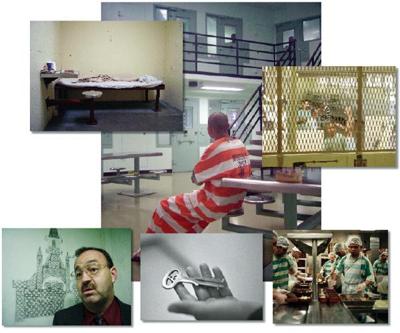
The light is a sickening green. It washes over the stainless steel tables and toilets, the smooth concrete, the flaking paint, the steel bars and expressionless faces of the inmates. Their faces give away nothing, but their eyes are agonized. Their subtle movements—the tapping feet, the bobbing knees, the clenching and unclenching hands, say it’s too goddamn crowded in here—but their faces reveal nothing. Only the eyes betray the anger boiling up inside them.
Many correctional facilities in California have court consent decrees to prevent them from exceeding rated capacities. Not the Monterey County jail. In its current state, the county jail is designed to house 813 inmates. Right now it houses 1,132 inmates. The population is 66.9 percent Hispanic, 20.5 percent Caucasian, 10.5 percent African-American, and 2.1 percent “Other”—mostly Asian. Those numbers stay quite constant.
Females make up 13 percent of the population. They are housed in a separate wing designed for 97 inmates. It currently holds 139.
Gone are the days when the county jail housed low-risk inmates in for minor crimes. Forty to 50 percent of the Monterey County jail’s inmates are gang-affiliated. Twenty three are murder suspects and 30 are attempted murder suspects.
“The kind of inmates we house are far, far more violent than we ever had before,” says Chief Deputy Burt Liebersbach, the wise, implacable man who’s spent nearly all of his 30-year career working for the Monterey County Sheriff’s Corrections division. “That coincides with the escalating violence out on the street.”
When a person gets arrested, the county jail traditionally houses them while they wait to be tried and convicted. If they get a sentence of more than one year they go to prison. Not so long ago, a vast majority of inmates in the county jail were in for minor crimes. Today that trend has been reversed. According to Liebersbach, 65 percent of the county jail’s inmates will go to prison when tried and convicted. To complicate matters, the judicial process has slowed to a crawl. Some of the inmates waiting to be sentenced to long prison terms have been in the county jail for three years.
The overcrowding and the increasingly violent nature of the inmates has created a “very, very hostile work environment” for Liebersbach and his deputies.
To make matters worse, the jail was designed with little practical knowledge and almost no foresight. It’s made up of 27 separate housing units, each tacked to the next in partially-funded bursts of administrative desperation over the last 36 years. As a result, the whole place has a jury-rigged feel, like it’s run on a shoestring. For a brief, scary moment it feels like the only thing keeping the inmates from taking the place over is the implacable confidence of their keepers.
“It’s the Winchester Mystery House of jail construction,” Liebersbach tells me as we wander through its convoluted and disorienting chambers. “We just keep adding on.”
• • •
Jails age at four-and-a-half times the rate of a regular office building. That would make this place well over a century old. It looks it.
The place is unnatural in the worst of ways, a portrait of institutional decay. It is soaked in frustration, despair, and fear, accented by surges of animal violence, tortured by each tick of the clock. Claustrophobic chamber leads to claustrophobic chamber, each sealed from the next by a 200-pound steel door. It’s an ugly equation without an answer. Most of the men and women inside these walls are repeat customers. The Monterey County Jail has an 85 percent return rate.
“You and I have careers—we go to work every day,” Liebersbach says. “They’re criminals for a living. Predators on society. Even with the facility as overcrowded as it is, it’s safer, better for the public to keep them in here. [The overcrowding] increases our liability, but we have responsibility to the safety of the community.”
We are standing in the control hub of the Rehabilitation Center, which is a complete misnomer. There’s very little rehab going on. Just a bunch of stewing. A bunch of stewing and plotting and fidgeting and TV-watching.
Originally built in 1970 to house 250 minimum-security inmates, the center houses over 400 men today. Half of these are un-sentenced medium-security felons. Some are very dangerous men.
The rehab center is laid out like a pie. We stand at its hub, in a command center that affords us an unimpeded 360-degree view into each thick slice, labeled alphabetically from A to G. The inmates in each section wear color-coordinated stripes—red, green, orange, black. Yet all color in this place is tainted by that nauseating green light. Everyone looks jaundiced and sick in here—the inmates, the deputies, my own reflection in the command center’s windows. Although each section was originally designed to house only 50 inmates, some hold many more than that—one houses more than twice that number.
Slice by slice, Liebersbach describes the pie to me. Section A is empty. It houses the rehab center’s administrative offices. Section B houses 72 men. These un-sentenced felons are separated into three tanks. Every two hours each tank rotates out into a small communal area that includes open toilets and showers. Back in the gloomy recesses of the tanks, men sprawl motionlessly on a forest of bunk beds. For the most part, these men ignore us. A few watch a television mounted to the ceiling—“the great pacifier,” Liebersbach calls it. Most stare into space.
Section C houses 114 un-sentenced misdemeanors. It’s packed with double- and triple-bunks. There is very little personal space. You can detect the taut web of tension in there. The men barely move, but you can sense their agitation. The whole place is pregnant with violence. It feels like one wrong move could set off a chain reaction of fists and gnashing teeth.
In comparison, Section D looks downright roomy. It houses only 40 inmates—sentenced Norteño inmates. Years ago Liebersbach and the jail authorities learned to keep Norteños, Sureños and gang drop-outs from each crew segregated from each other. The conflict between Norteños and Sureños street gangs in California is as old as this jail. Liebersbach describes it simply: “Sureños are generally Mexican and Norteños are US-born.” According to Liebersbach, until the 1980s, jail was neutral territory between the rival gangs. That’s changed.
“There was more room back then. Now it’s too tight. Tempers flare. Everyone’s so easily identifiable. The violence has gotten so much more intense.”
Yet there are benefits to gang membership. The Norteños have some room to spread out. Compared to the guys next door, they look downright chill— some even smile and mug for the reporter and photographer. They meet my eyes, they flex and posture and strip off their shirts to show off their ink. When I mention how much more relaxed they look, Liebersbach shrugs. “It’s all comes down to space. Human beings cannot stay sane without it,” he says matter-of-factly.
Section E houses 85 guys held under minimum security. They’re in for drug charges and other non-violent offenses; they’re the kind of guys this place was intended for. Next door, Section F houses the guys on work detail. Proven trustworthy, these inmates perform janitorial or kitchen work, yardwork, landscaping. They collect litter on county roads or do laundry. The barred doors to their tank are wide open and the residents of E and F section wander over to Section G and watch basic cable in the TV/dining room.
There are six deputies in the Rehabilitation Center. The four deputies stationed in the hub watch the tanks with expressions identical to their pent-up charges. They reveal nothing. But at any sign of trouble they are ready to move into these tanks with mace, batons and Tasers at the ready.
“Before we respond, we try to gauge what we should do,” a young deputy tells me, asking not to be identified. “We rarely go in alone. Usually we try to wait for five, six, seven other deputies. Sometimes you just have to jump in, though.”
It’s a brutal, thankless and dangerous job. The deputies work 12-hour shifts and frequently put themselves at risk—a fact that lies at the root of the Monterey County Sheriff Department’s difficulty in hiring new recruits.
Unlike many counties, Monterey requires all new deputies to serve at least a year in the county jail before they transfer out to patrol. To most, that’s a jail sentence.
• • •
It’s no secret that the Monterey County Sheriff’s Office is operating in “survival mode,” as one analyst put it at a budget committee meeting of the Board of Supervisors last month. According to Sheriff Mike Kanalakis, his department will be 29 officers short next year. He admits he has little idea how he’s going to fill the positions.
To date, they’ve gotten by on Herculean amounts of overtime. Last year the Sheriff’s office paid nearly 100,000 hours of overtime—most of which was attributed to the jail. It’s a tremendously wasteful solution.
Last year’s overtime budget was enough to cover the equivalent of nearly 48 full-time employees. The problem is, the Sheriff’s Office can’t seem to attract any candidates. Lower than average pay coupled with sky-high local rent and a one-year sentence in the county jail has effectively driven most prospective officers to greener pastures.
The situation has also driven the demoralized and fatigued deputies to the cracking point. Last June, Kanalakis won the support of the Deputy Sheriff’s Association by a single vote. His opponents in that race, bailiff Vincent Earland and Sgt. Robert Oen, ran campaigns that criticized Kanalakis for ignoring the jail—and the officers who work there. Kanalakis won the race easily, but the election revealed the fragile culture of his embattled department.
As Chief Deputy Liebersbach and I make our way through the jail, the deputies are hesitant to answer questions and do not want their identities revealed.
Liebersbach himself is the exception. He has made a career in corrections. After finishing high school, Liebersbach served as an MP at Fort Ord while he attended Monterey Peninsula College. When he was honorably discharged from the Army, he joined the Monterey County Sheriff’s Office. That was 29 years ago.
No one knows the jail and how it works better than him. Take, for instance, the fact that he has hand-archived every article about the jail from the Salinas Californian since 1978. The walls of his office are covered in historical photos of the jail. His knowledge of its development over the years is encyclopedic.
He’s a calm, congenial man whose intelligence and affability initially conceal the surprising toughness and intensity he’s aquired running a county jail on fumes.
Liebersbach and I stroll through a hallway of bolted windows. This portion of the main jail was constructed in 1977, seven years after the Rehabilitation Center. It is poorly designed and barely adequate. Back in the ’70s, Liebersbach says, the leading philosophy was rehabilitation. Experts were predicting that there would be no need for such jails in the foreseeable future. This same naiveté resulted in the poorly-conceived installation of plastic windows, aluminum window frames and even carpeting. On Jan. 1, 1978 the new jail experienced its first escape—a mass breakout through the windows.
Over the ensuing years, the inmates melted the windows with contraband lighters and matches, worried away the aluminum, and devoured the carpet. Today, the medieval slits which once were windows are covered with steel plates bolted on the outside. It’s all very Count of Monte Cristo. There are no windows anymore. Perhaps it’s a good metaphor for the jail itself—poorly conceived and now barely contained by desperate, blunt force.
• • •
Traversing each section of the jail requires a radio and a ridiculously large key. Without one or the other you’re stuck. It’s the deputies’ primary defense in case of a riot.
As we approach each 200-pound door, it clicks open and we enter. We’re being watched on video by deputies in hidden control centers. But they’re not the only ones watching. Before the huge door can clang shut behind us and we enter the hallway of the men’s section of the main jail, a spotter has seen us and the other inmates already know we’re coming.
“They know this place as well if not better than we do,” Liebersbach says. “It’s their life. They study it.”
The men’s section of the main jail has 80 single cells and 40 double cells. There are 15 cells in each block, eight of which hold double-bunks. Each of these 15 cell blocks has one day room and one bathroom. On the whole, the men’s section was designed to hold 180 inmates. It currently houses 266.
As we approach their block, the inmates peer down from the small windows of their cells. Two inmates sit at a stainless steel table in the day room area enjoying the one hour a day they spend outside their seven-by-10-foot cell.
We approach an empty block and go in. Liebersbach says its inmates are up on the roof getting their exercise—they get three hours a week. In the day room of this block, a deputy is watching two of the trustworthy inmates from the rehab center perform some electrical work. We cross the concrete floor and walk into one of the empty cells. Another deputy is inside systematically searching a tiny, irregular shaped room for contraband.
It’s bad enough to spend 23 hours a day in a seven-by-10-foot room, but more than half of the inmates in this section have to share their 70 square feet with another man. Liebersbach tells me they double-bunk those inmates who’ve proven they can get along with others. Apparently, you’re better off not getting along with anyone.
The cell we’ve entered has only one bed and is profoundly depressing. Someone’s drawn an elaborate castle and a monthly calendar on the wall in pencil. Each day on the calendar has been painstakingly X-ed off. Beside that someone’s written, “This is the place of false hope—except in Christ Jesus.” Below that is a scrawled response: “Bollocks to Jesus.”
A clipping from a high school football game is taped above the bed. The young black man in the article’s photograph is smiling with the confidence and joy of a born winner. All the potential in the world crackles off of him. Next to the clipping are two more photos of the same young man—backstage during a high school drama production and grinning with a pretty young girl at the prom.
The deputy opens a paper bag and dumps the absent inmate’s stuff on the floor. Liebersbach says they have to combat against makeshift weapons. Later, Liebersbach will show me his painstakingly constructed exhibits of contraband: shanks, syringes, a hanger used in a failed escape plot, Old Spice deodorant containers melted down and sharpened into shanks, toothbrush razors, a Bic pen shank, a toilet bowl brush shank, weed pipes, a battery-operated tattoo kit, a club made from a bunkbed’s brace, even rock-hard balls made from compressed flakes of paint.
But Liebersbach’s immediate fears are reserved for hoarded food. Food is a primary concern here in jail and the inmates are constantly trying to stockpile it. Last year, inmate food hoarders were responsible for a terrible outbreak of salmonella. And ants—oh, the ants, he says. They’re unbearable. We leave the ex-high school football star’s jail cell and continue our tour around the circular hallway of the main jail.
At the hub of the men’s section of the main jail is the saddest part of the whole, crumbling institution. Initially designed to be a recreational center, complete with a small stage for jailhouse drama and talent shows, the high-ceilinged rec center now houses the disabled, the old, and the infirm. They lie about on scattered cots or sit in wheelchairs reading Bibles or coughing spasmodically. It looks like a makeshift shelter.
“This jail was designed by someone in Washington, DC who probably had no experience in practical corrections. They had no idea what they were doing,” Liebersbach says with a nod at the concrete stage. “We make do with what we have. We use the space.”
• • •
In 1988, the jail added the K-Pod, a medium-security housing area designed for 64 inmates. As we enter I look up at 120 Hispanic men behind two large, Plexiglass walls. They sit on beds, lounge against the glass, walk in tight circles and talk. We mount a staircase and enter the deputy control room, which guards the residents of K-Pod. Inside the cool, dark tower a deputy monitors video from the Rehabilitation Center and main jail while watching activity in the glass rooms before him.
The inmates stare back at us, unable to see through the tinted glass, but keenly aware of our presence. I ask the deputy a few questions about his relationship with the inmates, but he’s hesitant to speak.
“For the most part there’s no problem,” Liebersbach says. “We’ve got a job to do and they’ve got their job to do. The roles are defined. You spend 12 hours a day here, you get to know them well. Especially since they almost always return. But sometimes they threaten our deputies. We’ve had gang members say things like, ‘We know where your kids go to school.’”
Liebersbach himself has had only one serious problem in all his years at the Monterey County Jail—a former inmate who tried to run him off the road in 1979. He considers it a minor incident, barely worth mentioning.
“When I see former clients of mine in the grocery store or on the street, I don’t let on that I knew them from jail,” Liebersbach says. “They’ve paid their debt to society. As far as I’m concerned they are just citizens now.”
• • •
From K-Pod we tour through the “new” dorms. Compared to the last three realms of misery, the four dorms look like a country club. They’re well-lit, open and spacious. I notice there are a lot more white and black guys incarcerated here. They sit around playing cards, watching television and chatting. In the corner of each dorm, natural light floods in from the attached exercise patio.
Don’t get me wrong—it would still suck to be here, but after the previous Dantean levels of hell, it looks mighty comfy. Yet even these four dorms are over capacity. Built to house 48 inmates each, they currently hold 63 and 71 inmates each. A fifth dorm built the following year was designed to hold 24 inmates and currently houses up to 36.
Strange thing is, there should have been twice as many of these dorms. This new addition was funded under Propositions 86 and 56 in 1990. It was designed to fulfill a 20-year need and it cost $23 million. Unfortunately, in 1992 and ’93, local governments suddenly fell into budget deficits, and the County realized it couldn’t afford to run the new addition once it was built. As a result, only $11.5 million of that $23 million was spent. Four dorms and a new kitchen were completed in 1993. That was the last jail expansion bond Monterey County has seen.
A quick tour of the kitchen shows the amount of energy, money and cooperation it takes to make the jail run on a daily basis. Trustworthy inmates prepare more than 6,000 meals a day, load them on carts and serve them to the jail’s population. I’m amused to find inmates’ dietary restrictions taped to the stainless steel carts.
It’s an immense amount of work. It costs $71.57 to house each inmate per day. That includes the cost of staffing, meals and operation. On our way back through the dorms I wave at some guys playing handball out on the exercise patio on our way out, but they’re too engrossed in their game to notice.
On the far side of the jail we reach isolation—where the worst of the worst are housed. These six cells are windowless and tiny. Inside are relentlessly violent men, lunatics and snitches. For one hour each day, they get out of their cells and pace the ISO Day Room. As we pass, an Asian dude trips out, walking back and forth and rubbing his head. He looks half-mad from terror and despair.
Outside another cell a sign reads, “Extremely Combative. 2 Deputies. Escort with Taser.” When I ask Liebersbach about the occupant I suddenly hear three quick taps followed by three quick taps from inside the cell. The desperate, frenetic rhythm of the communication is unnerving.
“Concrete floors, concrete walls, concrete ceiling,” Liebersbach says. “It’s an echo chamber. He can hear everything we’re saying.”
From isolation we wander through adminstrative offices, an infirmary and then the detox tanks. I glance inside the detox holding cells. Someone’s chewed the rubber off the wall. There’s nothing but a grate in the floor to piss in. Next door, the drunk tank is like a big concrete kiddie pool—all round edges and drains.
“On a weekend night this place is really a zoo,” Liebersbach says. “We can get pretty busy.”
• • •
The women’s section of the main jail is also overcrowded. Yet the occupants don’t exude the same tension and violence as their male counterparts. Despite the different atmosphere, Liebersbach says, violent and gang-related crime is on the rise among women.
As we walk past their cell blocks, the women, mostly in their 20s, watch us with cold expressions. Most of them don’t look like criminals. But I’m just as scared of them as I was of the men.
“We’re seeing more women arrested for assault, armed robbery and other violent gang crimes,” Liebersbach says. “These women will walk into a liquor store with a mask on, rob the place, then let their hair down after they run around the corner. They completely change their appearance. We’re starting to catch on.”
This rise in violent crime among women is just another indicator of a very disturbing trend, Liebersbach tells me.
“The jail didn’t used to be a very violent place,” he says. “We didn’t even go in with weapons.”
He says he recognized a major change after a five-year stint in the Court Services Department, beginning in 1998. When he returned to jail duty in 2003, he was startled by how much more violent it had become in his absence.
“In the early ’90s we had very few incidents of inmate-on-inmate violence,” he says. “Then beginning in 2003 and 2004, suddenly we’d have multiple inmate-on-inmate assaults per month. We could see it was a direct result of gang activity escalating in the community.
“Suddenly the jail just became a very, very dangerous place. We didn’t necessarily have more assaults on staff, but there was more non-compliance with staff rules, regulations and directives.”
This disturbing trend reached a fever pitch when the Norteños rioted on March 15, 2004, in the two open housing units.
Following his return, Liebersbach had ordered his deputies to stifle the gangs’ increasing activities. The Norteños responded by continuing to defy jailhouse bans on gang recruitment and group exercise. The struggle came to a head when the Norteños barricaded themselves into their open housing unit. Fortunately, the standoff concluded with no major injuries to the inmates or staff.
• • •
Last September, a professional consulting firm completed a staffing needs assessment for the Sheriff’s Department and the resulting report was presented to Monterey County’s ad hoc budget committee. At the meeting Kanalakis asked for $5.24 million over the next five years. The budget committee agreed to pass the sheriff’s request to the Board of Supervisors, which will be asked to consider it at a meeting in November or December.
Yet a comprehensive study of the Monterey County jail and its needs has yet to be done. According to Liebersbach, a report will be compiled over the next six to eight months. Nonetheless, Liebersbach believes that building a new jail is only part of the solution.
“We’re at a point that yes, we do need bigger jails. But we need crime prevention, gang prevention, when kids are young. By the time they hit the age of 20 they are already involved,” he says.
Of course, the jail has other methods of minimizing its overcrowding problem, but together they amount to more of a salve than a remedy. For instance, the jail has an early release program, but it is minimal compared to other correctional institutions in California.
“Some other facilities are releasing inmates with anywhere from 30 of 60 percent of their sentence not served. Many inmates in LA County only serve 10 percent of their sentence,” Liebersbach says. “We’re only releasing people five days early.”
According to Liebersbach, those five days save an average of 20.8 beds-worth of space per day. There are also other alternatives to incarceration, such as a work-release program alternative. About 900 non-violent convicts with sentences of 30 days or less have chosen to commute their time behind bars into community service. The probation department also has a home confinement program which serves about 75 to 100.
“[These programs] keep our population down,” Liebersbach says. “But they’re only part of the solution.”
Everyone agrees that Monterey County needs a new, bigger jail, but the fact of the matter is there’s no way to pay for it right now. Local officials have been trying to lobby Sacramento for a state bond to pay for jail and prison construction, but it failed to get on the November ballot.
“If we can’t get a bond issue then it’s going to come down to local government to fund jail expansion,” Liebersbach says. “Everything is competing for the same dollar. The problem is, how does the public decide which is more important, funding the hospital or the jail?
“It’s an impossible question, but one of the bottom lines is that one of public government’s primary responsibilities is public safety, and to keep the inmates locked up we need a facility.”
It’s a grim outlook, made all the worse by the news that the jail’s guiding light will soon hand in his key and radio. After putting in 30 years with the department, Chief Deputy Liebersbach plans to retire at the end of 2007.
Standing out in front of his jail, Liebersbach is matter-of-fact about the crisis. “If things continue this way, the possibility for a riot exists,” he says. When asked if it’s just a matter of time, he just smiles grimly, as though refusing to tempt fate with an answer.


(0) comments
Welcome to the discussion.
Log In
Keep it Clean. Please avoid obscene, vulgar, lewd, racist or sexually-oriented language.
PLEASE TURN OFF YOUR CAPS LOCK.
Don't Threaten. Threats of harming another person will not be tolerated.
Be Truthful. Don't knowingly lie about anyone or anything.
Be Nice. No racism, sexism or any sort of -ism that is degrading to another person.
Be Proactive. Use the 'Report' link on each comment to let us know of abusive posts.
Share with Us. We'd love to hear eyewitness accounts, the history behind an article.