
The opening salvo in the courtroom battle over the public buyout of California American Water rang out across a 24-page civil complaint filed April 5 by the local water management district.
The complaint takes aim at the Feb. 28 decision by the Monterey County Local Agency Formation Commission to deny an application by the Monterey Peninsula Water Management District to become a retail water utility – the consensus first step before making an official offer to buy Cal Am and triggering an eminent domain proceeding. It asks the court to force LAFCO to reconsider the decision and offer guidance to the commission on taking a different path. At its heart, the complaint poses the same question that the water management district and its supporters have long asked: Does it matter that a majority of Peninsula voters voted through 2018’s Measure J to initiate a public buyout of Cal Am?
The 5-2 vote by LAFCO’s governing board in February says no. The board arrived at the vote even as the decision flew in the face of its own staff’s recommendation and a third-party feasibility study, requested by LAFCO’s board, that showed the water management district could feasibly purchase and run the Cal Am system. Commissioners Chris Lopez, Kimbley Craig, Matt Gourley, Pete Poitras and Mary Ann Leffel voted to reject the application; Commissioners Wendy Root Askew and Ian Oglebsy voted to support the application.
Leffel’s vote has pushed her into the throes of an effort to recall her from the Monterey Peninsula Airport District – the agency through which she serves on LAFCO. Leffel, who, the lawsuit notes, helped write the opposition statement to Measure J, says she stands by her vote and it was in support of the districts that would lose property tax revenue if Cal Am’s private assets went into public hands. She claims the issues of property tax revenue loss and the potential impact on satellite Cal Am systems such as Chualar were not studied well enough in the lead up to Measure J.
Through the lawsuit, the water management district will try to prove the vote by LAFCO’s board was arbitrary and capricious and that they failed to weigh substantial evidence. However, LAFCO is a quasi-legislative board, which means they have more latitude in making decisions that set policy, as opposed to a quasi-administrative board, where decisions are more formulaic. This elevates the standard for proving LAFCO’s board miscarried their duties.
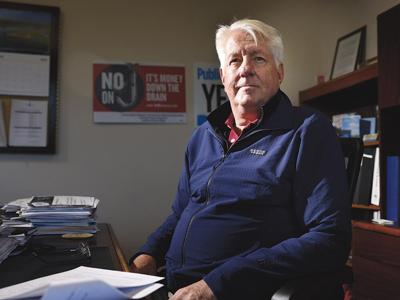
MPWMD General Manager David Stoldt estimates the lawsuit could take between one and two years. After a couple years of relatively rapid movement in the effort to buyout Cal Am, a one-to-two-year lull in the action is a concern for the movement’s momentum and morale, Stoldt says. Stoldt again acknowledged the option to move forward independent of LAFCO’s approval – the water management district, which sells water to Peninsula golf course for irrigation, could argue that it already operates in the capacity as a retail water utility.


(0) comments
Welcome to the discussion.
Log In
Keep it Clean. Please avoid obscene, vulgar, lewd, racist or sexually-oriented language.
PLEASE TURN OFF YOUR CAPS LOCK.
Don't Threaten. Threats of harming another person will not be tolerated.
Be Truthful. Don't knowingly lie about anyone or anything.
Be Nice. No racism, sexism or any sort of -ism that is degrading to another person.
Be Proactive. Use the 'Report' link on each comment to let us know of abusive posts.
Share with Us. We'd love to hear eyewitness accounts, the history behind an article.