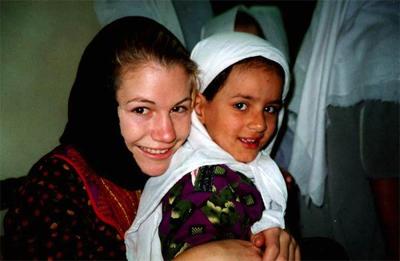
On the afternoon of Saturday, April 16th, Marla Ruzicka sat in her unarmored Mercedes, talking on the phone with her friend Colin McMahon, a reporter in the Baghdad bureau of the Chicago Tribune. She’d had a “great” round of meetings in the Green Zone, she told McMahon, and was just leaving the fortified compound in the hopes of squeezing in one last meeting before the end of the day. The Green Zone, which sits on the west bank of the Tigris River, used to be the heart of Saddam’s empire, and now houses the US Embassy, the Iraqi Parliament and other offices of the new Iraqi government. Outside of the Green Zone, in Baghdad itself, the security situation changes hourly. A route that was safe at noon could be unsafe at 1pm. A neighborhood that was peaceful at dawn could be in flames by lunchtime.
A petite, blond, 28-year-old humanitarian-aid worker from Lakeport, California, Ruzicka knew the volatility of Baghdad as well as anyone. She was virtually the only American aid worker in the Iraqi capital. She was the founder of a small non-governmental organization called CIVIC—the Campaign for Innocent Victims in Conflict—which assisted families whose lives had been ripped apart in the wars in Iraq and Afghanistan.
Passionate and driven, Ruzicka worked seven days a week, 18 hours a day, driving around the city with her Iraqi colleague Faiz Ali Salim. The two spent most of their days compiling data on the number of civilian casualties in Iraq, which Ruzicka then used to lobby American officials to compensate the victims’ families, often arranging for wounded children to be evacuated in order to receive medical treatment in the United States. It was revolutionary work—no other aid group or worker has ever negotiated with the US government on behalf of civilians injured in American military actions—and it was exhausting. Ruzicka, who had begun to demonstrate some of the classic symptoms of post-traumatic stress disorder, was preparing to leave Baghdad the next day for a vacation in Thailand and then a long rest back in the United States. Leaving was difficult. “This place continues to break my heart,” she wrote to a friend in London earlier in the month. “Need to get out of here—but hard!”
Now, talking on the phone with McMahon, Ruzicka sounded upbeat. In the past few days, she had obtained a document that was her grail: a detailed report showing that the US military keeps its own civilian casualty records, something the Pentagon has repeatedly denied.
Ruzicka’s methodology on behalf of Iraq’s war victims often involved a lot of cajoling of high-level brass at Camp Victory, the military headquarters near the Baghdad International Airport. To get there, she had to drive on the notorious airport road, one of the most dangerous thoroughfares in the world. It is a frequent site of suicide bombings, ambushes and other insurgent attacks.
The airport road is banked on both sides by housing complexes, heavily populated by people with military training and access to weapons. There are rules for driving on the airport road, the most important one being: Never get stuck behind a US convoy, which is a suicide bomber’s prime target. But this can be difficult, as security contractors, who drive in convoys of armored SUVs, fly down the highway at 90 mph. McMahon assumed Ruzicka was meeting with some Iraqi victims in Baghdad. But he never asked where she was going, and Ruzicka didn’t offer any information. “I think it’ll be fine,” she told him breezily at the end of their brief phone call. Then she hung up. McMahon went back to work.
The Tribune office was at the Al Hamra hotel, where Ruzicka lived. The Hamra is the major journalist hangout in Baghdad and has an otherworldliness about it that gives some people a false sense of safety. A white, two-tower complex, it has a sweeping outdoor patio and a beautiful pool: long, cerulean blue and clean. On warm nights, journalists ranging from the most senior correspondents of Time to the lowliest stringer can be found doing laps in the pool, or having drinks or dinner on the patio.
Marla Ruzicka was planning to host a party at the Hamra that night. Her all-night bacchanals of salsa dancing and heavy drinking were famous among the overworked, underexcited journalists in Baghdad. The party she’d planned for the night of April 16 promised to be “totally Marla,” as one of her friends told me. The patio would be full, the music would be pumping. Several people might hook up, quite a few would jump in the pool and a lot might pass out—the first one being Marla herself.
It was after eight o’clock when McMahon, still working, saw his colleague James Janega at the Tribune’s office at the Hamra. Janega had been down on the patio, waiting for the party. “It’s pretty boring, just about 10 guys sitting around by the pool,” he told McMahon. Marla, he added, hadn’t shown up yet.
“She’s not here yet?” Ruzicka would never be late to one of her own parties. In the next few hours, there would be frantic phone calls to sources and friends all over Baghdad, but no one had heard from Ruzicka.
“The worst fear was that she’d been kidnapped,” says McMahon. He imagined the pretty aid worker pleading for her life in front of insurgent cameras.
What happened to Marla Ruzicka was no less tragic but far more mundane. At approximately three o’clock in the afternoon, Ruzicka and Faiz were heading east on the airport road, toward Baghdad. Also on the road were a US military convoy and a convoy of private security contractors. From a nearby on-ramp, a suicide bomber merged into the traffic, most likely gunning for the military convoy, which he missed. Instead, he detonated beside his next best choice, the security convoy. Behind them was a Mercedes.
•••
Marla talked in surf-girl lingo—she called everyone, even the most austere US officials, “dude.” She giggled. “When she was happy, she clapped and did a little jump,” recalls her best friend, Catherine Philp, a reporter for the London Times. She was girlish—she used to dot her i’s with little hearts—and a little outlandish: She stood up in the middle of one press conference and told the stern US general giving the briefing that he looked as if he “needed a hug.” Quil Lawrence, a reporter for BBC Radio, once described her as a “love bomb.”
In the days and weeks after Ruzicka’s and Faiz Ali Salim’s death, virtually every reporter who’d met Ruzicka wrote a story about her—making her death headline news on four continents. In Washington, Vermont Sen. Patrick Leahy, a key ally, honored her on the floor of the US Senate, calling her “as close to a living saint as they come.” Six hundred people attended her funeral at the St. Mary’s Catholic Church in the tiny community of Lakeport, California, about three hours north of San Francisco. There were memorial services in New York, Washington, Baghdad, Kabul, San Francisco and cities across the country.
Ruzicka is perhaps the most famous American aid worker to die in any conflict of the past 10 or 20 years. Though a novice in life—she had less than four years of professional humanitarian experience—her death resonated far beyond the tightly knit group who knew her. She stands as a youthful representative of a certain kind of not-yet-lost American idealism, and darkly symbolic of what has gone so tragically wrong in Iraq. And yet trying to understand her is complicated by the fact that so much of her complex life remains a mystery to even those who knew her best. “It was almost like trying to get to know somebody at a performance,” notes Chris Hondros, a Getty Images photographer who knew Ruzicka in both Iraq and Afghanistan. “She always seemed to be playing the role of Marla.”
There is a certain banality to being killed in a suicide bombing; it’s like being blindsided. But there is nothing banal about choosing, against the advice of virtually everyone, to work in one of the most dangerous places in the world. It’s heroic. And it’s an escape.
•••
When she was 17 years old, Marla began frequenting the San Francisco headquarters of Global Exchange, an international human-rights organization, co-founded by Bay Area activist Medea Benjamin, which leads “Reality Tours” through Third World and war-ravaged countries. Ruzicka was fascinated—she had found a community vastly different from conservative Lakeport. Soon, she was spending weekends and vacations in San Francisco, volunteering at Global Exchange and crashing at the home of Benjamin and her husband, Kevin Danaher, who became Ruzicka’s surrogate parents. Benjamin remembers Ruzicka as a “spongelike” teenager, with a passion for human rights and an innate ability to hustle anyone. “She wanted to go on every trip, and for as close to free as possible,” says Benjamin. Pleased with Ruzicka’s work, Benjamin complied.
Ruzicka fell in love with Cuba, whose culture was built around two things she most valued: socialism and having a good time. “She was really in her element there: the music, the salsa, the mojitos,” says Benjamin. When it came time for college, Ruzicka insisted on finding a school where she could travel abroad, ultimately choosing Long Island University’s Friends World program.
During the next four years, Ruzicka studied in Costa Rica, Kenya, Israel, Palestine and Zimbabwe, where she became interested in the plight of AIDS victims. After graduating from LIU in the spring of 1999, Ruzicka intended to return to Zimbabwe, where she’d met and fallen in love with a musician named Phillip Machingura. The two had met on Ruzicka’s 22nd birthday, in December 1998, and had been inseparable. But instead of going to Africa, Ruzicka went back to San Francisco, where she briefly worked for the Rainforest Alliance, and then returned to Global Exchange. Machingura soon joined her in California, and the couple got married.
But Ruzicka was restless in San Francisco, particularly after Sept. 11, 2001. Six weeks after the war in Afghanistan was launched, she accepted Medea Benjamin’s invitation to visit Afghan refugee camps in Peshawar, Pakistan. Benjamin describes it as a highly emotional experience. One little girl, Benjamin recalls, told them that her mother had died in a US air strike, and her father was now mute, leaving her in charge of her brothers and sisters: “We were all devastated, crying. Marla was horrified by what had happened to this girl.”
When Benjamin returned to San Francisco, Ruzicka stayed. “She said, ‘I want to go in.’ And we said, ‘Great, get us some stories of civilian victims,’” says Benjamin. A few days later, as the Taliban fell, Ruzicka hitched a ride over the border to Afghanistan with a group of journalists. She was 24.
For the rest of her life, Marla Ruzicka would refer to Afghanistan as “my favorite place on the planet.” It’s a common sentiment among those who’ve worked there. “There’s never been a place like Afghanistan. It’s a land apart,” says Jon Swain, a veteran correspondent for the London Sunday Times. In November 2001, Afghanistan was a country utterly devastated by war. What Marla Ruzicka saw there would change her life.
Swain took Ruzicka around Jalalabad, where they examined the collateral damage of the US bombing campaign. At a Jalalabad hospital that was receiving many of the wounded from Tora Bora, Ruzicka saw scores of civilians, many of them children, whose limbs had been blown off by US cluster bombs.
After a short trip back to San Francisco, Ruzicka returned to Afghanistan, moved by her experiences in Jalalabad to find out how many civilians had been hurt in the war. She arrived just before Christmas; dressed in a dusty old coat, she made her way to the Mustafa Hotel, the central staging ground for the grizzled, largely all-male crowd of Western journalists in Afghanistan. The Taliban had fallen, and Kabul had begun to enjoy what would later become a full-scale post-apocalyptic renaissance. Armed with a backpack, a few thousand dollars (most of it borrowed from friends and family in San Francisco) and a vague mission to help work on “human rights” issues pertaining to Afghanistan’s civilian victims, Ruzicka was the most untraditional aid worker anyone had ever seen.
To begin with, “she looked about 16,” remembers Pamela Constable, a reporter for the Washington Post. She also acted that way, padding around the Mustafa in pajamas with little cartoon animals on them. She giggled and fawned over the awestruck men who hung all over her, and, given that she had almost no money, often went room to room at the Mustafa, offering back rubs in exchange for a meal or a place on someone’s floor.
In ad-hoc, postwar Afghanistan, Ruzicka had found a perfect mission: No one, including the US military, was counting the number of civilian casualties. It was too time-consuming, often dangerous and, from the military’s perspective, unnecessary. Working with a few Afghan colleagues, Ruzicka went from village to village, and hospital to hospital, interviewing witnesses. She was at times so overwhelmed by their tragedies, she’d empty her pockets to help them. But over time, she honed her technique so effectively that the press started following her. On one memorable occasion, in April 2002, Ruzicka assembled a group of Afghans—“mostly Pashtun tribesmen, some bandaged and limping,” one journalist later wrote—at the gates of the US Embassy, and, with the media in tow, demanded compensation for them. Ruzicka’s demonstration was written up in papers around the world, including the New York Times.
One group Ruzicka was not impressing was Global Exchange, which had given her money to conduct her survey and was waiting for the results. Medea Benjamin says, “We didn’t really know what she was doing.” Benjamin claims that she sent Ruzicka roughly $20,000 to pay Afghan surveyors and cover other expenses (a claim Ruzicka’s friends are skeptical of, given that Ruzicka was always broke), but when the data arrived, in a FedEx package from Kabul, it was weeks overdue and also a mess. “It was a bunch of pieces of paper and some photos, and nothing you could call a comprehensive survey,” says Benjamin.
On Benjamin’s beckoning, Ruzicka returned to San Francisco in early May, depressed, moody and overall “not in a good space,” according to Benjamin. Markedly thinner than she’d been in San Francisco, she told her family it was because of the Afghan food—Ruzicka, a vegetarian, said it was “full of grease.” But Machingura thought something was wrong. “I remember asking her, ‘What’s up with you?’ And she was like, ‘Am I really that thin?’ And I said, ‘You’re Ally McBeal thin.’”
“I could tell she felt like she didn’t really belong in San Francisco anymore,” says Jennifer Abrahamson, who saw Ruzicka shortly after they had both returned from Kabul. She seemed to be having a hard time settling back into ordinary American life, frequently saying how much she wanted to go back to Afghanistan. Drink in hand, Ruzicka told Abrahamson that night that she wanted to start her own organization that could put pressure on the American government to take responsibility for the civilians they hurt in the war. “I thought, ‘Yeah, right, Marla…’” she says.
In the fall of 2002, Ruzicka went to Washington, DC, where she found a natural ally in Sen. Patrick Leahy, a longtime proponent of assisting war victims. “She was like one of those mini-tornados, a dust devil,” Leahy recalls. But she wasn’t a zealot, he adds. “It’s not like this woman was fixed on saving the world. She was fixed on saving individuals. There’s a big difference.”
Ruzicka teamed up with Leahy’s aide on the Senate Appropriations Committee, Tim Rieser, who, like everyone who met her, was baffled at first. “She had no place to live, no organization, no money, and she lost her cell phone every 15 minutes,” he says. “But there was something special about her.” She was the first person Rieser had met in Washington who’d been to Afghanistan and could provide hard facts about civilian casualties. “She’d actually seen what we’d only read about, namely US bombs dropped in the wrong place, which had wiped out whole communities. Marla gave us on-the-ground information about these people and told us that nothing was being done to help them.”
The Pentagon has a somewhat arbitrary policy of compensating civilians, by no mean institutionalized. Ruzicka thought it should be, and during the next several months, she and Rieser met with officials at both the State and Defense departments, hammering out a plan. They came up with a program to provide medical care, home rebuilding, micro-loans and other forms of assistance, which is channeled through USAID. It was the first time the US government had taken responsibility to help those they had specifically harmed. “It never would have happened without Marla,” says Rieser.
Through her experiences in Afghanistan, Ruzicka’s politics, and views toward the war, had changed. Once a dedicated peace activist, she’d decided that war was terrible but in some cases inevitable, even justified. It was a conscious split between her and her mentors at Global Exchange, and her embrace of the people Medea Benjamin calls “the realists” signified a major shift not just in Ruzicka’s political philosophy but in her life as well. For about the past 10 years, Benjamin had been both a mentor and a mother to Ruzicka. But now, the two clashed on their views regarding the upcoming war with Iraq, something that became more apparent when Ruzicka joined Benjamin on a fact-finding tour in Baghdad just prior to the war. “She was working with people in DC who were saying the war is going to happen, let’s help the people who will be hurt,” says Benjamin. “I thought it was a mistake to think like that before civilians were even killed.” Medea urged Ruzicka to return to the activist fold and come back to San Francisco to “join us with all her energy and all her incredible enthusiasm to do whatever we could to stop the war.”
Instead, Ruzicka returned to Washington and watched the war unfold on TV. Then, just after the fall of Saddam, she packed her bags and moved to Baghdad.
“Just a little bit about me,” Ruzicka e-mailed a contact in Washington in August 2003. “I love life. I can be silly. I don’t sleep—trying to learn more. I like to do a million things at once. CIVIC is my life.”
By now, Ruzicka had been working in Baghdad for several months. It was a city abuzz with the postwar rush of aid workers, journalists and reconstruction experts—similar in many ways to what Kabul had been like in 2002. Iraq was exciting, exhilarating. And it was heartbreaking. Rather than hundreds of casualties, as Ruzicka had found in Afghanistan, there were thousands in Iraq. But because the US military didn’t release civilian casualty records, no one knew how many people had been hurt in the war. As she’d done in Afghanistan, Ruzicka dedicated herself to finding out, going door-to-door throughout Baghdad and elsewhere in Iraq, with her colleague Faiz Ali Salim.
Humanitarian-aid work is a passion, not a career path. Ruzicka approached the work with an almost manic dedication. Unable to sleep, she’d be up at dawn and awake at 3 or 4am. Her day-timer was filled with “to do” lists, hundreds of contact names and fund-raising goals—as well as personal buck-up notes, some almost Bridget Jones-like in content (she kept a running tally of the number of cigarettes she smoked per day). Still on a shoestring budget, she bounced from friend to friend, many of whom she’d met in Afghanistan, crashing on their couches at the Hamra or in their spare rooms. Pamela Hess, a reporter for UPI who’d met Ruzicka in Kabul in 2002, bumped into her while swimming in the Hamra pool. “She’d gone from anti-war, almost radical, to a woman who could deal with the US military as a partner in her work,” she says. “I was impressed at how much she had matured in the intervening year.”
On Aug. 19, 2003, the United Nations headquarters in Baghdad was hit in a massive suicide attack, signifying a dramatic shift in the war. Westerners—even those occupying positions of neutrality—were now targets. By the end of the year, most of the Western aid workers in Iraq had pulled out. Ruzicka decided to stay. In the breezy, upbeat notes she’d post to CIVIC’s Web site, she would often begin with a chronicle of Iraq’s escalating danger but conclude with detailed accounts of the week’s work with victims. “Their tragedies are my responsibilities,” she wrote.
But by April 2004, Iraq had become increasingly dangerous for Americans. As the mortar attacks and suicide bombs grew in frequency, those who remained rarely left their fortified compounds. Ruzicka was warned, most likely by an Iraqi friend, to get out of Iraq for awhile. Reluctantly, she agreed, posting a note to her Web site on April 8 declaring her decision to return to Washington “and try to make a home...sort of.” But a few weeks later she was back in Iraq. “I didn’t want the hard work we’d put into motion to stall,” she wrote in her journal. During the next two months, she jetted in and out of Baghdad, ignoring warnings that the situation had become too risky. “Just think of all the work you will be able to do when the situation is better because you were not killed by a bomb,” one friend urged.
Wars have a unique capacity to take you away from yourself. There is something extremely voyeuristic about witnessing other people’s suffering. Ruzicka had a talent for compartmentalizing the tragedies she witnessed, but gradually that compartmentalization began to wear thin. In her journal, she confessed, “I am young, and new at this and developing ways to cope, but in honesty I have tried red wine a little too much for medicine, deprived myself of sleep and felt extremely inadequate.”
By late spring, Ruzicka’s behavior was becoming more and more manic. Still working at a frantic pace, she seemed off-kilter, “a little random,” says her friend Catherine Philp. It was more than just sadness. Swimming, which had once given Ruzicka such solace, had become a two-hour-per-day obsession. She’d often drink until she was sloppy, and then pass out, waking up to “eat everything in the fridge,” as one friend recalls.
Ruzicka had always had a questionable relationship with food. Her high school coaches frequently worried that she wasn’t eating enough protein. By her early 20s, Ruzicka had gotten even more restrictive; meticulously wiping the grease from her food, or drinking protein shakes as a meal.
In the summer of 2004, Ruzicka returned to Lakeport and received treatment for anorexia. She was also diagnosed with bipolar disorder—a condition she shares with her twin brother—and was prescribed lithium. In letters to friends, Ruzicka worried about losing the manic energy that had allowed her to accomplish so much.
Ruzicka started the fall sobered, both by her condition and by Baghdad’s obviously worsening security situation. Rather than returning to Iraq, she spent most of the autumn preparing to move to New York’s East Village, where she found an apartment in November. “She seemed giddy about it,” recalls Philp, who spent a few days with Ruzicka, shopping in SoHo, eating at restaurants in the meatpacking district and watching old episodes of Sex and the City.
To many who saw her during that time, Ruzicka appeared to have turned a corner. She curbed her alcohol intake, went to therapy several times a week and took a variety of medications that made her calmer and helped her gain weight. Now occupying a desk at the Open Society Institute, the George Soros-sponsored foundation that was funding Ruzicka’s work, she spoke frequently of expanding CIVIC’s work to less dangerous conflict zones like Nepal, where she went on a brief research trip in January 2005. Her story was being circulated in Hollywood, and a piece on Nightline had piqued the interest of a New York literary agent. A memoir, co-written by her friend Jennifer Abrahamson, was under way.
And yet Ruzicka felt badly out of place. “It can get lonely here,” she said of New York in a February 2005 letter to a friend. She missed the field, the camaraderie she had in Baghdad—a city she’d lived in for the better part of two years. And she missed the work.
And so, despite her many promises to make a home for herself in New York, Ruzicka began talking more and more about returning to Baghdad. In March, she got her wish: a $10,000 foundation grant to look into allegations of human-rights abuse against women who’d been detained at Abu Ghraib. Elated, she bounced into OSI and announced to her colleague, Robert von Dienes-Oehm, that she was “going home.”
“Where? California?” he asked.
“No, Baggers!” she replied. “I’m going to Baggers!”
“I want to assure you of my safety,” Ruzicka wrote to Aryeh Neier, the president of the Open Society Institute, in an e-mail dated April 11, five days before Ruzicka died. The letter was hardly truthful. Ruzicka had promised friends that she’d restrict her movements to the Hamra compound. But she found that difficult to do.
Arriving in Baghdad in late March, she assured Catherine Philp that the trip would be for only two weeks—solely for the Abu Ghraib project. Thrilled to be back in Baghdad, she came laden with gifts for Philp: French vanilla coffee, Italian cheese, copies of People and The New Yorker. Spotting one of Philp’s Iraqi drivers, Haider, Ruzicka jumped him and kissed him on both cheeks.
During the next few days, Ruzicka and Salim started their research into the abuse allegations pertaining to female detainees. About a week into the research, Ruzicka confided to Philp that she was getting anxious. “She came up to my room at the end of a hard day and we stood on the balcony as the sun was setting and talked about it all. She sensed that many people were lying to her in their interviews, and she didn’t know whether to trust them.”
And so, Ruzicka dropped the project and went off in other, more familiar directions. She began to go into Baghdad to visit families she’d helped the previous year and took on new cases as well: securing compensation for an Iraqi woman who’d lost several family members and arranging for an injured child to be flown, on US aircraft, out of Iraq to a hospital in California.
Ruzicka spoke regularly with her doctor in New York. Still taking medication for the manic-depression, she was also on a new drug that had been prescribed for her eating disorder. “She knew she was fucked up. She didn’t like being ill,” says McMahon. “She was seeing one of the military shrinks in the Green Zone, who was extremely helpful, and she was thrilled that she’d found him. And she’s doing all this while she’s trying to help these families—to me that was so impressive. It was a daily struggle, [but] she got up every morning and got out and helped these people.”
In the first week of April, Ruzicka obtained a detailed US military civilian casualty report. Her source: a high-ranking US general in Baghdad. It was perhaps the biggest achievement of Ruzicka’s career. The number—29 civilians killed in Baghdad from February 28 to April 5—was small. But what it meant was tremendous: It was proof, in her eyes, that despite the Pentagon’s denials, the military did, to some degree, keep track of its actions. Elated, Ruzicka wrote her friend Peter Bergen, a writer and CNN commentator, in Washington. “Dude!...this is huge.” After gushing about the party she was planning that evening—”Now I must go and keep everyone happy”—Ruzicka ended her note, as she almost always did: “I am being very safe.”
If not quite the truth, this statement was motivated by hope. After the January 30 elections, the number of attacks decreased in Baghdad, leading many to believe that the insurgency was on the wane. But in the last week of Ruzicka’s life, the attacks in Baghdad took a sharp spike upward. On April 15, there was a double suicide bombing right in front of the Hamra compound, which scattered body parts all over the street.
Ruzicka spent the day of the 15th with some families she’d helped in 2004. She also talked with Philp, who was in Sri Lanka. In an e-mail she sent later that day, she wrote, “Thank you for being there for me…You all take such good care of me…”
That night, there was a party at the Washington Post house. It was a subdued night, coming on the heels of the suicide bombing that had killed 18 people. Earlier in the day, Ruzicka had let several journalists use her room at the Hamra to take a shower. Now, standing by the pool table with McMahon, the two discussed the worsening insurgency.
“These people are fucking demonic,” said McMahon.
“And can you fucking believe there are people in the USA who call them ‘resistance fighters?’” Ruzicka added.
Then, Ruzicka left the party. “I’ll be right back,” she promised McMahon. But she never returned.
In the past month or so, McMahon has wracked his brain trying to recall more of his last conversation with Ruzicka; probably the last conversation she had with any friend before she was killed. But he can’t remember a thing. “It was just so typical. She was calling me to check in and say hello and let me know that she was going for another interview. She said quickly something like ‘Can’t wait for tonight’…but she was going quickly, as if she had a lot on her mind.
“I remember she did say something about trying for one more interview,” he adds. “The point was things were going pretty well and she wanted to get this one thing done before the day was ended. I remember that, because I thought that it was typical—she’d keep going until the work was through.”
Janet Reitman is a freelance reporter based in New York City. This story first appeared in Rolling Stone magazine.

(0) comments
Welcome to the discussion.
Log In
Keep it Clean. Please avoid obscene, vulgar, lewd, racist or sexually-oriented language.
PLEASE TURN OFF YOUR CAPS LOCK.
Don't Threaten. Threats of harming another person will not be tolerated.
Be Truthful. Don't knowingly lie about anyone or anything.
Be Nice. No racism, sexism or any sort of -ism that is degrading to another person.
Be Proactive. Use the 'Report' link on each comment to let us know of abusive posts.
Share with Us. We'd love to hear eyewitness accounts, the history behind an article.