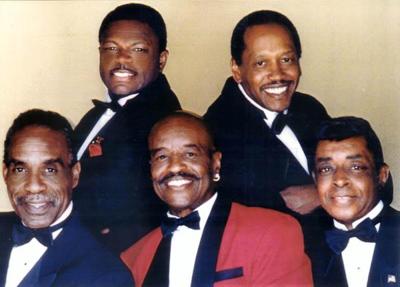
In 1957, at a concert in Columbus, Ohio, Bobby Hendricks’ wildest dreams were realized. After performing in the opening band, the Five Crowns, for the Drifters’ Columbus show, Hendricks was asked to join the Drifters as a second lead vocalist. Being a big Drifters fan since his early teens, Hendricks was ecstatic about his new job.
“I think a little divine intervention had something to do with it,” Hendricks says during a phone interview from his home in Southern California.
By the time Hendricks joined the group, the Drifters were a popular R & B group due to hit songs like “Such a Night,” “Honey Love” and “Money Honey,” which was one of the first rock ‘n’ roll singles. The group had been founded in 1953 by tenor vocalist Clyde McPhatter, who left a year later to pursue a successful solo career.
When Hendricks joined the group as a 19-year-old, he says, he was unaware of the pitfalls of show business. He recalls that guitarist Jimmy Olivier taught him a lot of lessons about performing in clubs.
Eventually, Hendricks and the Drifters went into the studio to record “Moonlight Bay,” “Drip Drop” and “Suddenly a Valley.” According to the singer himself, it didn’t really work out. “It wasn’t really a great session as far as I could see,” he says.
In 1958, Hendricks, who had scored a minor hit with “Itchy Twitchy Feeling,” quit the group with guitarist Jimmy Olivier. After Hendricks exited, the history of the Drifters becomes very convoluted and confusing. Before a 1958 show at the Apollo Theater, all of the remaining members of the Drifters either quit the group or were fired by manager George Treadwell. In an act of desperation, Treadwell hired a Harlem act known as the Crowns, featuring a baritone named Benjamin Earl Nelson, to fill the open slot at the theater. From then on, the Crowns became the new Drifters.
A year later, Nelson, who later changed his name to Ben E. King, recorded “There Goes My Baby,” “Hey Senorita” and “Oh My Love” with the group. Like many other members before him, Nelson left the group in 1960. In 1960, a vocalist named Rudy Lewis joined the Drifters and sang on hits like “Some Kind of Wonderful” and “On Broadway.”
Around this time, Hendricks had joined the group Bill Pinkney and the Original Drifters, put together by the bass vocalist Bill Pinkney.
By the early ‘70s, Hendricks left Pinkney’s group and abandoned music altogether to work for Sears and General Electric. But after a couple of years, Hendricks says, he realized that he missed singing and touring.
Hendricks says that he started his version of the Drifters with Pinkney and Treadwell’s permission, and with this group, he feels liberated by no longer having to emulate the vocal style of the Drifters’ original vocalist Clyde McPhatter. “Now, at my age, I do what I want to do,” he says.
For Hendricks, doing what he wants to do means expanding his performance beyond playing just Drifters’ songs. The vocalist says he sometimes throws songs by Little Richard, The Temptations, and even Elvis Presley into his sets.
Hendricks’ Drifters will be joined by tenor Leon Hughes and his version of the Coasters. The Coasters, the first vocal group inducted into the Rock and Roll Hall of Fame, are known for humorous hits like “Yakety Yak” and “Charlie Brown.”
The Drifters and The Coasters, backed by the Muddy Rivers Revue, play Sly McFly’s, 700 Cannery Row, Monterey, Sunday at 6pm and 9:30pm. $25. 649-8050.


(0) comments
Welcome to the discussion.
Log In
Keep it Clean. Please avoid obscene, vulgar, lewd, racist or sexually-oriented language.
PLEASE TURN OFF YOUR CAPS LOCK.
Don't Threaten. Threats of harming another person will not be tolerated.
Be Truthful. Don't knowingly lie about anyone or anything.
Be Nice. No racism, sexism or any sort of -ism that is degrading to another person.
Be Proactive. Use the 'Report' link on each comment to let us know of abusive posts.
Share with Us. We'd love to hear eyewitness accounts, the history behind an article.