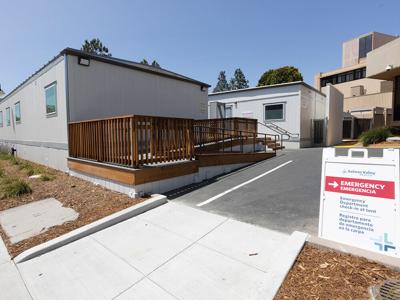

When the Salinas Valley Health Medical Center emergency department was built in 1980, it was designed to handle 15,000 patient visits a year. Today the 17-bed department sees 65,000 visits annually. Doctors, nurses and technicians regularly play a game of Tetris to care for patients within the facility’s constraints.
“When you’re challenged from a geographic or space issue you have to become extremely efficient,” says Dr. Allen Radner, SVH president and CEO.
Anticipating an increase in patients at the start of Covid-19, SVH officials added triage tents outside of the emergency department which worked well – so well, the tents remained after the pandemic subsided. In the meantime, officials weighed how to move away from tents toward a more permanent solution, Radner says. Ultimately that would mean building a whole new facility.
That step would take years and a large amount of capital, so officials debated whether to upgrade the tents or switch to temporary modular buildings until a permanent solution was ready. The decision was made to go modular, but even that process was a lengthy one – about a year – due to strict California Department of Public Health Guidelines.
“It’s a laborious, complicated process to get approval,” Radner says. The cost of the project was over $1.1 million, approved by the SVH board of directors in 2024.
Two modular buildings were finally certified by the state to open last July, and so far it’s working well – doctors, nurses and patients are especially appreciative now that the rainy season is here, Radner says
Leaders of the public health care district are now turning their attention to a $10 million capital campaign through the nonprofit SVH Foundation, with the goal of constructing a $100 million facility of 40 beds or more to replace the current administration building. The plan is to tear down the administration building to make room for the new facility.
In June, the board approved $1.6 million for initial plans by HDR Architecture based in Omaha, Nebraska, with an amount up to $2 million for additional services as needed. The hope is to start the project in early 2027, with a goal of opening in 2030.
“If we could get it open in three years, I’d be pretty happy,” Radner says.


(1) comment
One of the problems of ER facilities is that they are ethically constrained to admit anyone needing service, regardless of insurance status or ability to pay. Many of the visits are from people who would otherwise be turned away from the more proper facility, i.e. Urgent Care facilities, which can turn away if it is not an emergency. Hopefully, we can change that situation, allowing Urgent Care to receive government reimbursement from non-paying clientele, as an urgent care visit is much less costly overall, than an ER visit.
Welcome to the discussion.
Log In
Keep it Clean. Please avoid obscene, vulgar, lewd, racist or sexually-oriented language.
PLEASE TURN OFF YOUR CAPS LOCK.
Don't Threaten. Threats of harming another person will not be tolerated.
Be Truthful. Don't knowingly lie about anyone or anything.
Be Nice. No racism, sexism or any sort of -ism that is degrading to another person.
Be Proactive. Use the 'Report' link on each comment to let us know of abusive posts.
Share with Us. We'd love to hear eyewitness accounts, the history behind an article.