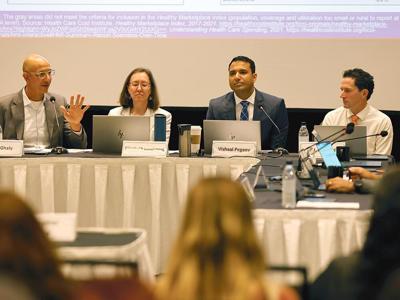

The health care landscape in Monterey County could look different in the next few years, after the state’s Office of Health Care Affordability board voted 5-0 on Tuesday, April 22, to label Community Hospital of the Monterey Peninsula and Salinas Valley Health as high-cost outlier hospitals, requiring them to cap their spending growth at a lower rate than over 400 other hospitals in the state, starting with a 1.8-percent cap in 2026.
While advocates hailed the vote as a step toward lowering health care costs, executives at both hospitals warned before the meeting that the cap, combined with forces beyond their control – labor and material costs, tariffs and uncertainties in Medicare and Medicaid at the federal level – could lead to cuts in care that will limit patient access, as well as a reduction in community programs and other services.
Dr. Mike McDermott, the new CEO of Montage Health, parent company of CHOMP, told the OHCA board the cap will have “catastrophic impacts” on patient care.
In addition to the 1.8-percent cap next year, CHOMP and SVH – along with seven other “high-cost” hospitals in the state determined by OHCA – will face a 1.7-percent cap in 2027 and 2028, landing on 1.6 percent in 2029. All hospitals are currently operating under a cap of 3.5 percent, approved by the OHCA board last year. That rate, which applies to all California hospitals, decreases to 3.2 percent in 2027 and 2028 and 3 percent in 2029.
“We are disappointed by OHCA’s decision to label Salinas Valley Health a high-cost outlier, especially given our long-standing commitment to make health care more affordable and more accessible for everyone in our community,” SVH officials said in a written statement. They called the methodology to determine high-cost hospitals “flawed” and narrowly focused on the hospital, not the entire system that includes clinics subsidized by hospital income.
In his remarks to the board, McDermott said Montage absorbs $35 million in annual losses by operating Montage Medical Group.
One of the main union organizers who has been lobbying OHCA for two years, Steve McDougall of the California Federation of Teachers (also president of the Municipalities, Colleges, Schools Insurance Group, or MCSIG), calls the decision a positive step for working families and employers statewide.
“Bad actor hospital providers shall be outed and held to account moving forward,” he says. “The era of outlier-costing hospitals raiding households’ economic security is coming to an end.”
Former Montage Health CEO Steven Packer, in a letter written just days before he retired last month, said if the board proceeds with “premature, arbitrary and capricious cost caps,” public health programs Montage supports addressing diabetes and overdose prevention would be cut, adding that they would be forced to hold off on hiring two new physicians in dermatology and primary care.
OHCA board member Dr. Richard Pan suggested that public health and social service programs that hospitals take on shifts the burden away from taxpayers and puts it on patients who have commercial insurance. The challenge is for communities to get resources for those services from other entities, including local and state governments, he said.


(0) comments
Welcome to the discussion.
Log In
Keep it Clean. Please avoid obscene, vulgar, lewd, racist or sexually-oriented language.
PLEASE TURN OFF YOUR CAPS LOCK.
Don't Threaten. Threats of harming another person will not be tolerated.
Be Truthful. Don't knowingly lie about anyone or anything.
Be Nice. No racism, sexism or any sort of -ism that is degrading to another person.
Be Proactive. Use the 'Report' link on each comment to let us know of abusive posts.
Share with Us. We'd love to hear eyewitness accounts, the history behind an article.