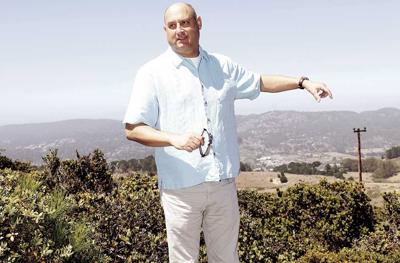

Monterey resident Marty Renault thought the idea of a zipline at Point Lobos Ranch was dead. The concept last came up in 2012, and she was part of a citizens’ group that opposed it then. “And here it crops up again,” she says.
California State Parks and Recreation officials are working on the early stages of a general plan for their Carmel-area properties: Carmel River State Beach and Point Lobos State Natural Reserve, both popular destinations, and Hatton Canyon and Point Lobos Ranch, which have limited to no public access.
On July 22, State Parks held a public workshop at Rancho Cañada Golf Club. Among the options presented across the four parks: a zipline course, a new visitor center, rustic cabins, a science school, the conversion of employee housing to private rentals, a new parking lot and a shuttle service to allow remote parking. Also on the table: re-classifying the east side of Point Lobos State Natural Reserve, Point Lobos Ranch, Carmel River State Beach and Hatton Canyon as state parks.
Some of the ideas drew protest from the 100-plus workshop attendees, including Renault, who feels a zipline would disrupt the peace at Point Lobos Ranch. “Ziplines have their place, but they’re an extreme sport-type thing. People are screaming from the skies,” she says. “It would be fine for the boardwalk in Santa Cruz. It’s not what we want for this area.”
Mat Fuzie, superintendent of State Parks’ Monterey District, says the concept is actually a series of gently sloping aerial trails anchored in cement, with educational hikes in between. Small groups of up to 10 riders at a time would zip over coastal scrub, with views of Carmel Bay. “It wouldn’t just be a one-way thrill ride,” he says. “It’s really interpretation with fun thrown in.”
Augie Louis, president of the Point Lobos Foundation, says his organization is pushing back on a potential new visitor center at the property known as Odello West, and expanded parking on the west side of Highway 1.
“All those things we think are inappropriate,” he says. “We’ve been telling that to State Parks for a long time.”
Louis would like to see new facilities such as parking, a visitor center and bathrooms on the east side of Highway 1 – along with a tunnel or traffic signal for safe highway crossing – to reduce pressure on Point Lobos State Natural Reserve, which draws more than a half-million visitors a year.
“We still want visitors to come to Point Lobos, but we want them to treat it like a reserve,” he says.
Rachel Saunders, director of conservation for Big Sur Land Trust, notes the local community has dedicated a lot of financial support to Carmel-area parklands.
“With that public investment comes an expectation and a promise that there will be well-managed public access,” she says.
Fuzie says the alternatives are designed to draw public feedback on a spectrum of development intensities, from light to heavy. The state plans to present a preferred alternative later this year.
He personally isn’t taking a position, but says the public response has been strongly in favor of a light touch. “Anything that falls under the category of ‘not in my backyard’ has been somewhat of a lightning rod,” he says. “What you’re really seeing in this general plan is a philosophical battle between commercialization and preservation.”


(1) comment
Good to see that people are working to bring public back in parks. Thank you for sharing information with us and I believe some good news is just step away over http://7stepdesign.com/2017/03/30/sat-essay-scores.asp
blog so i ll visit here again for sure thanks..
Welcome to the discussion.
Log In
Keep it Clean. Please avoid obscene, vulgar, lewd, racist or sexually-oriented language.
PLEASE TURN OFF YOUR CAPS LOCK.
Don't Threaten. Threats of harming another person will not be tolerated.
Be Truthful. Don't knowingly lie about anyone or anything.
Be Nice. No racism, sexism or any sort of -ism that is degrading to another person.
Be Proactive. Use the 'Report' link on each comment to let us know of abusive posts.
Share with Us. We'd love to hear eyewitness accounts, the history behind an article.