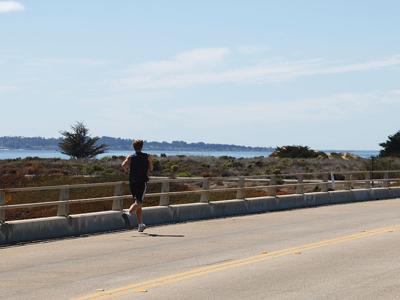

When California voters passed Prop. 20 in 1972, establishing the California Coastal Commission, the message from voters was clear: Protect the environmental health of California’s coast, and preserve the public’s access to it.
So from the outset, ensuring coastal access has been central to the agency’s mission, and nearly every project in the Coastal Zone – the area near the coast where the Coastal Commission has jurisdiction – must have a public access management plan, aka PAMP, that the agency must approve before construction is allowed to begin.
When it comes to Monterey-Salinas Transit’s SURF! busway project, which will pave over the rail tracks from Marina to Sand City to put in an off-highway bus road, a crucial part of MST’s coastal access plan was a bike and pedestrian access path at the 5th Street tunnel under Highway 1 in Marina. The tunnel is where MST’s buses will pass through on their way to and from a new MST transit station under construction at 5th Street and 1st Avenue, just east of the highway. The plan was for that bike-and-pedestrian access point to connect to Beach Range Road in Fort Ord Dunes State Park, just west of the tracks.
The problem is, when MST asked State Parks for permission to build the access point, State Parks – which is currently constructing a campground in the park – said no.
John Hiles, who manages State Parks from Garrapata to Zmudowski State Beach, says the agency wanted to avoid a “redundant trail connection” into Beach Range Road when the campground opens up in a few years. State Parks’ plan is for the tunnel at Divarty Street to the south to be the park’s main entrance, which would serve both vehicles and pedestrians, as well as the 8th Street bridge to the north, which connects to Beach Range Road and the day-use Stillwell parking lot. Hiles says aside from a “redundant” trail connection, the 5th Street path would impact natural and cultural resources, so all in all, “it didn’t check those boxes.”
That leaves MST in a tough position: Its approved project includes a requirement from one state agency for a path that another state agency won’t allow.
In order for construction on SURF! to begin, MST’s plans have changed. Now, as an alternative, MST will be adding a series of improvements to the bridge at 8th Street, adding signage, sharrows and raising the railing heights along the sidewalks to bring them up to code, among other things.
“A lot of this stuff is evolving,” MST General Manager Carl Sedoryk says. “The requests from [jurisdictions] throughout the process, they’re dynamic, they change over time… we are constantly making minor tweaks to the plan.”
Despite the delays, Sedoryk says he’s confident SURF! will be operational by March 31, 2028, the federal deadline MST must meet.
“It would have to be a major natural disaster for us not to meet that deadline,” he says.


(1) comment
Incredible that bus road planners could take this long to realize the Fort Ord Dunes State Park has its own vehicle circulation plan for their new campground. During its Coastal Commission hearing It was testiified that only transit busses would be allowed to travel on the dedicated bus road in order to maintain a tight schedule, now we hear the same tunnel access under Highway One is also a campground entrance? Will the tunnel accommodate these vehicles? Meanwhile, in Marina tree removals and other preliminary work commences even though the revised bus road plan has not even been finalized and has received no final approvals. And what is the real transit necessity of connecting the bus road to the east side of Highway One anyway?
Welcome to the discussion.
Log In
Keep it Clean. Please avoid obscene, vulgar, lewd, racist or sexually-oriented language.
PLEASE TURN OFF YOUR CAPS LOCK.
Don't Threaten. Threats of harming another person will not be tolerated.
Be Truthful. Don't knowingly lie about anyone or anything.
Be Nice. No racism, sexism or any sort of -ism that is degrading to another person.
Be Proactive. Use the 'Report' link on each comment to let us know of abusive posts.
Share with Us. We'd love to hear eyewitness accounts, the history behind an article.