There might be a silver lining to the devastating drought that’s drying out the West: The bone-dry Salinas River is allowing an alphabet soup of permitting agencies to take an extra year developing flood control plans.
And they need the extra time, because the board of Monterey County Water Resources Agency voted 7-0 on Sept. 30 to sink its own plan for Salinas River channel maintenance.
That plan, which cost about $610,000, was an environmental impact report that laid out a map to clear choke-point vegetation from 92 miles of riverbank.
The idea behind the plan is relatively simple: An overgrown riverbed could mean dire flooding next time it rains hard and continuously.
The controversial part is deciding how to control that flood risk. Does it mean bulldozing swaths of vegetation to make way for a cascading river? Or restoring a more natural-looking, meandering river? The vetoed EIR would have allowed for unlimited removal of non-native plants and 845 acres of native vegetation.
Stakeholders from the environmental conservation and agricultural communities agreed the September plan was no good. Enviros said it would’ve wreaked havoc on important habitat; growers and property owners along the Salinas River worried it wouldn’t control flood risk.
The MCWRA’s unanimous rejection left a space for other groups to try and find a resolution.
One is a working group of about 15 growers led by The Nature Conservancy, which has been quietly meeting regularly over the past four months to look for a possible solution that works for everyone.
To start, Jennifer Biringer, TNC’s senior director of the Central Coast, decided to revisit basic assumptions about the Salinas River. TNC developed a more sophisticated model than the Water Resources Agency used, which provided more precise intel on what might happen during big rains.
“Basically, we tried to understand how the river’s working, and how helpful it is to remove vegetation,” Biringer says. “It reduced the depth of flooding to some extent, but not the horizontal flooding, so it really doesn’t save many acres.”
The model showed the old practice of bulldozing riverbanks, to smooth them out and get a rushing river to move more swiftly past farm fields, does just that – it can increase the speed of water, actually worsening flooding downstream. The group expects to propose a plan for strategic vegetation removal later this spring.
Meanwhile, the Central Coast Regional Water Quality Control Board is hosting a March 6 workshop in Salinas to bring together various stakeholders.
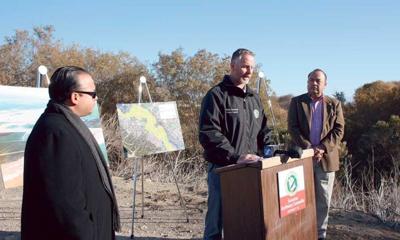
And state lawmakers have also been dipping their toes into the issue; in December, State Sen. Anthony Cannella, R-Ceres, held a news conference under a Highway 68 overpass to announce his plan for a legislative fix. There’s still no specific language, but aides say Cannella expects to formally introduce a bill this week. He pitched a bill that would allow faster permits for growers at chokepoints.
“It’s clear that vegetation removal by itself is not a silver bullet,” Biringer says. “It’s not going to solve the problem of flooding on the Salinas.”


(0) comments
Welcome to the discussion.
Log In
Keep it Clean. Please avoid obscene, vulgar, lewd, racist or sexually-oriented language.
PLEASE TURN OFF YOUR CAPS LOCK.
Don't Threaten. Threats of harming another person will not be tolerated.
Be Truthful. Don't knowingly lie about anyone or anything.
Be Nice. No racism, sexism or any sort of -ism that is degrading to another person.
Be Proactive. Use the 'Report' link on each comment to let us know of abusive posts.
Share with Us. We'd love to hear eyewitness accounts, the history behind an article.