They make bathtubs cleaner, dishes shinier and hair silkier. But water softening systems could be bad news for the limited water supply in Monterey County. And a state bill originally intended to green-light municipal bans on softening systems has been so watered down by industry that local regulators can’t take action.
Last year, California American Water reported an average calcium carbonate level of 173 parts per million in the Monterey service area. Water that hard deposits mineral scale in pipes, leaves scum on dishes and dulls laundry. Softeners solve those household nuisances by swapping the water’s calcium and magnesium ions for sodium.
A 2009 L.A. Times article estimates 10 percent of California households have softeners; Monterey Regional Water Pollution Control Agency spokeswoman Karen Harris says the local rate was once about 25 percent.
When softener salt discharges into sanitary sewers, it makes water treatment more difficult. Flushed into septic tanks, it adds salinity to aquifers already threatened by seawater intrusion. Used to irrigate, it compacts soil and stresses vegetation.
Arlos Anderson of Aptos-based Blue Lotus Water Technologies says softeners are particularly damaging in Santa Cruz and Monterey counties, where droughts and pumping restrictions make every drop precious. “With as few resources as we have, we cannot afford to sacrifice additional water for softening,” he says. “Everybody knows the Culligan man, but unfortunately most people’s understanding of water problems is pretty primitive.”
The industry is fighting efforts at tighter regulation. In 2008, then-Gov. Arnold Schwarzenegger vetoed Assembly Bill 2270, co-authored by then-Central Coast Assemblyman John Laird, which would have made it easier for municipalities to ban residential water softeners. In 2009 the bill returned as the narrower AB 1366, requiring regional water board action for local bans. Schwarzenegger signed it.
Pacific Water Quality Association is at the forefront of the industry lobby. “Banning something is not the answer,” says PWQA board member Clifford Fasnacht, president of Salinas-based Pacific Purification. “It decimates the local water treatment base.”
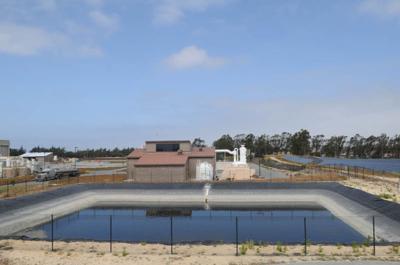
MRWPCA is expanding its facilities with the ultimate goal of zero discharge into Monterey Bay. Eventually, the agency hopes to return all its treated wastewater to ag fields, where salinity is problematic, and to aquifers.
But Harris says the agency can’t consider a softener ban unless the regional water board finds a discharge permit violation. The current permit places no limit on salts, so there’s no threat of violation – and MRWPCA can’t restrict water softeners.
Instead, Harris encourages residents to consider whether they really need one. Vinegar dissolves tub scale and brightens laundry; Lemi Shine cuts dish scum; faucet filters remove minerals.
For people determined to buy salt-based softeners, Harris recommends exchange services like Culligan, which hauls the brine from its Salinas regeneration facility to an MRWPCA holding tank, where it’s diluted before being discharged into the bay. Potassium chloride refills are eco-friendlier (but more expensive) than sodium chloride ones.
Fasnacht says his industry is evolving quickly – but struggling with big-box competitors and a down economy. If Monterey County’s roughly half-dozen water softener dealers go out of business, he says, we lose the expertise to transition to more efficient, lower-salt technologies. “The days of selling water softeners with salt to supply it are pretty much gone,” he says.



(0) comments
Welcome to the discussion.
Log In
Keep it Clean. Please avoid obscene, vulgar, lewd, racist or sexually-oriented language.
PLEASE TURN OFF YOUR CAPS LOCK.
Don't Threaten. Threats of harming another person will not be tolerated.
Be Truthful. Don't knowingly lie about anyone or anything.
Be Nice. No racism, sexism or any sort of -ism that is degrading to another person.
Be Proactive. Use the 'Report' link on each comment to let us know of abusive posts.
Share with Us. We'd love to hear eyewitness accounts, the history behind an article.