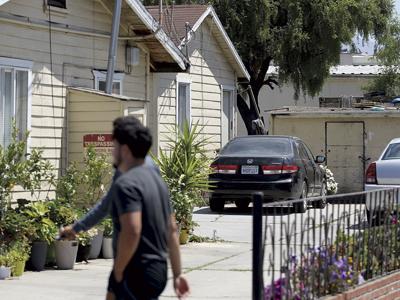

A 911 call on Friday, July 16 took a tragic turn. Salinas Police responded to a report of a man pointing a gun at the neighbors. That man was Gerardo Martinez, a 19-year-old, who was shot and killed by police in the doorway of his home on Smith Street.
Three days later, the Monterey County District Attorney’s Office released some information surrounding the shooting, including drone video footage showing Martinez’s last minutes: He was holding a realistic-looking gun, and pointed it toward people. Later on, it was confirmed to be a BB gun.
A week after the shooting, on Saturday, July 24, people carried signs and flowers and marched from La Paz Park to the Salinas Police Department headquarters asking for justice for Martinez and better de-escalation techniques. Martinez’s family and neighbors said he was fluent in Zapotec, an indigenous Mexican language, and spoke little Spanish.
Four days after the march, Salinas Police made their first public remarks about the shooting during a July 28 meeting of the city’s Police Community Advisory Committee. Assistant Chief Roberto Filice told commissioners Martinez was a fluent Spanish speaker, and they had video from February to prove it: “We have video depicting Mr. Martinez speaking to one of our officers in fluent Spanish.”
Filice said it was unfair his officers had been depicted as careless for not getting a translator when they confronted Martinez. He added it is impossible for his officers to learn multiple indigenous languages. According to the National Institute of Indigenous Languages, there are 68 indigenous languages in Mexico and Zapotec has over 60 variants. When police face a language barrier, Filice said they use technology such as translating apps to identify the language, or they get translators on the phone. The Weekly has filed a California Public Records Act request seeking the video footage Filice described, and a response is pending.
“I am satisfied that my officer did everything that he was supposed to do,” Filice told commissioners.
In an interview, he adds that there was more than language at play: “I really wish people [would] just put their guns away and then deal with the police in a normal way,” says. “When somebody points a gun [at] you, you don’t have much choice.”
But Cesar Lara, director of policy and programs at MILPA, a Salinas-based social justice organization, says the language issue is missing the bigger point. “Communities of color, not just in Salinas, but across the nation, have a negative relationship with the police.”
Aside from possible language barriers, Lara says police respond to incidents that should be addressed by counselors or social and mental health workers.
Following Martinez’s death, Filice met with Alejandra María Gabriela Bologna Zubikarai, consul general of Mexico in San Jose, and reached out to LULAC. He says they are working on an educational community program so residents in Salinas know how to interact with the police.
But MILPA leaders say the answer isn’t to train people how to react around police officers. “It’s more of a question of the police needing to change the way they do business,” Lara says.



(0) comments
Welcome to the discussion.
Log In
Keep it Clean. Please avoid obscene, vulgar, lewd, racist or sexually-oriented language.
PLEASE TURN OFF YOUR CAPS LOCK.
Don't Threaten. Threats of harming another person will not be tolerated.
Be Truthful. Don't knowingly lie about anyone or anything.
Be Nice. No racism, sexism or any sort of -ism that is degrading to another person.
Be Proactive. Use the 'Report' link on each comment to let us know of abusive posts.
Share with Us. We'd love to hear eyewitness accounts, the history behind an article.