
First came the legalization of medical marijuana dispensaries, cultivation, manufacturing and delivery services in Salinas. Now comes another thorny question: How much will these businesses be taxed?
Salinas residents will have a chance to cast their vote on a marijuana business tax in the Nov. 8 general election. For cultivators, the city proposed a rate of $15 per square foot for plant canopy, or square footage, for the first three years, with a cap at $25 per square foot.
Other business models (delivery, dispensary and manufacturing services) are looking at a 5-percent tax for the first three years, with a ceiling of 10 percent, of their total gross revenue. The tax revenue, up to $2 million annually, would go into the city’s general fund.
“We looked at what other jurisdictions are currently taxing these businesses across the state, trying to be as consistent as possible,” City Attorney Chris Callihan says.
While the tax measure will be left to voters, the city’s process of choosing which businesses get medical cannabis permits is already in motion.
The application period ended July 6, with a total of 24 applications submitted by 14 businesses. There were eight requests each for dispensaries and cultivation, four for manufacturing and four for delivery services. The city will weed out which businesses to give a total of 12 permits (three for each business model). Callihan expects permits will be granted by this fall.
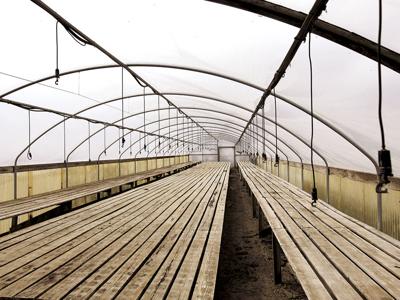
Some applicants are concerned about the looming tax decision. Mike Hackett’s River View Farms applied for a permit to grow marijuana in a greenhouse and open a dispensary. He wishes the proposed tax would’ve set different rates for greenhouses and warehouses, lit by sun or electricity, because growers produce more with electric light.
“There is a huge difference,” he says. “You shouldn’t have the same tax base for the two.”
Del Rey Oaks City Manager Daniel Dawson, who paved the way for Monterey County’s first medical marijuana dispensary – Monterey Bay Alternative Medicine in Del Rey Oaks – has applied to bring a new Monterey Bay Alternative Medicine to Salinas.
Dawson, an unpaid board member of MBAM in Salinas, says he’s helping the nonprofit “navigate the onerous application process.”
Grant Palmer, director of Santa Cruz-based Canna Cruz, Inc., applied for a permit to open a dispensary in Salinas. He says a 10-percent tax could be a “little debilitating.” His business is heavy on medicinal research – something Salinas is pushing – and says a bill for lab tests can reach up to $10,000 a month. A heavy tax, he says, could chip away from those efforts.
“We will respect the people’s wishes, but it would be rough if you’re being taxed 10 percent,” he adds.
While Palmer hopes to operate a dispensary in Salinas, he is also looking to grow cannabis in the unincorporated county. “The tax proposed for unincorporated areas is an affordable tax – it’s reasonable [for cultivation],” he says.
Monterey County voters (beyond Salinas city limits) will also decide on a cannabis tax in November. On July 19, the County Board of Supervisors approved a ballot measure calling for an annual tax of $15 to $25 per square foot of canopy space, that could generate an estimated $30 million a year.



(2) comments
First the throw people in jail and destroy families now they wanna tax people to death. I'm loosing faith in our "democratic" process. It all looks like the mafia.
It's a combination of ignorance, greed, and short sightedness. If it's over taxed or over regulated then the price will remain high and the black market will continue to flourish. The upside is that other agricultural counties in California will want to compete for the jobs and revenues for their residents and local coffers. Monterey will be left in the dust as Tulare, Kern, SLO, Mendocino, ... will allow unlimited outdoor growing. The trend is towards mass production for oil extraction used in edibles and vaporizers prefered my most non-smokers. If adult recreational use passes and the over 30 year old and baby boomer groups rediscover the benefits this will further move the demand toward edibles, oil, and thus outdoor farming, e.g. field corn, tomatoes, soybeans. Monterey County needs to think long term of they want a piece of the action.
Welcome to the discussion.
Log In
Keep it Clean. Please avoid obscene, vulgar, lewd, racist or sexually-oriented language.
PLEASE TURN OFF YOUR CAPS LOCK.
Don't Threaten. Threats of harming another person will not be tolerated.
Be Truthful. Don't knowingly lie about anyone or anything.
Be Nice. No racism, sexism or any sort of -ism that is degrading to another person.
Be Proactive. Use the 'Report' link on each comment to let us know of abusive posts.
Share with Us. We'd love to hear eyewitness accounts, the history behind an article.