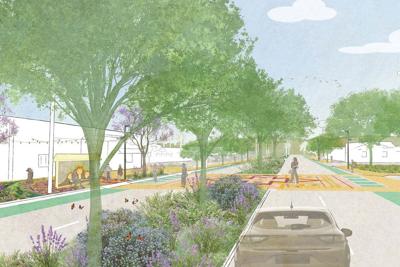

Salinas City Council voted 6-0 to approve a new subdivision map on Tuesday, Aug. 6, and was met with applause. The project, part of the Central Area Specific Plan (CASP), is the first major subdivision to be approved in the city in some 25 years.
Stonebridge Homes, the same developer behind Creekbridge, will subdivide 189 acres north of Boronda Road into 437 parcels. Of those, 10 will be for parks or open space. The other 427 are slated to become 1,674 units of housing; about one-third will be single-family homes while the majority will be condos and apartments; 335 units will be deed-restricted as affordable.
“This is a long time in the making, 18 years’ worth of work to get to this stage,” said Hugh Walker, vice president of Stonebridge. He expects the new neighborhood to mitigate the housing crunch: “The more we can put supply out there, the more competitive it becomes – it’s pretty simple economics.”
The subdivision is just one piece of CASP, a concept approved in 2020. Along with West Area Specific Plan (approved in 2019) and the East Area Specific Plan – now in the making, with a community open house scheduled for 6-7:30pm on Thursday, Aug. 15 at the Cesar Chavez Library – these North Salinas planning areas comprise an area intended for future growth. The subdivision map is a final bow on top of past planning and analysis.
In a rare show of solidarity, the project received an endorsement not just from the developer and unanimous support from City Council, but also from environmental watchdogs like LandWatch and housing advocates. “This is what we’re about – housing for everybody,” said Xago Juarez of the Salinas Housing Justice Coalition.
Back in 2020, Stonebridge agreed to build inclusionary units rather than pay in-lieu fees, and to exceed the city’s required construction timeline – it has committed to obtain one permit for affordable housing per every six market-rate units, instead of waiting until later in the development process.
That timeline in particular earned praise. “I think this development is a real strong example of how you can bring the community into the decision-making process,” Councilmember Anthony Rocha said.
As Salinas moves forward with plans for future growth to its north, officials are also continuing to look at applying urban planning principles to existing neighborhoods. On Wednesday, Aug. 7 (after the Weekly’s deadline) the Planning Commission was set to vote on the Alisal District Identity Master Plan, which establishes design guidelines based on the Alisal Vibrancy Plan, adopted in 2019, for a neighborhood that was annexed back in 1963.
The plan covers things like streetscape improvements, public art and tree canopy. It calls for widening sidewalks to enable outdoor dining on commercial strips like East Market and East Alisal streets. It also calls for a program to help business owners improve signage and facades, something the plan argues would “help improve the perception of Alisal’s business corridors and revitalize the district.”


(2) comments
Bring back gated communities! People want to live in seclusion, away from riff raff.
This is wonderful news. Not only do we need the additional housing, it will serve to help modernize Salinas. Many of the areas of The Alisal (as we called it before it was annexed to Salinas) also can and should be modernized. When I was doing housing construction in one of the last areas of South Salinas for such, we knew that Blanco Road should remain the South border of Salinas, while we moved northwards for expansion. It's about time we resumed this trek.
Welcome to the discussion.
Log In
Keep it Clean. Please avoid obscene, vulgar, lewd, racist or sexually-oriented language.
PLEASE TURN OFF YOUR CAPS LOCK.
Don't Threaten. Threats of harming another person will not be tolerated.
Be Truthful. Don't knowingly lie about anyone or anything.
Be Nice. No racism, sexism or any sort of -ism that is degrading to another person.
Be Proactive. Use the 'Report' link on each comment to let us know of abusive posts.
Share with Us. We'd love to hear eyewitness accounts, the history behind an article.