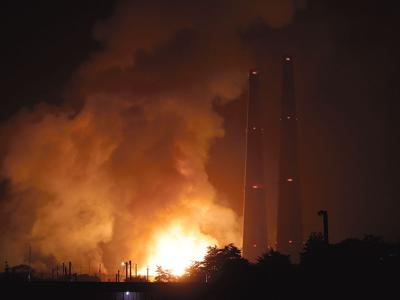

Questions continue to emerge after a fire broke out on Thursday, Jan. 16 at the Vistra battery plant in Moss Landing, and not just about how the fire started, or what kind of pollutants it put into the environment, but about whether such battery plants can operate with a guarantee of safety to local residents.
Officials issued an evacuation order to nearby communities lasting about 24 hours, and Highway 1 in Moss Landing remained closed until 5pm Sunday, three days after the fire began.
County officials have been providing regular updates to the public, with near-daily press conferences.
On Saturday afternoon outside the Power Plant cafe in Moss Landing, officials from the County of Monterey, Vistra and the U.S. Environmental Protection Agency addressed the media and public. At the time, the fire was still burning, as lithium ion battery fires can’t be extinguished with water, so firefighters can only just watch and monitor the situation until it burns itself out. (Remaining batteries in the facility began combusting around noon on Friday, generating more flames and smoke.)
There have been two previous incidents at the Vistra plant in the past four years, but in those cases, the water suppression systems worked as intended to cool overheating batteries before they burst into flames; in 2022, there was a fire at the adjacent PG&E battery plant. That fire did not spread like this one did.
“Safety is Vistra’s top priority,” Vistra spokesperson Brad Watson said. “We’re focused on the safety of the people who live around the plant, and we’re sorry they’ve had their lives impacted.”
The Texas-based company spent about $1 billion on the facility.
“This is the future. We want it to be safe.”
County Supervisor Glenn Church, who represents District 2 which includes Moss Landing, said, “This is the future. We want it to be safe, we want it to be secure, we want it to be effective.”
Church joined Assemblymember Dawn Addis, D-Morro Bay, in requesting the plant remain offline until, Addis said in a press conference on Jan. 17, it’s “guaranteed as safe.”
The primary, most dangerous pollutant created by lithium ion battery fires is hydrogen flouride, or HF, which is an acidic gas. Olivia Trombadore of the EPA said that starting late Thursday, EPA’s response included setting up nine specialized air monitoring stations, two inside the plant property and seven around it. None of them showed levels of HF that pose harm to the public, she says, with the exception of the two inside the plant.
In response to the fire, a group of local residents formed the Moss Landing Community Response Group, which held its first meeting at the Prunedale Grange Hall on Monday, Jan. 20, four days after the fire began. Church spoke to the packed room near the start of the meeting, saying, “What’s happened here in the last four days should never have happened at all, and it can’t happen again.” He called on the community to unite.
“This is going to be a real David and Goliath battle,” he said. “We need new and effective regulations. All building should be paused.”
Also on Jan. 20, the law firm Singleton Schreiber met virtually with area residents to talk about potential litigation.


(0) comments
Welcome to the discussion.
Log In
Keep it Clean. Please avoid obscene, vulgar, lewd, racist or sexually-oriented language.
PLEASE TURN OFF YOUR CAPS LOCK.
Don't Threaten. Threats of harming another person will not be tolerated.
Be Truthful. Don't knowingly lie about anyone or anything.
Be Nice. No racism, sexism or any sort of -ism that is degrading to another person.
Be Proactive. Use the 'Report' link on each comment to let us know of abusive posts.
Share with Us. We'd love to hear eyewitness accounts, the history behind an article.