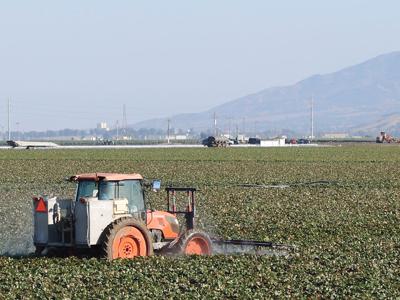

The “miracle” class of chemicals known as PFAS (polyfluoroalkyl substances) can do it all – famous for making pans nonstick, clothing water-resistant and carpets stain-resistant. PFAS are prolific, used in everything from deodorant and dental floss to agriculture, yet their special chemical structure is so strong it does not break down in the environment. They have been linked to cancer, found contaminating waterways and bioaccumulating in the food chain.
A report conducted by the Environmental Working Group (EWG), a nonprofit environmental group, found that 2.5 million pounds of PFAS pesticides are spread annually on California farmland. Of that total, 551,108 pounds were used on crops in Monterey County between 2018 and 2023, where the highest traces were found on wine grapes (116,499 pounds), strawberries (99,972 pounds) and leaf lettuce (76,248 pounds).
“A lot of farmers, I don’t think they know that’s what they’re spraying on their crops,” says Bernadette Del Chiaro, EWG senior vice president. “The EPA doesn’t label them as PFAS.”
Almost 40 percent of non-organic fruits and vegetables grown in California had residues of PFAS pesticides. Grapes and cherries showed contamination rates of 80 percent or higher, frequently carrying four or more different PFAS pesticides on individual samples, whereas strawberries carried the greatest variety of any of the crops tested.
Twenty-five of the 50 PFAS pesticides currently allowed in California have already been banned from the E.U., “usually a step ahead of the U.S. in chemical regulation,” Del Chiaro says.
A bill introduced in the California Legislature on March 20 would establish a timeline to end the use of these chemicals in the state by 2035 and give growers time to transition to safer alternatives.
AB 1603, introduced by Assemblymember Nick Schultz, D-Burbank, calls for enhanced labeling transparency, a moratorium on PFAS pesticides and a ban on new state approvals.
“It’s a huge family of chemicals,” Del Chiaro says. “To allow them to be used in such an uncontained way, ending up on the strawberry or the peach a kid [might eat] – that’s not a contained use of this chemical.”
The bill is scheduled for a hearing in the Environmental Safety and Toxic Materials Committee on April 14.


(0) comments
Welcome to the discussion.
Log In
Keep it Clean. Please avoid obscene, vulgar, lewd, racist or sexually-oriented language.
PLEASE TURN OFF YOUR CAPS LOCK.
Don't Threaten. Threats of harming another person will not be tolerated.
Be Truthful. Don't knowingly lie about anyone or anything.
Be Nice. No racism, sexism or any sort of -ism that is degrading to another person.
Be Proactive. Use the 'Report' link on each comment to let us know of abusive posts.
Share with Us. We'd love to hear eyewitness accounts, the history behind an article.