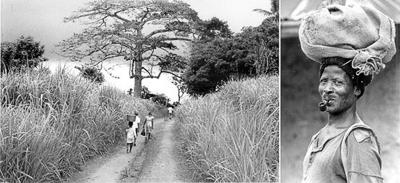
Contemporary maps of the West African nation of Sierra Leone still show the town of Kainkordu marked in the easternmost section of the country.
But what exists as a name on a map exists no longer exists as a place or community.
In the aftermath of the horrific nine-year civil war that devastated much of Sierra Leone, Kainkordu and its people were obliterated. What remains are the memories of a handful of survivors, and the profoundly moving images by photographer Michael Katakis, who documented life in Kainkordu just prior to the outbreak of the civil war.
A Time and Place Before War, which opens Friday at the Center for Photographic Art in Carmel, is much more than a document of rural life in a West African town. In the context of the civil war that descended upon Kainkordu and its residents, the work has become an unintended elegy for all the innocent victims of political strife around the globe.
“People do not wish to ask questions, and that is partly what this exhibition is about,” explains Katakis. “I’ve traveled so much in the world that I don’t accept the excuses anymore of not knowing.
“The exhibition is trying to say that people are worthy of attention. The people of Kainkordu died by powers far away from them. They had no vote or no say. They were just trying to live their lives, and although their lives were difficult they loved their children and were trying to have a better life.”
From the perspective of future events, the images Katakis made in Kainkordu take on an added poignancy. As we look upon the faces of the town’s residents and share in the daily rhythms and rituals of their lives, we see the humanity and hopefulness, the caring and sense of community that is the hallmark of all our lives. What we also see, knowing as we do what was about to unfold in that village, is how our hopes and dreams are too often mocked and undermined by events beyond our control.
Katakis’ great achievement as a photographer is to record the lives of the people of Kainkordu with directness, simplicity and elegance. He avoids the superficial folkloricism that too often treats members of foreign cultures as ethnographic specimens, and conveys a true appreciation for the lives of his subjects.
“I first got to know the people without cameras, and it was only after I got to know them that the camera came out,” he says.
In addition to the photographs on display, the CPA show will include explanatory text panels by Katakis’ wife Kris Hardin, an anthropologist who spent two years in the early ‘80s recording the history and daily lives of the people of Kainkordu for the Smithsonian. Katakis made his photographs when he accompanied Hardin on a return trip to Kainkordu in 1988.
Unlike many photographers who developed an early passion for their craft, Katakis didn’t became a photographer until later in life. A much respected and accomplished musician, Katakis was a staff composer with MGM and a recording artist with A&M Records before embracing photography. According to Katakis, his decision to abandon his career in music and become a full-time photographer was part of a broader political awakening.
Katakis pinpoints his decision to a specific moment in time when he watched a televised debate between Gore Vidal and Gene McCarthy. “McCarthy and Vidal were debating Vietnam in an extraordinary conversation filled with ideas and contradictions,” he recalls. “It awakened me to wanting more knowledge and understanding of the world around me. I started to travel around the world using my camera as a sketchbook.”
In the ensuing years, Katakis worked as a freelance photojournalist on assignment and on self-directed projects in countries ranging from the Philippines to China, Cuba, Korea, Taiwan and Cambodia, among many other destinations. In addition to his magazine and editorial work, he has published two books, one on the Vietnam Veterans Memorial in the mid-’80s, and one on Kainkordu published in 2002. The images of Kainkordu have also been preserved as a complete set in the archives of the Royal Geographical Society in London.
For all of his artistry, Katakis is committed to the kind of photography that is more concerned with truth and ideas than aesthetics.
“Photographs for me are meaningless unless they elucidate something,” says Katakis. “For me pretty pictures alone are not of interest. Photography is always about the story and not the preciousness of the print. Photography is at its very best when you see a picture and want to know more. Great photography is also about participating, and I don’t pretend to be objective. I try to get to the heart of the matter, and for me that’s when a photograph is most powerful.”
While it would be fair to characterize Katakis’ work as politically motivated, his motivation derives more from his sense of human commitment than from political dogma or ideology.
“When I began traveling in the late ‘70s on my own savings, I wasn’t on a crusade,” says Katakis. “I wanted to understand the world as it was, not as I wished it to be.
“One of the things I learned was I had an extraordinary responsibility. I held peoples’ stories in my hand and I had to get it right. I’ve learned what you must have as a photographer and human being is an open mind that is always poised to change based upon the evidence.”
Katakis does hold strong political views when it comes to corporate ownership of the media, which he believes has compromised the search for truth and meaning. It is his concern for sharing the truth that has led him to focus more on book publishing and exhibitions than on magazine outlets for his work.
“In the end, I only have my camera and words to record what I see,” he says. “I can only hope that it makes a difference.”
A Time and Place Before War: Images and Reflections From a West African Town opens at the Center for Photographic Art in Carmel’s Sunset Center Friday, Jan. 16, with a reception from 6-8pm. 625-5181.



(0) comments
Welcome to the discussion.
Log In
Keep it Clean. Please avoid obscene, vulgar, lewd, racist or sexually-oriented language.
PLEASE TURN OFF YOUR CAPS LOCK.
Don't Threaten. Threats of harming another person will not be tolerated.
Be Truthful. Don't knowingly lie about anyone or anything.
Be Nice. No racism, sexism or any sort of -ism that is degrading to another person.
Be Proactive. Use the 'Report' link on each comment to let us know of abusive posts.
Share with Us. We'd love to hear eyewitness accounts, the history behind an article.