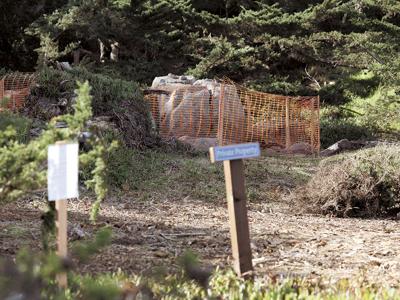

Louise Ramirez got the call Nov. 29, and immediately sprang into action. Ramirez, the chairwoman of the Ohlone Costanoan Esselen Nation, was told by some friends who live near Asilomar State Beach that a group of young men was removing vegetation on a nearby property that her friends knew to be archaeologically significant.
Ramirez, who lives in San Jose, called the Pacific Grove Police Department to shut the work down. Over the next two days, Ramirez drove down to meet with Pacific Grove city staff to find out what was going on. She was told the owners of the property weren’t doing any work on the ground, they had merely obtained a tree trimming permit.
Ramirez also met with one of the property’s owners, Kevin Smith, who, along with his wife Linda bought the vacant 2-acre parcel in September for $460,000.
“He seems like a very nice man, he really does,” Ramirez says. “But his intention is to build a house.”
If that ever happens, Ramirez fears, the site will be destroyed forever.
“It is a very sacred site, probably a village site,” she says. “It’s filled with mortars and middens and shell fragments are everywhere.”
The roots of the site’s ice plant are so deep, she adds, they could be wrapped around bones or remains that could be unearthed by just pulling up the plants.
The Smiths hired Salinas-based archaeologist Gary Breschini to assess the site this past fall. While Breschini agrees there are significant artifacts on the western portion of the property, he doesn’t believe it was ever part of a village.
“At the very most, it was a temporary coastal processing site and camping site,” Breschini says, adding that while mortars should be preserved, his core samples on the property reveal the eastern portion is not archaeologically significant by the standards of the California Environmental Quality Act.
“Do I want my ancestor pulled up with ice plant?”
He says CEQA defines that significance by how much information can be gleaned from the remains and that “under CEQA, the significance is quite low.”
The Smiths won’t be building a home anytime soon, as the property has no water credits, but if and when they do, Kevin says they plan to have native monitors onsite, and they have already given Ramirez a tour of the property.
“You could tell she has a deep connection with her ancestors,” Smith says. “She told me other horror stories, of people bringing in a backhoe. We agree when we have something done, we want to do the right thing.”
For Ramirez, development on former native sites presents a no-win situation.
“All we can do is ask to be there and ensure that if any artifacts or remains are found, that they are protected and reburied. They don’t give us a lot of choices.”
Ramirez says that when work was being done to remove ice plant from the nearby beach, State Parks officials called her and gave her a choice: Would she rather have the ice plant pulled, or sprayed with poison? She frames it differently.
“Do I want my ancestor pulled up with ice plant, or do I want them covered with poison?” she says. “It’s hard, it’s terrible and my heart hurts. Because my job is to protect my ancestors.
“[The system is] not meant for us.”





(0) comments
Welcome to the discussion.
Log In
Keep it Clean. Please avoid obscene, vulgar, lewd, racist or sexually-oriented language.
PLEASE TURN OFF YOUR CAPS LOCK.
Don't Threaten. Threats of harming another person will not be tolerated.
Be Truthful. Don't knowingly lie about anyone or anything.
Be Nice. No racism, sexism or any sort of -ism that is degrading to another person.
Be Proactive. Use the 'Report' link on each comment to let us know of abusive posts.
Share with Us. We'd love to hear eyewitness accounts, the history behind an article.