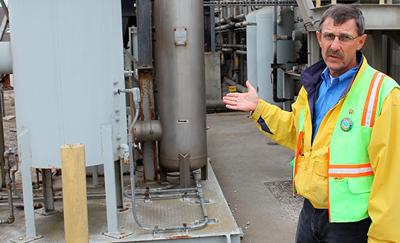
The bulk of Monterey Peninsula’s future water supply is likely to flow from a desalination plant just north of Marina. And the bulk of that desal plant’s energy could flow from the landfill next door.
Officials with the peninsula’s three major water agencies and California American Water Company have been discussing that possibility with the head of the Monterey Regional Waste Management District.
The district launched one of the nation’s first landfill gas-to-energy plants in 1983, harnessing methane from decomposing organic matter. This September marked the end of a 30-year agreement to sell that power to Pacific Gas & Electric, allowing MRWMD to hawk its gas as renewable energy—a higher-value product than fossil-fuel-based “brown” energy—on the open market.
“We’re very interested in the prospect of selling this power to the desal plant,” District General Manager William Merry says. “This potential arrangement could close the loop on recycling: Power locally generated from your trash, used in this community to make water.”
The landfill gas plant produces about 5 megawatts and the district’s operations in north Marina use about 0.5, leaving a surplus supply of 4.5 megawatts. Merry says future expansions could add another megawatt or two.
That pencils out nicely with the desal plant’s estimated demand of 5 megawatts if it’s built to the larger of two proposed sizes, 9.4 million gallons per day.
Merry says the landfill gas power could, in theory, be routed directly to the desal plant at the Cemex property next door, taking it off the power grid and eliminating transmission costs. “It’s like running a big extension cord over there,” he says.
But for a variety of technical reasons, officials don’t expect landfill gas to become the desal plant’s sole power source. In a document for contract bidders, Cal Am proposes to source half its energy from landfill gas and the other half from PG&E.
First, officials have to strike a deal. Landfill managers have a responsibility to their customers to sell their renewable energy at a fair market price, Merry says. Its current buyer is an S.F. Bay Area-based broker that pays $0.08-$0.09 per kilowatt-hour, several cents higher than the rate for brown energy. “Why would we sell it at a discount?” he asks. “My job is to get the highest return for the district.”
Cal Am, meanwhile, needs to keep power costs as low as possible. That’s one of the terms of a settlement agreement with the Monterey Peninsula Regional Water Authority. Jim Cullem, the water authority’s executive director, says cheap trumps green in terms of his agency’s priorities: “Hopefully we’d get [the landfill gas] for less than PG&E [rates], or at least competitively.”
Richard Svindland, Cal Am’s engineering director, thinks that’s possible. Landfill gas could present the desal plant’s least costly power source if, for example, Cal Am locks in a competitive 10-year rate, he says.
The water company may not have a choice but to pay extra for renewable energy. Svindland expects a state regulator, such as the Public Utilities Commission or the Coastal Commission, to make Cal Am offset the desal plant’s greenhouse gas emissions, as it did with the project’s failed predecessor.



(0) comments
Welcome to the discussion.
Log In
Keep it Clean. Please avoid obscene, vulgar, lewd, racist or sexually-oriented language.
PLEASE TURN OFF YOUR CAPS LOCK.
Don't Threaten. Threats of harming another person will not be tolerated.
Be Truthful. Don't knowingly lie about anyone or anything.
Be Nice. No racism, sexism or any sort of -ism that is degrading to another person.
Be Proactive. Use the 'Report' link on each comment to let us know of abusive posts.
Share with Us. We'd love to hear eyewitness accounts, the history behind an article.