
On Jan. 20, just days after scientists declared 2016 the warmest year on record – edging out 2015 – and just moments after President Donald Trump was inaugurated, nearly all references to climate change were deleted from the White House website.
But for now at least, that doesn’t mean scientists working on behalf of the U.S. government are going to stop doing climate change-related research.
On the third floor of Spanagel Hall at the Naval Postgraduate School, a group of scientists are leading a team of researchers from eight institutions to better understand the changing Arctic, and to give the Navy a better understanding of sea ice trends.
The project, called the Regional Arctic System Model, is among the most advanced Arctic climate models in the world, and takes into account details like land ecology, streamflows, marine chemistry and land ice.
Earlier results from RASM helped inform the Navy’s 2014 Arctic Roadmap, and as the model continues being tweaked for greater accuracy, will help the Navy achieve the strategic objectives of that roadmap, namely, to protect U.S. sovereignty in the region and to be ready to to respond to a crisis.
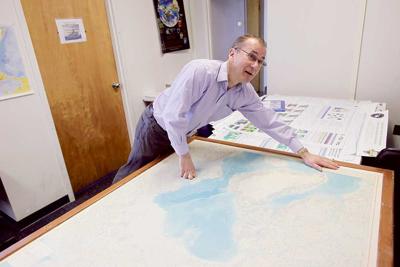
In their office at Spanagel Hall, NPS professors Wieslaw Maslowski and Andrew Roberts stand over a map of the Arctic. 2016, they report, saw the second-lowest minimum of Arctic sea ice on record, and was beat out only by 2012.
“It’s not that all the ice is melting,” Roberts says, “but that the perennial ice is melting.”
Presently, RASM can do short-term seasonal forecasts of up to four months, but Maslowski says the ability to do long-term forecasts is the ultimate goal. To get there, he says, will require continued assimilation of observational data from the region and an increased understanding of the interplay of myriad factors that influence Arctic weather.
“How do you model it if you don’t know how it works?” Maslowski says, adding, “The more progress you make, the more information you need.”
Over the course of nearly an hour, the two explain the various complexities they’re challenged with grasping, which, with respect to sea ice, include countless moving parts. Those also include feedback loops like melting Arctic snow, which then accelerates climate change: Snow-covered ice reflects more than 80 percent of the sun’s energy back into space, whereas ice only reflects about 60 percent and the ocean just 7 percent.
And given that the decline in Arctic sea ice is continuing unabated, and possibly even accelerating, Maslowski says Arctic weather is becoming more variable and harder to predict. Add to that, Roberts says, the fact the overall decline of sea ice is making navigating Arctic waters in summer even more treacherous.
Despite the politicization of climate change by the Trump administration, Maslowski says that understanding the Arctic – especially as waters open up and nations try to extend their maritime boundaries – remains critical to the Navy’s mission, and he is hopeful cool heads will prevail and that research will continue without interruption.
“The U.S. Navy is doing it the right way, in my opinion,” he says.